
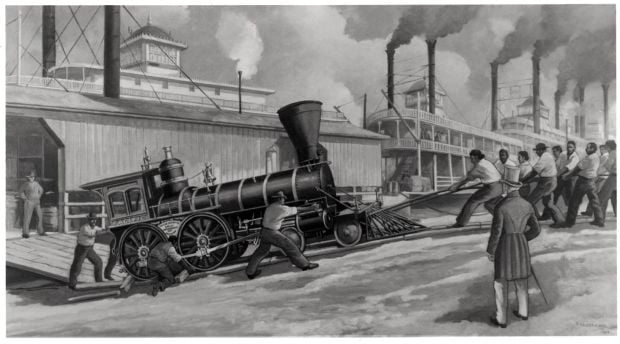
In 1849, a firestorm consumed much of the riverfront. A cholera epidemic killed thousands. Nothing could cool railroad fever.
Leading St. Louisans had been pushing to build railroads since 1835, when they hosted a state convention on the subject at the St. Louis County (Old) Courthouse downtown. One year later, the Missouri Legislature enthusiastically chartered 18 railroad companies. But it was all talk, no track.
Things got serious a decade later with the national drumbeat for a transcontinental railroad. In February 1849 — three months before the city’s Great Fire — U.S. Sen. Thomas Hart Benton proposed building one from St. Louis to San Francisco. In March, a who’s who of local businessmen incorporated the Pacific Railroad Co.
On Oct. 18, Benton was the star speaker at a national railroad conference, also at the old courthouse, which attracted about 1,000 delegates from 14 states.
People are also reading…
“Let us make the iron road, and make it from sea to sea!” Benton shouted to cheers in the crowded rotunda.
But the conference didn’t endorse a route. Southern interests wanted it through Memphis or New Orleans. U.S. Sen. Stephen Douglas of Illinois, who was angling for upstart Chicago, made certain Benton didn’t get his way.
But St. Louis was putting money down. It became locally patriotic to buy stock, even just a few shares. The city and county governments underwrote construction bonds. In 1851, the state legislature pledged $2 million for the Pacific and $1.5 million for a line from Hannibal to St. Joseph. Conveniently, Pacific president Thomas Allen also was chairman of the Missouri Senate improvements committee.
Legislators also backed lines into north-central Missouri, southwest to Springfield and south to the Iron Mountain mining district.
Construction on the Pacific began near 14th and Chouteau avenues on July 4, 1851. Seventeen months later, the first train chugged five miles to Cheltenham, a hamlet near Manchester and Hampton avenues.
The line reached Kirkwood in 1853. On Nov. 1, 1855, a train filled with dignitaries on the inaugural run to Jefferson City plunged through the bridge over the Gasconade River, killing 31. The bridge was rebuilt in four months.
Work continued on the city’s expanding web. The Ohio & Mississippi Railroad, with significant St. Louis backing, linked Illinoistown (East St. Louis) to Cincinnati and the East Coast in 1857. Another line through Alton connected Chicago. The North Missouri Railroad from St. Charles met the Hannibal & St. Joseph at Macon, Mo.
Costs were another matter. As usual, first estimates were wildly optimistic. The Pacific was supposed to cross the state for $6 million. It ended up spending $14 million to finally reach Kansas City in September 1865. The state sold its $11 million investment for $5 million to the railroad directors, who later renamed their road the Missouri Pacific.
Civil War raiding heavily damaged Missouri’s railroads. That and geography frustrated Benton’s preferred route. When the first transcontinental opened in 1869, it ran through Chicago — a more direct line from San Francisco to New York.
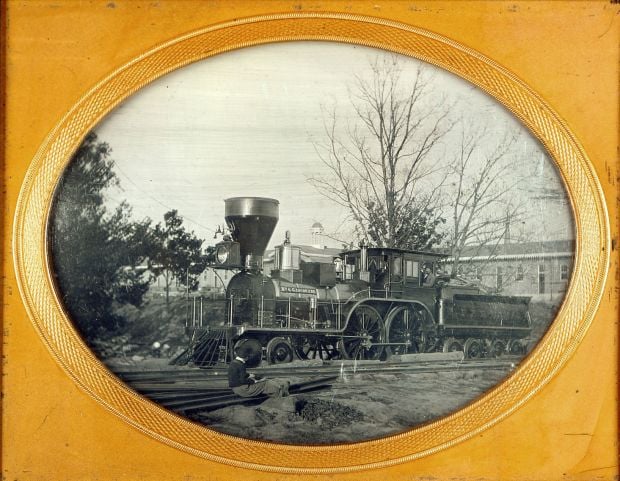
A daguerreotype, or early photograph, of the Pacific Railroad's locomotive "Gasconade" in 1855.

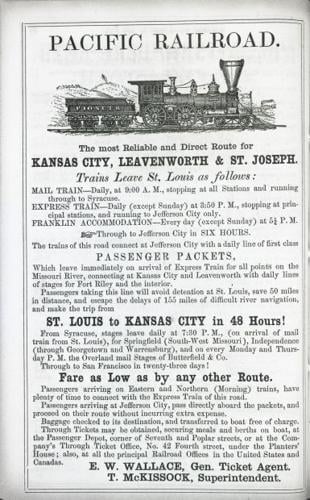
An 1859 advertisement for the Pacific Railroad.
Hawken rifle a symbol of St. Louis industrial quality

Samuel Hawken
Colonial St. Louis was known as Pain Court ("short of bread") because the villagers neglected their crops to pursue furs. Steam power, on boats and in factories, propelled the city toward industry.
By the 1840s, its mills shipped flour across the South. William Lemp's brewery introduced lager beer to the region. The Excelsior Stove Works and Belcher Sugar Refinery were major employers.
At Main Street and Washington Avenue, where the Eads Bridge is now, brothers Jacob and Samuel Hawken put assembly-line improvements to gunsmithing. Their product was the Hawken Rocky Mountain Rifle, a weapon prized by explorers and trappers. Among their loyal customers were Kit Carson and Jim Bridger.
The Hawken was expensive but worth it. The rifle was among the first in the American West to replace flintlocks with percussion firing systems. Their small factory produced standardized parts for repairs. They didn't slap things together — the shop turned out no more than 100 rifles annually for many years.
Jacob Hawken died of cholera during the 1849 epidemic. Samuel Hawken died in 1884 at age 92. Their rifles remain hot items for serious collectors.
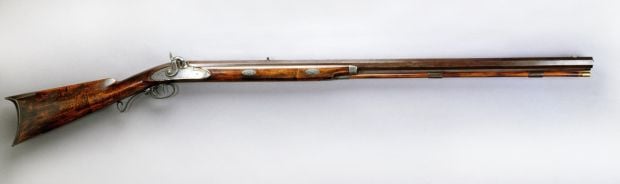
A Hawken rifle
Editor's note: As the nation celebrates 250 years of existence, we look back to the 250th anniversary of the founding of St. Louis. This series was originally published in 2014.
John O'Fallon guides railroad building with energy and money
John O'Fallon served in the War of 1812 and later was stationed at Fort Bellefontaine on the Missouri River. He saw opportunity in nearby St. Louis.
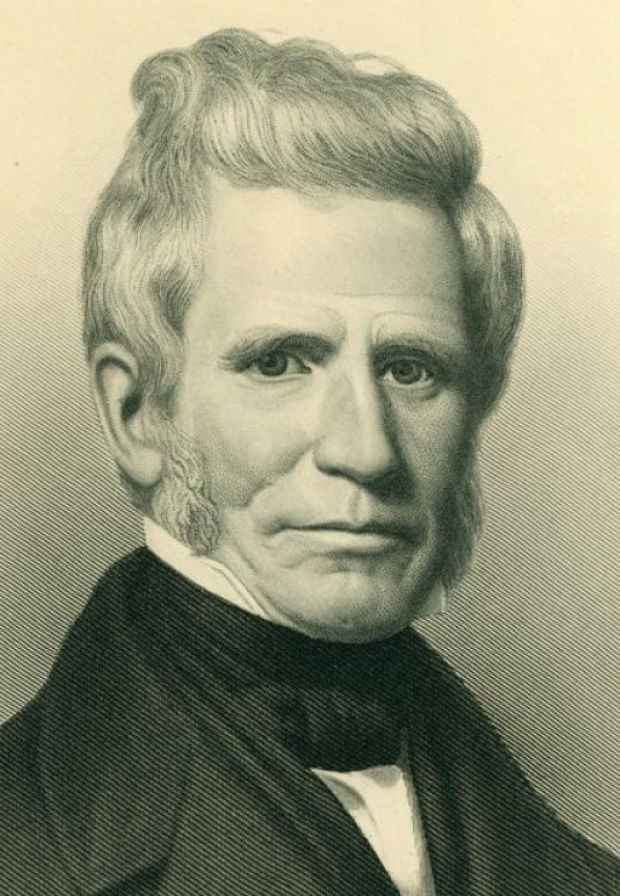 | |
| O'Fallon | |
In 1818, he provided supplies and handled payroll for local army units. He made smart deals in real estate. Among his enterprises was whiskey distilling.
By the 1830s, he was one of St. Louis' leading bankers. When talk turned to building railroads, O'Fallon jumped in with money and energy.
He was the largest shareholder of the Pacific Railroad and president of two other lines, the Ohio & Mississippi to Cincinnati and the North Missouri from St. Charles to Macon, Mo.
Those titles put his name on whistle-stops that became major suburbs - O'Fallon, Mo., and O'Fallon, Ill.
He donated land to St. Louis and Washington universities and endowed O'Fallon Polytechnic Institute, an early public school. In 1955, the city returned the favor by naming its new integrated technical high school after him.
He died in 1865 at 74. His former country estate is O'Fallon Park in St. Louis.