
In a laboratory at Washington University, guinea pigs in one room breathed filtered air. A second test room was open to the city atmosphere.
The year was 1932. Eighteen months later, the filtered room was home to twice as many critters as the other.
“I’d see these little shavers get the sniffles and then flicker out,” Dr. Lee Wallace Dean, a research physician, said of the unprotected population.
The killer was the coal-smoke pollution that smothered St. Louis every winter. Factories, locomotives and homes burned sooty, high-sulfur soft coal from mines in Southern Illinois. It was cheap and plentiful, but it belched thick, choking smoke. It darkened the daytime and covered everything with black dust.
St. Louisans had grumbled about it since at least the 1820s. The city adopted its first smoke ordinance in 1867, but pollution grew with the city. By the 1930s, national studies called St. Louis air the nation’s worst. In 1936, a St. Louis grand jury called the city “a nose and throat doctor’s paradise.”
People are also reading…
Five years later, the air was much clearer. How that happened is one of this community’s signal achievements. It required battling entrenched household habits and major interests from business and labor. And it took an infamously nasty day to force change.
The solution was to greatly reduce the use of Illinois coal. The St. Louis Smoke Abatement League, a reform organization, proposed the idea in 1933. Coal interests howled, arguing for 25,000 miners and 15,000 distributors. The Coal Exchange of St. Louis urged people to install more efficient furnaces.
There was serious talk of building neighborhood power plants to provide steam for houses, much like the “steam loop” that still heats many downtown buildings. In 1937, the Board of Aldermen voted to require that low-quality coal be “washed,” an expensive process that smaller mines couldn’t afford.
It didn’t work. Dealers kept slipping across the Mississippi River bridges with dirty coal. Then the city required them to sell smaller chunks. Coal interests opposed that, too.
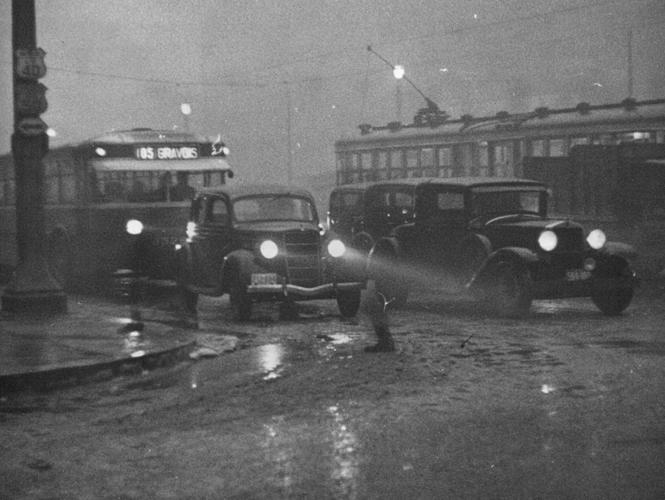
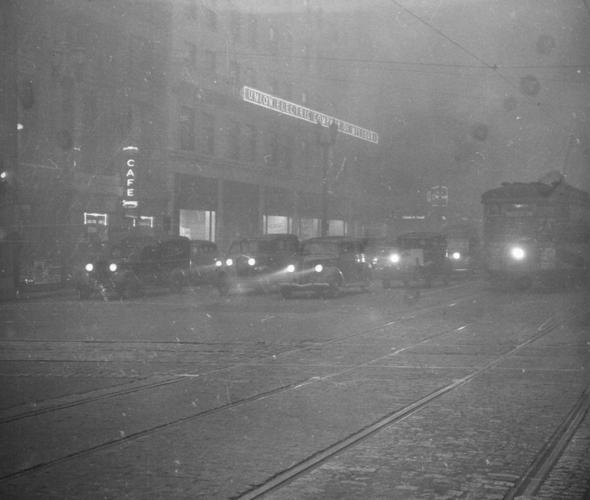
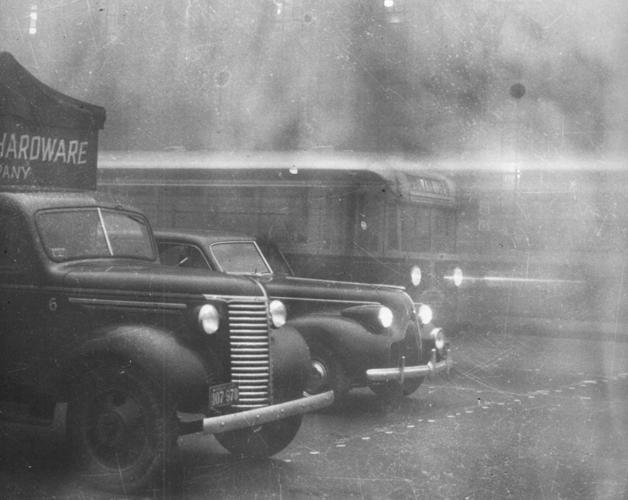
Then came Nov. 28, 1939, or “Black Tuesday” — the ninth day of thick smoke with a winter season barely begun. Bright sunshine illuminated the suburbs. East of Kingshighway, motorists used headlights to inch through haze. Trains ran late. Street lights stayed on, glowing dimly.
Article from Nov 28, 1939 St. Louis Post-Dispatch (St. Louis, Missouri)
This time, it was the gasping citizenry that howled. Mayor Bernard F. Dickmann created a special Smoke Elimination Committee, including Raymond R. Tucker, an engineer and the city’s dogged smoke commissioner. Three months later, the committee recommended that all customers, big and small, install efficient and expensive mechanical fireboxes or use anthracite, high-quality hard coal.
On April 8, 1940, aldermen adopted the plan 28-1 after endorsing, then rejecting, a last-minute exemption for railroads. About 250 angry coal dealers heckled from the gallery during the vote.
The city helped arrange shipments of hard coal from Arkansas for the next winter. Illinois communities talked of boycotting St. Louis-made products. City smoke inspectors hunted “bootleg” coal dealers in alleys. But changing fuel did the job.
For winter 1940-41, the Weather Service reported seven bad smoke days compared to 30 the year before. Railroads bought diesel engines. Homes and businesses switched to natural gas. In five years, the city cut coal smoke by 75 percent.
Raymond Tucker, dogged smoke-pollution fighter

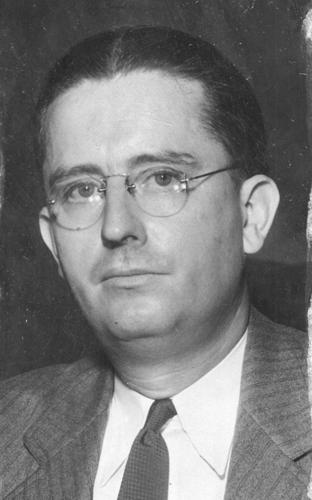
Raymond R. Tucker in 1934, when he became secretary to Mayor Bernard F. Dickmann. Tucker, 37, had been an associate professor of mechanical engineering at Washington University when he was hired. Three years later, Dickmann appointed Tucker as city smoke commissioner, and Tucker worked diligently to ban the burning of high-polluting Illinois coal in most city furnaces in 1940. He was elected mayor in 1953 and served three terms. Post-Dispatch file photo
Raymond R. Tucker was teaching mechanical engineering at Washington University when he became secretary to Mayor Bernard F. Dickmann in 1934. Three years later, he helped write the city's first major coal-smoke ordinance, which created a powerful new job of smoke commissioner.
Nobody wanted it. The word around engineering circles was that the political headaches weren't worth the $6,000 salary.
Tucker already made that as mayor's secretary. Dickmann talked him into taking the job, even though the ordinance wouldn't allow for a raise.
Tucker jumped into it with determination and an engineer's eye for detail. He soon concluded that the problem was the fuel, not how it was burned.
He backed the call for banning low-quality coal — Illinois coal — except in furnaces with automatic stokers, an expensive proposition that made the cheap coal impractical for most customers. He was Dickmann's expert when the mayor persuaded the aldermen to adopt that key reform in 1940.
Tucker returned to the university in 1942 and later served as city civil defense director for two years until 1953, when he ran for mayor. He was re-elected twice, becoming the city's second three-term mayor, but lost his bid for a fourth term to Alfonso J. Cervantes in 1965.
Later on, Tucker was fond of saying that the job of smoke commissioner was tougher than being mayor. He died in 1970 at age 73.
Newspaper wins Pulitzer Prize for smoke reporting
On Nov. 26, 1939, the Post-Dispatch ran a lead editorial of about 1,400 words under the headline, "An Approach to the Smoke Problem." It called for a community-wide effort to solve "the evil that is ruining our city."
Two days later became known as Black Tuesday, when the blanket of coal smoke covering the city was so thick that motorists and streetcar operators had trouble seeing where they were. Mayor Bernard F. Dickmann later said the fortuitously timed editorial "gave the opportunity we were looking for" in enacting needed reform.
The newspaper covered the issue with nearly daily articles, features and photographs — nothing flashy, just thorough journalism. The staff effort earned the Post-Dispatch the 1941 Pulitzer Prize for public service.

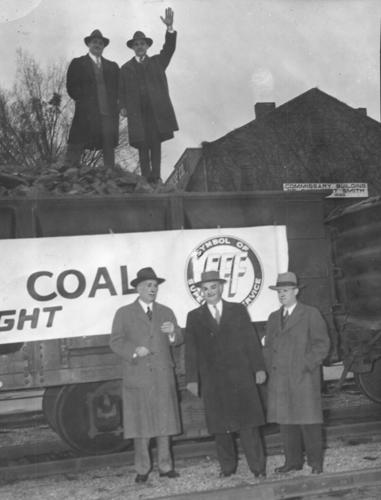
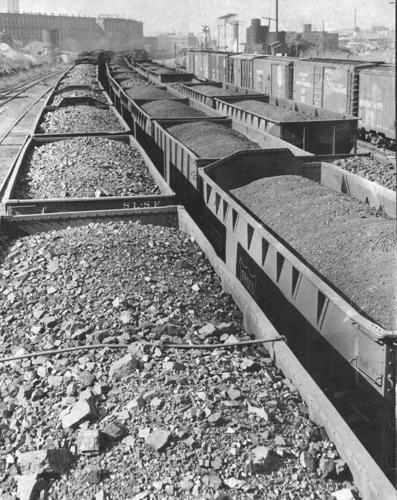
A train of Arkansas coal arrives in St. Louis on the Frisco Railroad in February 1950. Use of the lower-polluting hard coal greatly helped clear the local atmosphere. By 1950, many homes and businesses were switching to natural gas. Post-Dispatch file photo

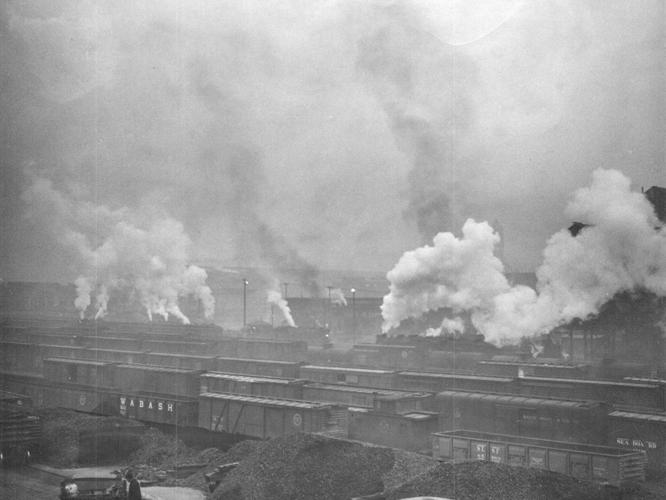
Another smoky day in St. Louis on Dec. 31, 1941, more than a year after the city adopted the hard-coal ordinance. There were fewer high-pollution days, but still times like this. The scene is of the Mill Creek rail yard downtown, where smoke often was thick because of the many coal-burning steam locomotives. Railroads had begun switching to diesels, but still ran plenty of steam engines during World War II. Post-Dispatch file photo

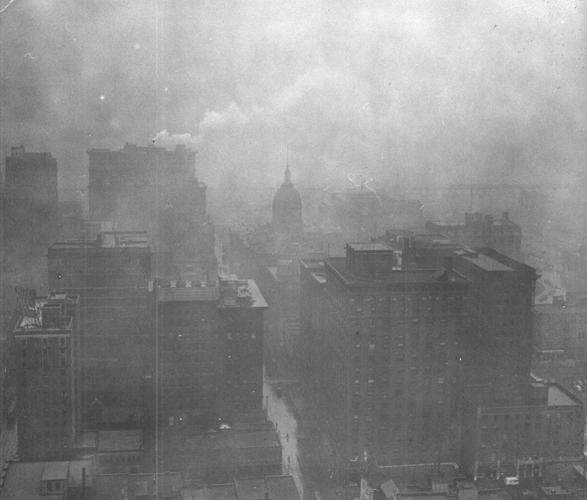
The city's switch to hard coal after passage of the soft-coal ban in April 1940 significantly improved conditions the following winter, but there still were bad days when winds were low. This is a view of downtown, looking eastward, on Jan. 13, 1941. The dome of the Old St. Louis Courthouse is in the center. Post-Dispatch file photo

St. Louis Mayor Aloys Kaufmann waves from atop a coal car in Fort Smith, Ark., in December 1943. The city's first source of lower-polluting hard coal was from mines in northwestern Arkansas. Other supplies came from Eastern mines. Post-Dispatch file photo

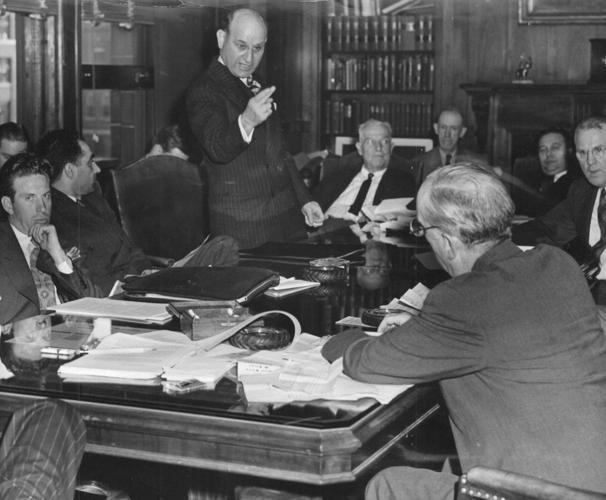
Louis Horen, chairman of the St. Louis Fuel Dealers Association, complains about supplies of hard coal during a meeting of the city Smoke Elimination Committee at City Hall in October 1942. Coal dealers had fought the smoke ordinance throughout the debate to ban the use of high-polluting Illinois coal in most city furnaces. Post-Dispatch file photo

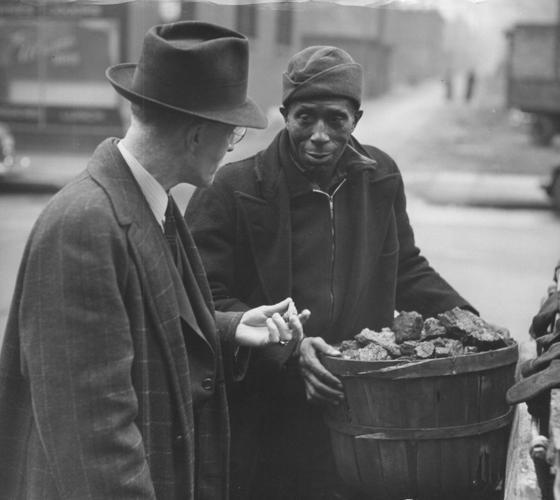
A neighborhood coal dealer sells cheap Illinois coal by the basket at Vandeventer Avenue and Olive Street in February 1939. A city ordinance required that Illinois coal be "washed" of impurities, but it still was too easy to get tons of the coal across the river. Reform efforts threatened coal interests, from mining companies to small-time salesmen, and most ordinary residents just worried about staying warm. Post-Dispatch file photo

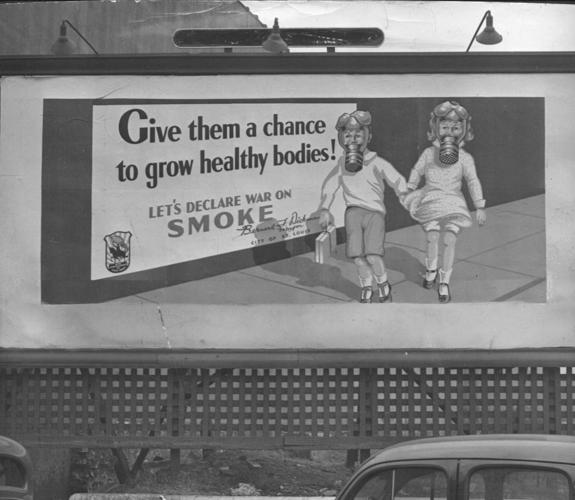
A billboard used in smoke commissioner Raymond R. Tucker's public campaign in December 1938. Post-Dispatch file photo
Raymond R. Tucker in 1934, when he became secretary to Mayor Bernard F. Dickmann. Tucker, 37, had been an associate professor of mechanical engineering at Washington University when he was hired. Three years later, Dickmann appointed Tucker as city smoke commissioner, and Tucker worked diligently to ban the burning of high-polluting Illinois coal in most city furnaces in 1940. He was elected mayor in 1953 and served three terms. Post-Dispatch file photo

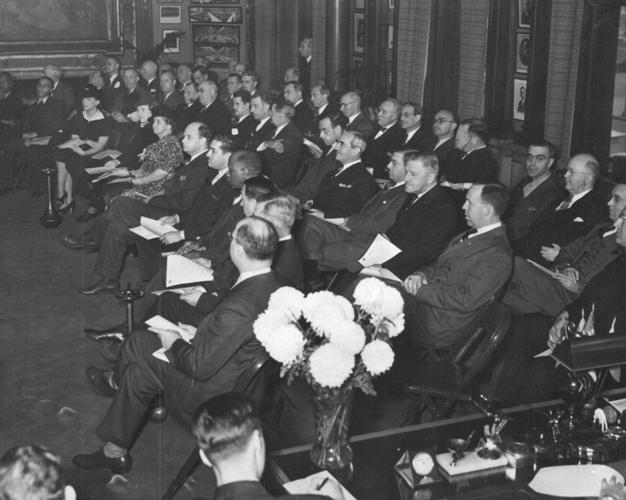
After Black Tuesday, Mayor Bernard F. Dickmann and city leaders moved quickly to finally take decisive action. This is a gathering of business and political leaders in the mayor's office on Dec. 5, 1939. Four months later, the Board of Aldermen acted to ban the burning of low-quality Illinois coal except in furnaces with expensive automatic stokers, which made combustion much more efficient. Most residents and business owners shoveled their own. Post-Dispatch file photo

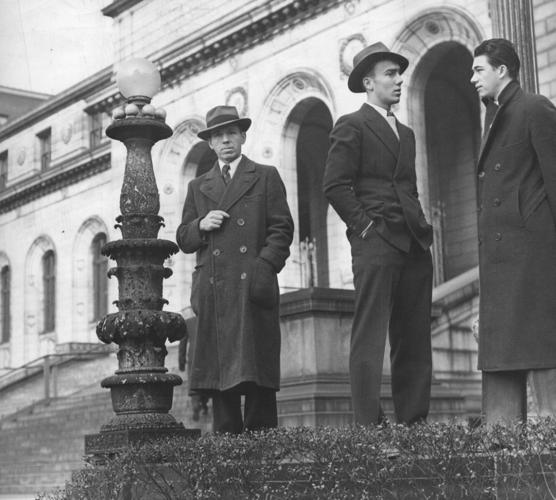
In February 1941, men stand on the steps of the Central Library downtown where three others had been in coal haze 14 months before. St. Louis still had smoky pollution after the hard-coal ordinance was adopted, but far fewer of them even in that first winter. Post-Dispatch file photo

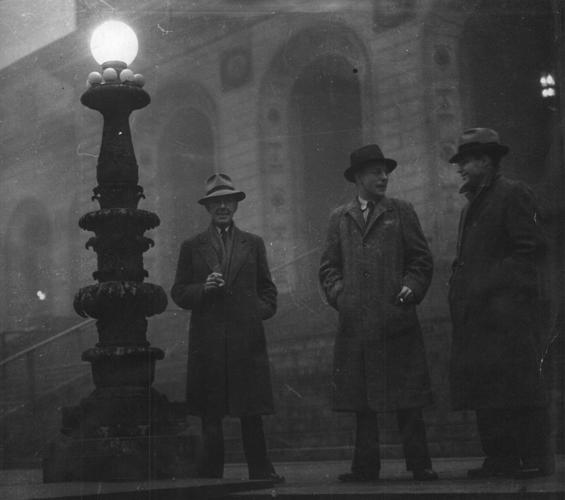
Three men stand in the coal-smoke haze on the steps of the Central Library, Olive and 13th streets, on Black Tuesday, Nov. 28, 1939. Post-Dispatch file photo

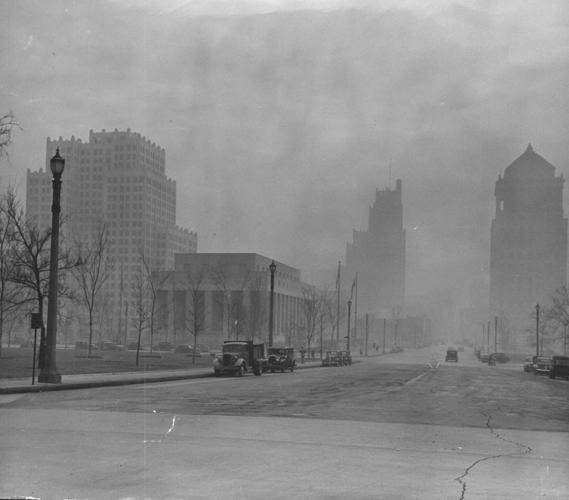
Choking smoke lingered for many days after Black Tuesday. This view is looking east on Chestnut Street with Soldiers Memorial in the center on Dec. 1, 1939. Post-Dispatch file photo

Westbound traffic on Market Street stopped at 12th (now Tucker) on Black Tuesday, Nov. 28, 1939. Barely visible through the smoke is the U.S. Courthouse, now a city courts building. Post-Dispatch file photo

Olive and 12th streets on Black Tuesday, Nov. 28, 1939. Motorists had to use their headlights to move slowly through the smoke, which was thick enough to make trains and streetcars run late. Post-Dispatch file photo

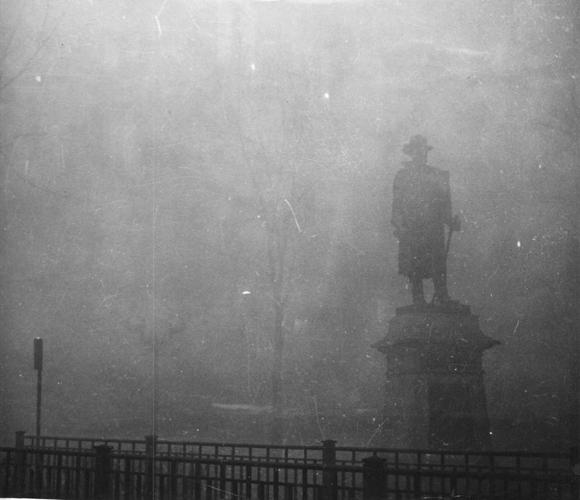
The statue of Gen. Ulysses S. Grant on the lawn of City Hall, at Market and 12th streets, on Black Tuesday, Nov. 28, 1939. The city later renamed 12th in honor of Raymond R. Tucker, smoke commissioner during the coal-reform days. He later was mayor.

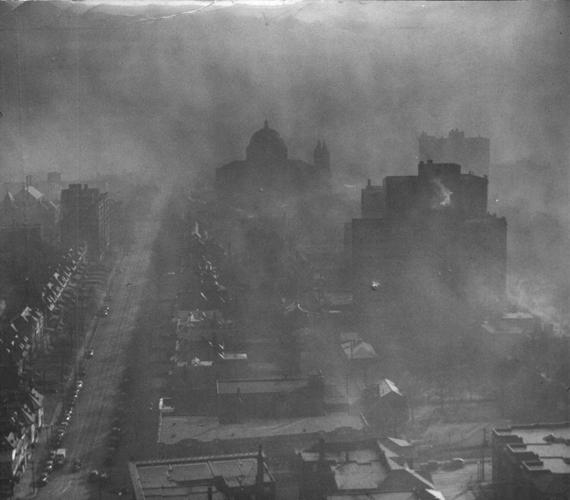
The smoke on Black Tuesday, Nov. 28, 1939, the filthy, choking day that finally spurred action to greatly reduce the use of high-polluting coal from Illinois. The view is looking east toward the St. Louis Cathedral, 4431 Lindell Boulevard. Post-Dispatch file photo
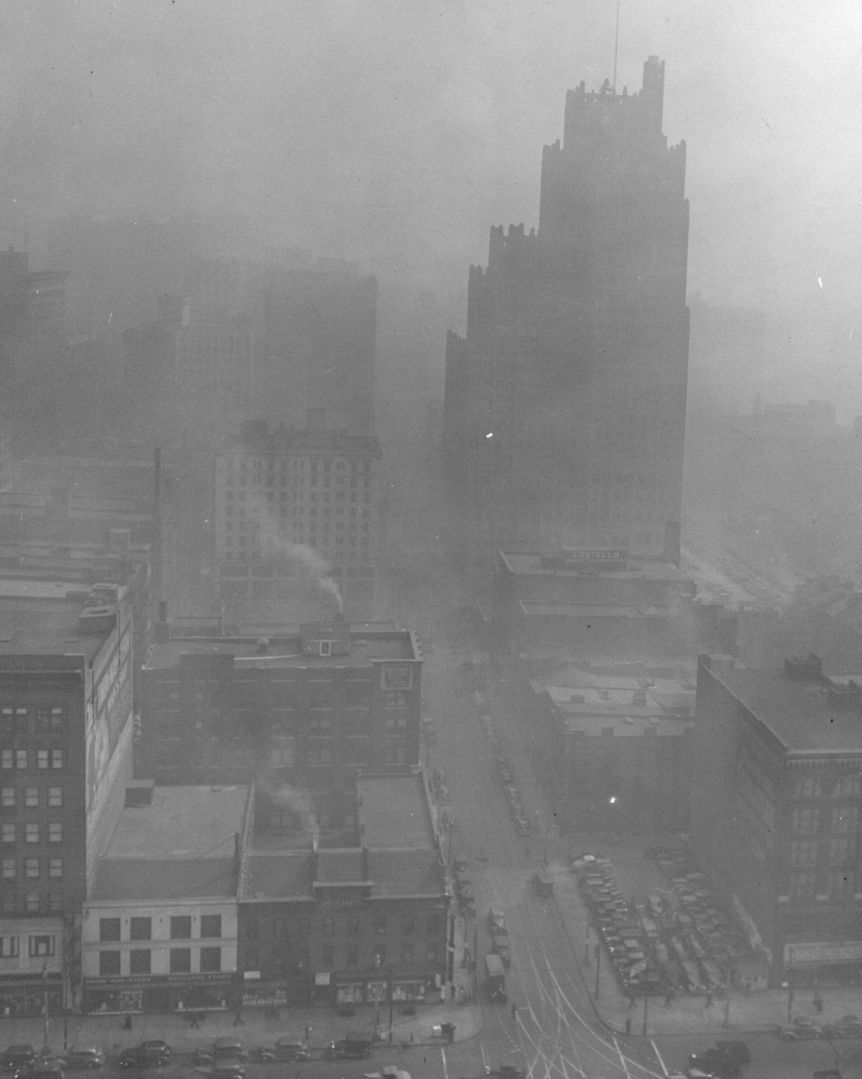
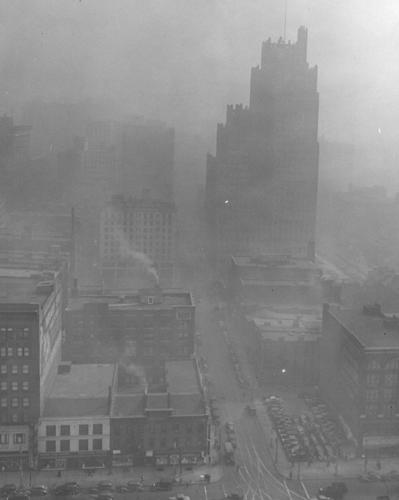
The pall of smoke in downtown St. Louis on Oct. 29, 1938, looking east toward the Bell Telephone Co. building. Thick smoke was a regular hazard of life in St. Louis during winters. In the 1930s, citizens and city leaders finally worked to solve the problem. Post-Dispatch file photo

Smoke from burning coal makes for a dark midday on Feb. 13, 1936, at 12th (Tucker Boulevard) and Market streets downtown. For more than a century, St. Louis had been burning coal from mines just across the Mississippi River in Illinois. It was plentiful, cheap and made a choking haze of smoke and soot. St. Louis adopted ordinances to reduce smoke, but nothing worked as long as the coal was of low quality. Post-Dispatch file photo