


Look Back 250: A whirlwind tour of St. Louis history in photos
This list was originally published in 2014.
On Feb. 15, 1764, Auguste Chouteau began construction of what would become St. Louis. The 15-year-old led a group of men to the spot picked by his stepfather, Pierre Laclede, for a trading post. As the nation celebrates its 250th anniversary, see where St. Louis has come since its 250th.
Celebrating St. Louis in photos

St. Louis once was the nation’s fourth-largest, home to five national political conventions, major railroad networks, smoke-belching industries and flourishing arts and culture. It remains most of that, minus the conventions and the infamous coal soot. St. Louis is a matured community of varied neighborhoods, familiar corner taverns, a diverse economy and a sense of identity. Take a look back in photos of how we got to where we are today.
Founding of St. Louis
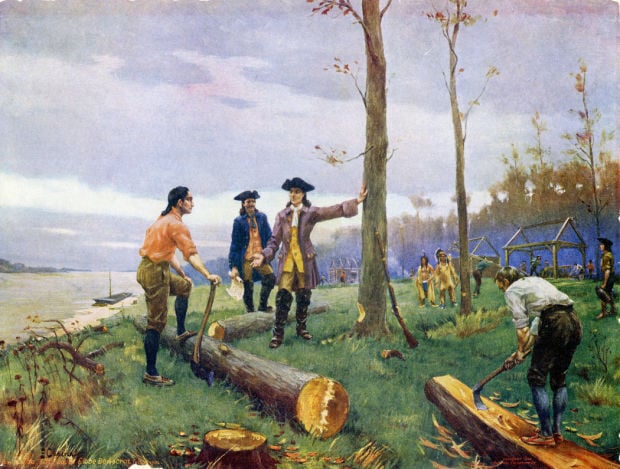
The founding of St. Louis, 1764. Chromolithograph by National Colortype Co. after painting by E. Cameron, 1902. Supplement to the St. Louis Globe-Democrat, Feb. 28, 1902. Missouri Historical Society Photographs and Prints Collections. Scan © 2002, Missouri Historical Society.
Chouteau begins building St. Louis, 1764

A painting that depicts Auguste Chouteau (pointing) as he leads 30 laborers on Feb. 15, 1764, to the site of St. Louis. Pierre Laclede had chosen the spot during a brief stop two months before, and send Auguste and the workforce to begin building the trading village. Laclede chose the site because it was accessible high ground on the Mississippi River. Oscar E. Berninghaus painted the work in 1925. Image courtesy St. Louis Mercantile Library
Pierre Laclede

The statue of Pierre Laclede next to City Hall in downtown St. Louis. Post-Dispatch file photo
Auguste Chouteau
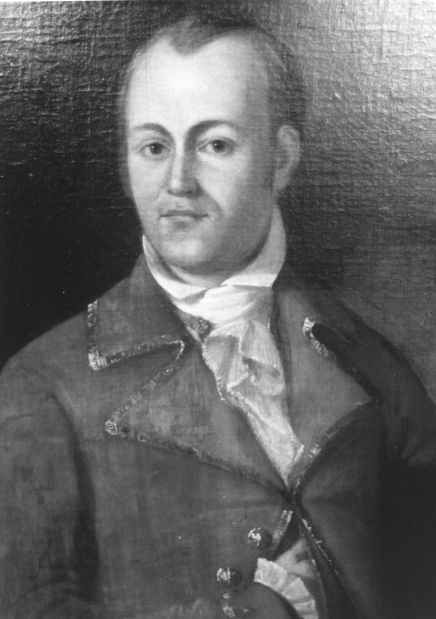
Auguste Chouteau, Laclede's assistant in founding St. Louis. Chouteau, then 14, traveled with Laclede upriver and, upon Laclede's orders, led construction for the new trading post on Feb. 14 or 15, 1764. This painting was made circa 1780, two years after Laclede's death, when Chouteau would have been about 30. Chouteau became a successful trader and was St. Louis' wealthiest resident when he died in 1829. He is buried in Calvary Cemetery. Post-Dispatch archives
Attack on St. Louis, 1780

An artist's depiction of the British-led attack upon the village of St. Louis by Native American warriors on May 26, 1780. The attack was part of European machinations during the American Revolution. The town heard rumors of an attack ahead of time and prepared well. The attackers were repelled. The painting, by Oscar Berninghaus of St. Louis, is one of the scenes from Missouri's early history that are on the walls of the mezzanine level of the Missouri Capitol in Jefferson City. They were painted during the 1920s, shortly after the building was opened. Missouri History Museum image
Fort San Carlos, 1780

An ink drawing of the stone defensive tower that St. Louis residents built in 1780 near present-day Fourth and Walnut streets downtown. Don Fernando de Leyba ordered its construction after hearing of British plans to attack the village. He named it Fort San Carlos in honor of Spanish King Charles III. Five cannon mounted in the tower fired upon the British-led force of Native American warriors who attacked on May 26, 1780. The drawing was made more than a century later. The tower was 30 feet in diameter and 30 to 40 feet tall. Image courtesy Missouri History Museum
St. Louis map, 1796
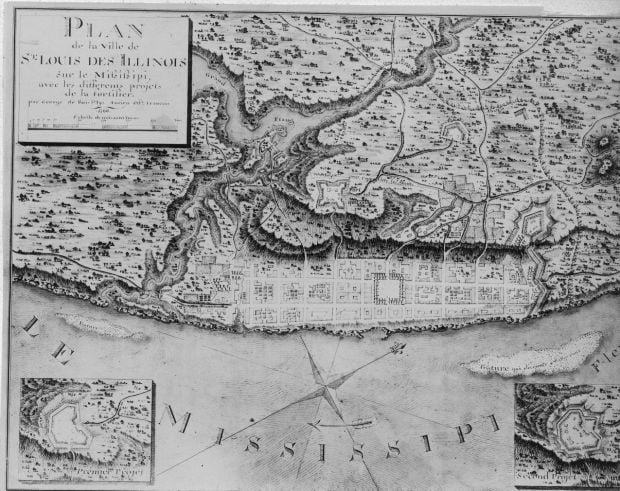
A map of St. Louis in 1796, while it was a Spanish colony. The tributary on the left was known to the original French residents as Le Petite Riviere, then Mill Creek. A dam built later formed Chouteau's Pond. The site now is part of the rail yard downtown. Post-Dispatch archives
Transfer of St. Louis, 1804

The transfer of Upper Louisiana at St. Louis to American control after the Louisiana Purchase. Tradition holds that three flags flew over St. Louis — first the Spanish flag, then the French, then the American — as the three-way transfer was made. Watercolor by F.L. Stoddard, ca. 1914. Missouri History Museum Art collection.
Three Flags Ceremony, 1935

Mayor Bernard Dickmann stands in as Capt. Amos Stoddard during a commemoration of "Three Flags Day" on March 9, 1935, at First and Walnut streets, site of the original Louisiana Purchase ceremonies in 1804. Dickmann is at the podium holding papers. To his right, also in 19th Century garb, is Louis LaBeaume as Charles de Hault de Lassus. Photo courtesy Missouri History Museum
First St. Clair County courthouse in Belleville, 1814

A drawing of the first St. Clair County courthouse in Belleville, which was established in 1814 to be the new county seat. It replaced Cahokia, the oldest European settlement in the St. Louis area. George Blair, a farmer, gave the land for the county government square in Belleville. The log house served as the courthouse until another was built in 1817. St. Clair County Historical Society image
Herculaneum, 1817

A drawing of Herculaneum on the Mississippi River in 1817, with one of the shot towers on the bluff. The sketch was used on a $20 note issued by the Bank of St. Louis. Moses Austin was a major investor in the bank.
First steamboat, 1817

The Zebulon Pike, the first steamboat to reach St. Louis, labors up the Mississippi River for its inaugural landing here on Aug. 2, 1817. The boat had a single engine and was woefully underpowered, but its arrival heralded a form of transportation that quickly turned the former fur-trading post into a bustling city. The scene includes Auguste Chouteau's mansion and the town Catholic church in the center, and the old Spanish colonial fort on the horizon to the right. Pictorial History of St. Louis
The Old Rock House, built 1818
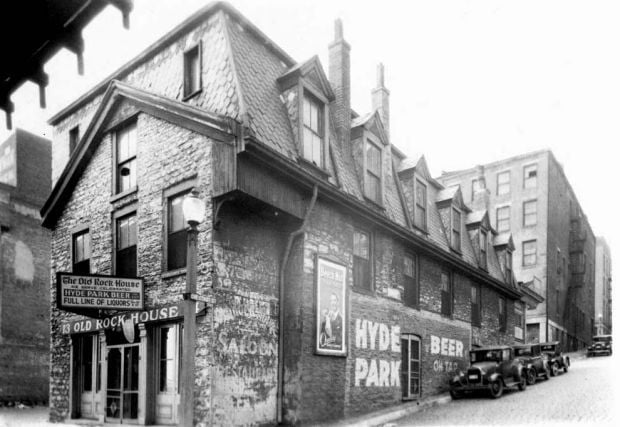
The Old Rock House in the late 1930s, when it was used as a tavern. It had been remodeled and modified several times since fur-trader Manuel Lisa, one of the city's first businessmen, built it in 1818 as his warehouse on Front Street. The building survived the Great Fire in 1849 and the massive demolition of the riverfront that began in 1939 to make way for the Jefferson National Expansion Memorial. Workers removed the roof and other ad-ons, but dismantled it in 1959 to await permanent reassembly at a site nearby. Most of the stones were lost or stolen. Some are on display in the Old Courthouse, and the rest of what's left are in storage. The Rock House was at 13-14 North Front Street, later called Wharf Street and now known as Leonor K. Sullivan Boulevard. Jefferson National Expansion Memorial
The St. Louis Catholic parish lot circa 1820
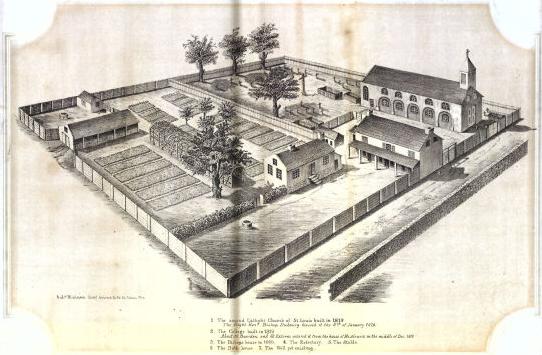
A drawing of the St. Louis Catholic parish lot circa 1820, showing the third church building on the upper right. That brick church was dedicated in 1820.
The Old Cathedral, 1836

A drawing of the St. Louis (Old) Cathedral made in 1834, the year it was dedicated. Leon Pomarede, decorator and artist for the project, drew the sketch, probably before the orphanage on the left and the rectory on the right were built. Those two buildings, constructed later, ended up being somewhat different from Pomarede's expectations. For one thing, the cathedral dedicated on Oct. 25, 1834, was next to its short-lived predecessor, a brick cathedral that was the third of the four churches to occupy the original village of St. Louis church lot. The brick church burned the following year. On Jan. 27, 1961, Pope John XXIII renamed the church the Basilica of St. Louis, King of France. The designation of basilica is a rare honor declaring that the building is "a treasure of the universal church." Cardinal Joseph Ritter, then the archbishop of St. Louis, kept the news to himself until Sept. 20, 1963, after a $600,000 restoration of the old limestone landmark. Missouri History Museum image
Lynching by fire, 1836
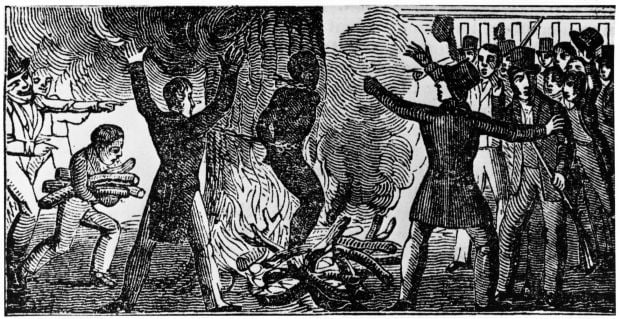
A drawing of the lynching by fire of Francis L. McIntosh in St. Louis on April 28, 1836. McIntosh, a free man of color and a cook on a steamboat, was arrested that day after a scuffle on the levee. While being taken to jail, he fatally stabbed a sheriff's deputy. A mob pulled him from the county jail, chained McIntosh to a tree and burned him to death.
Elijah P. Lovejoy, 1837

A drawing of the mob that gathered outside Winthrop Gilman's warehouse at the foot of William Street in Alton on Nov. 7, 1837. Inside the warehouse was abolitionist editor Elijah P. Lovejoy's fourth press, which had been delivered by steamboat earlier in the day. Mobs had destroyed the other three. When several men tried to set fire to the roof, some of Lovejoy's supporters stepped out of the warehouse and fired at the mob. In the ensuing quiet, Lovejoy took a look outside at the front door and was hit by five shots. He collapsed and died, but became a martyr of the anti-slavery movement. Image courtesy Missouri History Museum
Alton in 1837

The town of Alton in 1837. To the left on the riverbank is the warehouse where Elijah Lovejoy, an abolitionist newspaper publisher, was shot by a mob in that same year. Up the hill is the first Illinois Penitentiary. The steamboat Alton in the image is moored where the Alton Belle casino is now. Alton Museum of History & Art image
The St. Louis riverfront in 1840

The St. Louis riverfront in 1840. The Great Fire on May 17-18, 1849, heavily damaged the market and city hall building to the left and destroyed most of the buildings to its north. Missouri Historical Society
Slave auction in St. Louis, 1800s
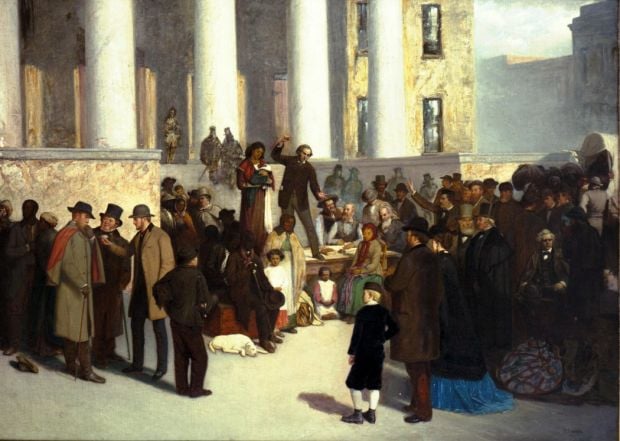
A depiction of a slave auction outside the St. Louis County (Old) Courthouse. More than 530 slaves were sold outside the courthouse, usually by order of the Probate Court. Missouri History Museum image
Dred and Harriet Scott - 1847

This painting of Harriet and Dred Scott was hung in the Old Courthouse in St. Louis in 1973.
Dred and Harriet Scott statue unveiled

Attendees get their first look after the unveiling of the new Dred and Harriet Scott statue on the grounds of the Old Courthouse in downtown St. Louis on June 8, 2012.
Photo by Christian Gooden, cgooden@post-dispatch.com
Riverfront in 1844
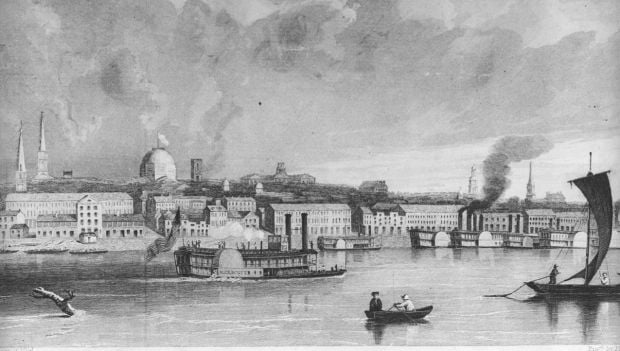
A scene of the St. Louis riverfront in 1844, with the St. Louis (Old) Courthouse dome and church steeples, including the St. Louis (Old) Cathedral on the far left. J.C. Wild image
Great Fire of 1849

Great Fire at St. Louis, 1849. The first started on the steamer White Cloud and wasn't stopped until it had consumed 23 steamboats and 430 buildings along the city's riverfront. Color lithograph by Nathaniel Currier. Missouri History Museum Photograph and Print Collection.
The Great Fire of 1849

Another drawing of the firestorm in the business district. In the background are the dome of the St. Louis (Old) Courthouse and the steeple of the St. Louis (Old) Cathedral. Both of those landmarks were spared, but the firestorm got within a block of the Cathedral. Firefighters saved it by blowing up a row of buildings along Market at Second streets. The caption below the photo is in English and German. The drawing by Henry Lewis, a visiting German artist, appeared in a publication in Dusseldorf, Germany, in 1854. Missouri History Museum image
Firefighter hero of 1849 fire

Captain Thomas Targee, the volunteer fireman who died fighting the devastating Great Fire of 1849 in St. Louis. He was trying to stop the blaze, which started on the steamer White Cloud and wasn't stopped until it had consumed 23 steamboats and 430 buildings along the city's riverfront. Oil on canvas by Mat Hastings, 1902. Missouri Historical Society image
Damage from the Great Fire of 1849

A daguerreotype of the ruins of the city's commercial district, looking south toward the steeple of the St. Louis (Old) Cathedral. Thomas Easterly, a portrait maker in St. Louis, made the image using an early form of photography known as the daguerreotype. The method required a time exposure. Missouri History Museum image
Crowded riverfront, 1850

An early photograph of steamboats lining the St. Louis riverfront in 1856, looking north from the foot of Market Street. Missouri History Museum image
Volunteer fire company, 1851
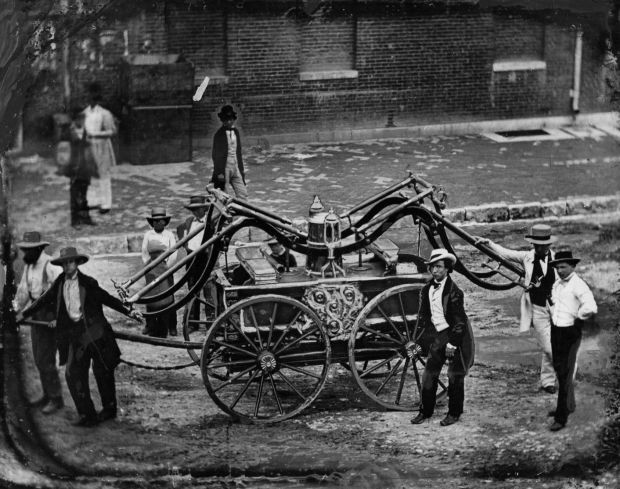
Members of the Union Fire Company, one of the city's early volunteer units, show off their new hand-pump fire engine in 1851. The Union company had its station on Third Street, just south of Washington Avenue. St. Louis had 12 volunteer companies by the 1850s, when city leaders began pushing for a paid fire department as part of local government. The volunteer companies strongly resisted, but the city finally established the St. Louis Fire Department in 1857. Henry Clay Sexton, the first chief, took office on Sept. 14, 1857, for an annual salary of $1,000. He had been chief of the Mound Volunteer Fire Company, at North Broadway and Brooklyn Street, just north of present-day downtown. His company sold its fire truck and house to the city for $250. Gunsmith Samuel Hawken helped to organize the Union company 1832. It disbanded in 1855. Post-Dispatch file photo
Outside a slave pen, 1852

Men gather outside a Bernard Lynch slave pen at Locust and Fourth streets in St. Louis in 1852. Lynch ran a thriving business in St. Louis trading slaves, many of whom were sold to plantations in the South.
Pacific Railroad, 1852

The Pacific Railroad's first locomotive, the "Pacific," arrives by steamboat on the Mississippi River landing downtown. The locomotive was built in Taunton, Mass., and cost $9,000. It hauled the first train west of the Mississippi on Dec. 9, 1852, on a five-mile jaunt from near 14th Street and Chouteau Avenue to the village of Cheltenham, at today's Hampton and Manchester avenues. This is a work by Frank B. Nuderscher, once known as the dean of painters in St. Louis. Image courtesy Missouri State Archives
Crowded St. Louis landing in 1853
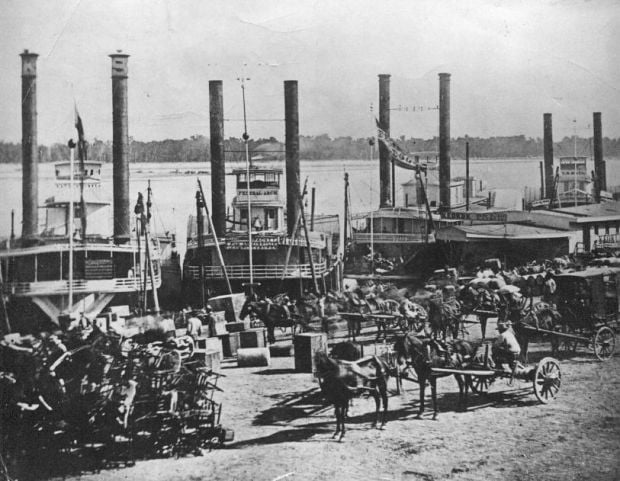
Steamboats and freight wagons crowd the St. Louis landing in an early photograph in 1853. Missouri History Museum image
Chouteau's Pond, early view

The pastoral scene of Chouteau's Pond when it was a refuge on the edge of town. La Petite Riviere (later called Mill Creek) was dammed for a flour mill shortly after St. Louis was founded, creating a lake of about 100 acres running to 22nd Street. It was named for Auguste Chouteau, who owned the mill for many years. By 1849, it was polluted by encroaching industries and neighborhoods. The city drained it after the cholera epidemic. Missouri History Museum image
Chouteau's Pond becomes a cesspool, 1854
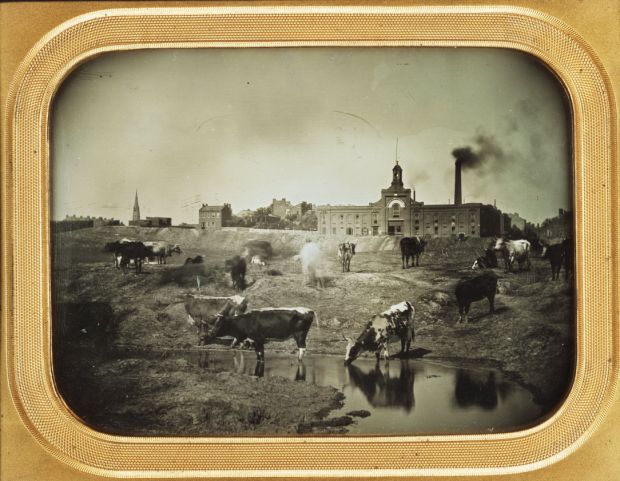
A daguerreotype by Thomas M. Easterly in 1854 of cows drinking from the remnants of Chouteau's Pond, a large man-made lake south of Market Street that city officials began draining after an 1849 cholera epidemic. Many suspected that the pond had played a role in spreading the disease. In the early days of St. Louis, the pond was a pleasant place for picnics. But as the city and its industry grew, businesses such as tanneries and butcher shops crowded along its banks, quickly turning the pond into a cesspool. In the background is a lead mill. Missouri History Museum image
St. Louis, 1865

A view of the St. Louis skyline, looking eastward from about 16th Street, in 1865. The city boomed during the 1800s while the towns we now know as suburbs mostly remained small hamlets. Missouri History Museum image.
Anti-Irish riots, 1854

An 1853 map of St. Louis showing the heavily Irish 5th Ward, the scene of nativist anti-Irish rioting in 1854. Some incidents did spill to the south (left) into the 4th Ward, which also had many Irish residents. The city had six wards during the 1850s, all starting on the riverfront. Rioting began at Second and Morgan streets, on the line dividing the two wards. The intersection is in today's Laclede's Landing, then a neighborhood filled with Irish immigrants who had fled the 1845 potato famine. An Irishman who had stabbed a boy near a polling place fled into a rooming house there, and a nativist mob entered and trashed the place. Irish steamboat-landing workers fought nativists in a pitched battle on Morgan near the site of the damaged rooming house. Battles ranged as far west as Franklin and Eighth streets, now part of the America's Center convention hall. At the bottom (east) or the map is part of Bloody Island, infamous as the place for dueling. Missouri History Museum image
Big Mound in 1852
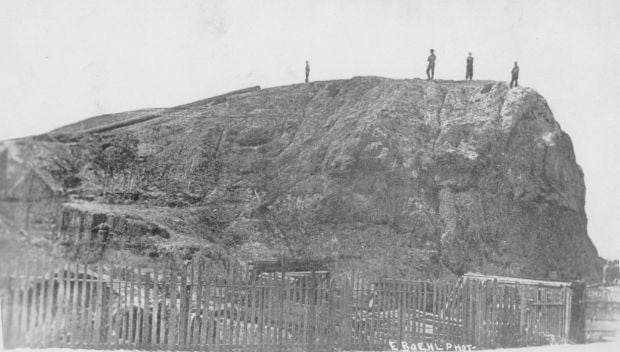
Big Mound in 1852, showing erosion and removal of some of its earth to make way for a street. When St. Louis' founders arrived, the mound at today's North Broadway and Mound Street was the largest and northernmost of a cluster of 25 mounds. It measured 319 feet long by 158 feet wide, and was 34 feet high. Final destruction began in November 1868 to provide fill dirt for the North Missouri Railroad, running along the Mississippi River. Missouri History Museum photo
The last hours of Big Mound, 1869

The last hours of Big Mound in April 1869, when its destruction was complete. The dirt was used to build the North Missouri Railroad along the Mississippi River. Missouri History Museum photo
Civil War street battle

A street battle erupted between Union soldiers and Southern-sympathizing civilians on May 10, 1861, on Olive Street near Garrison Avenue. It was the bloodiest of three violent clashes in the city on May 10-11, which ripped open the city's deep division at the outbreak of the Civil War. City voters had supported Abraham Lincoln for president in November 1860, and St. Louis had a unionist majority when war broke out in April. But there was plenty of sympathy for the Confederacy, both in the city and in the countryside around it (Across the state, only Gasconade County also went for Lincoln. Missouri supported Democrat Stephen Douglas for president). On May 10, Union soldiers under Capt. Nathaniel Lyon obtained the surrender of secessionist Gov. Claiborne Fox Jackson's Southern-leaning local militia, camped at the edge of town near today's Lindell and South Grand boulevards. As Lyon's soldiers were lining up their captives on Olive Street, an angry crowd formed around them. Someone fired a shot, followed by volleys, killing 28 civilians and seven soldiers. That night, three German immigrants were murdered downtown. (Germans usually supported the Union, and their presence and politics were resented by native-born Southern sympathizers.) The following day, six people died in another street battle at Broadway and Walnut Street between German militiamen and an angry mob. The bloodshed shocked St. Louis into an uneasy peace. So did the arrival of Union reinforcements. Missouri History Museum image
Civil War clash in St. Louis

A drawing of a violent clash between Union home guards and Southern-supporting civilians on Walnut Street and Broadway downtown on May 11, 1861. The home guards were marching on Walnut when a civilian fired a pistol. The soldiers fired into the crowd. Six people were killed. The drawing, entitled "The Terrible Tragedy in St. Louis," was published in Harper's Weekly. Missouri History Museum image
Civil War fundraiser for troops, their families and freed slaves
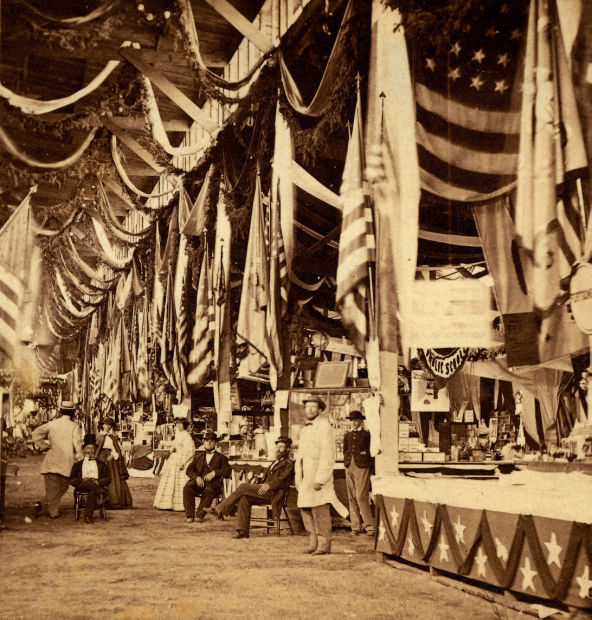
A scene at the Grand Mississippi Valley Sanitary Fair, held from May 17 to June 18, 1864, in St. Louis to raise money for assisting Union troops, their families and freed slaves. The fair was held in a temporary building erected for that purpose in the middle of 12th Street (now Tucker Boulevard) on the two blocks north of Olive Street. It had 54 booths that sold food, clothing, needlework and Missouri-made wine and beer. Many members of the Ladies' Union Aid Society members wanted to ban beer, but relented in a nod to the many pro-Union and pro-beer German immigrants in St. Louis. Missouri History Museum image
Emancipation, 1865
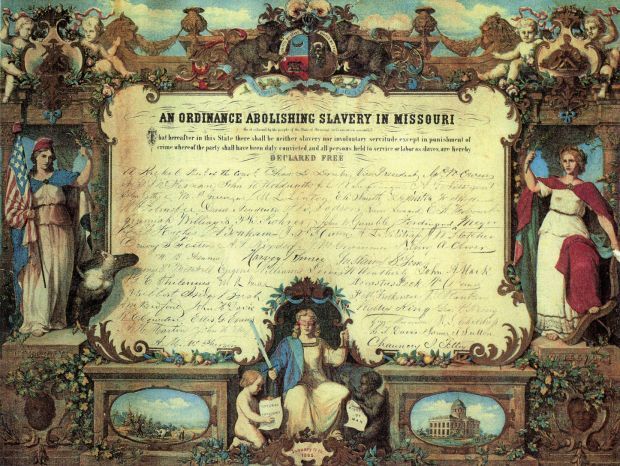
A lithograph produced for the Westliche Post, a German-language newspaper in St. Louis, to honor adoption of Missouri's emancipation ordinance. A state constitutional convention, meeting at the Mercantile Library in St. Louis, voted 60-4 on Jan. 11, 1865, to immediately abolish slavery in Missouri without compensation to slaveowners. Special wartime powers gave the convention that authority. Missouri History Museum image
A bird's eye view of Belleville in 1859

A bird's eye view of Belleville in 1859. The town, established in 1814, had more than 7,000 residents by 1860, mainly because of immigration from Germany.
'New' St. Clair County courthouse, 1859

An 1859 drawing of downtown Belleville showing preparations for building a courthouse that served St. Clair County from 1861 to 1972. It was the fourth, counting the original in Cahokia. The current courthouse is on the same site shown here. St. Clair County Historical Society image
Alton map, 1868

An Army Corps of Engineers map of Alton and the Mississippi River in 1868. Alton Museum of History & Art image
Cheltenham post office, c. 1870

The family of Augustus Muegge, about 1870, at his Cheltenham post office on Manchester Avenue just west of Hampton Avenue in what is now St. Louis but then was outside the city's border. It was the site of the closest reported approach to the city by Confederates during Gen. Sterling Price's invasion in 1864. Muegge is third from right. Image courtesy Missouri Historical Society
St. Charles, 1870s

Main Street in St. Charles in the late 1870s. Louis Blanchette founded the town in 1769.
Steamboats, 1871

"The Levee at St. Louis, Missouri," an engraving of steamboats and freight crowding the landing that was published in Harper's Weekly in October 1871. Steamboats fueled the town until the Eads Bridge linked train lines from east to west and roalroads became the dominant mode of transportation. Image courtesy Missouri History Museum
Eads Bridge construction

Eads Bridge construction, view from second pier east. Men on shore and in rowboat are seen observing work. From a stereograph by Boehl and Koenig, 1873. Photographs and Prints Collections. Missouri History Museum.
Construction of the Eads Bridge
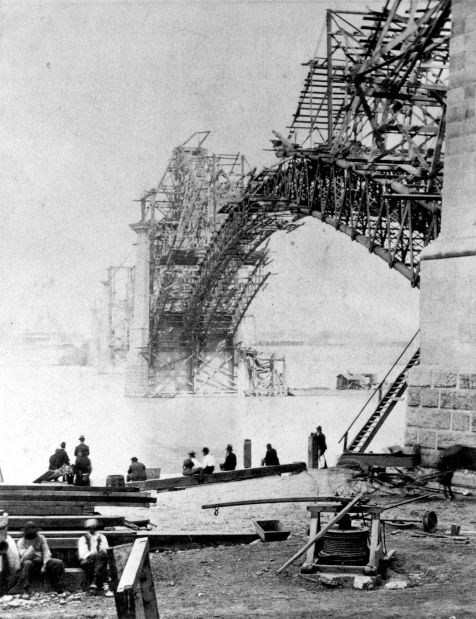
The Eads Bridge, then called just the St. Louis Bridge, under construction over the Mississippi River downtown. James B. Eads built the steel-and-stone bridge, which opened on July 4, 1874. Missouri History Museum photo
Roadway work begins as Eads Bridge is under construction

The Eads Bridge under construction, with the ribs completed and the roadways begun. Photo courtesy of the Library of Congress
Construction work on renovation of Eads Bridge in 2000

Construction work continues during a renovation of the Eads Bridge on Jan. 7, 2000. Photo by J.B. Forbes, jforbes@post-dispatch.com
Riverfront shortly after Eads Bridge opened in 1874

A drawing of the busy St. Louis riverfront shortly after the St. Louis Bridge, now known as the Eads Bridge, opened in 1874. The bridge, which allowed railroads to cross the Mississippi River, meant doom for the riverboat business. St. Louis Mercantile Library image
Southern Hotel fire, 1877

A depiction of the great Southern Hotel fire on April 11, 1877. Heroic firefighters rescued people many people, but 21 guests and workers died, some by jumping from upper-floor windows. Wood engraving after E. Jump, from Frank Leslie's Illustrated Newspaper, April 28, 1877. Missouri Historical Society Photographs and Prints Collections.
Fire hero, 1877

Phelim O'Toole, a hero of the Southern Hotel fire in April 1877. O'Toole used an early version of a ladder truck to rescue people from the burning hotel. When ladders couldn't reach the top floors, O'Toole climbed up bed sheets lowered by people trapped in the hotel to help them out. Another firefighter, Michael J. Hester, strapped ladders together to try to reach higher in the building. The firefighters, both Irish immigrants, saved about 20 people and were heralded by a grateful city. One of those O'Toole saved called him "an angel sent for our deliverance." A song was even written about the firefighters. O'Toole died in 1880 when a fire extinguisher blew up in his hands. Twenty thousand people showed up to mourn him.
Southern Hotel fire, 1877

The ruins of the Southern Hotel at Fourth and Walnut Streets after a devastating fire on April 11, 1877. Photograph by Robert Benecke. Missouri History Museum Photographs and Prints Collections.
St. Louis County Courthouse after "Great Divorce," 1878

A drawing of the St. Louis County Courthouse in present-day Clayton as it appeared shortly after construction in 1878.
Lucas Public Market, 1878

Lucas Public Market, an open-air market along 12th Street downtown. The long-gone market explains the extra width of the street, now called Tucker Boulevard. Wood engraving by St. Louis Democrat Litho and Publishing Co., ca. 1878. Photo courtesy Missouri History Museum
A-B ad, 1879

And advertisement for E. Anheuser Co's St. Louis Lager Beer touting "Shipment to all parts of the globe." Chromolithograph by Winkelmann Bros., 1879. Missouri Historical Society
Sportsman's Park, 1887

An 1887 view of Sportsman's Park, where three of the 15 games of the World Series of that year were played. Starting in 1885, the St. Louis Browns won four consecutive pennants here. They also won one world championship, tied another and lost two, all played in part at this field.
Pontoon bridge to St. Charles, 1890

A short-lived pontoon bridge across the Missouri River at St. Charles in 1890, showing the town's riverfront district. St. Charles County Historical Society image
Gen. William Tecumseh Sherman buried, 1891

The caisson carrying Gen. William Tecumseh Sherman's casket turns from Pine Street north onto Grand Boulevard during the procession from downtown to Calvary Cemetery, where he was buried in 1891. The scene is looking east on Pine. Missouri History Museum image
Anheuser-Busch Brewing Association, 1891

Workers of the Anheuser-Busch Brewing Association in an 1891 image. Photo by D.C. Redington, courtesy of Missouri Historical Society
Anheuser-Busch, 1892

Anheuser-Busch Brewery boiler house with refrigerator cars. Photograph by Emil Boehl, 1892. Missouri Historical Society
First car, c. 1893

J.D. Perry Lewis and his battery-powered horseless vehicle, the first in St. Louis about 1893.
Union Station, 1894

The Grand Hall was the site for the opening reception of St. Louis Union Station on Sept 1, 1894. Ninety-one years later, the station reopened with similar pomp and circumstance as the largest re-use project in the nation. Image courtesy Missouri Historical Society
The Great Cyclone of 1896

The jagged remains of St. John Nepomuk Church, at Lafayette and 11th streets, which exploded as the Great Cyclone of 1896 passed directly overhead. The tornado killed 255 people as it sliced like a turbine through St. Louis and East St. Louis. Its wide path, running roughly along today's Interstate 44 and across the Mississippi River at the Gateway Arch, was a ruin of 7,500 buildings destroyed or damaged, sheared trees and trains tossed from tracks. Among the wrecked buildings was the St. John Nepomuk school, across 11th from the church, that had been filled only two hours before with 800 children from the Bohemian community that ringed the church. Both church and school were rebuilt. Image courtesy St. John Nepomuk Church
Wreckage of Purina Mills, 1896

The wreckage of Purina Mills, at 12th and Gratiot streets, after the Great Cyclone of 1896. Photograph by J. Edward Roesch. Missouri History Museum Photographs and Prints Collections.
The Great Cyclone of 1896

A wrecked home in St. Louis after the Great Cyclone of 1896. Image courtesy Missouri History Museum
The Great Cyclone of 1896

The scene at the southwest corner of Seventh and Rutger streets (left foreground), the deadliest spot along the tornado's 10-mile path in 1896. Seventeen people were killed when a three-story tenement building collapsed. Frederick Mauchenheimer, who ran a tavern on the ground floor, was playing cards with two patrons when the storm hit. They were among the dead. Across the street, another six died. Image courtesy Missouri History Museum
Transit strike in 1900

The "civic elite" members of the sheriff's posse resting in a streetcar barn during the streetcar strike of 1900. They killed and wounded striking streetcar workers, touching off class warfare in the city. Many of the posse were prominent businessmen, judges and lawyers. The transit workers were strictly working class, including immigrants of Irish extraction.
Tower Grove Park, c. 1900
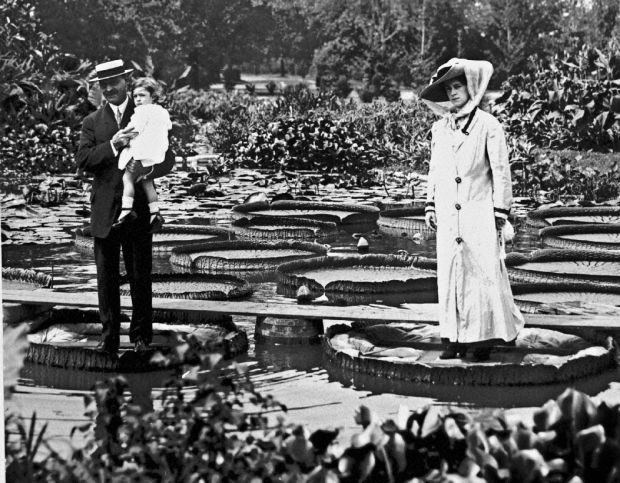
Visitors stand on "Victoria Regina" water lilies in Tower Grove Park around 1900. Missouri Historical Society image
Construction laborers, 1900
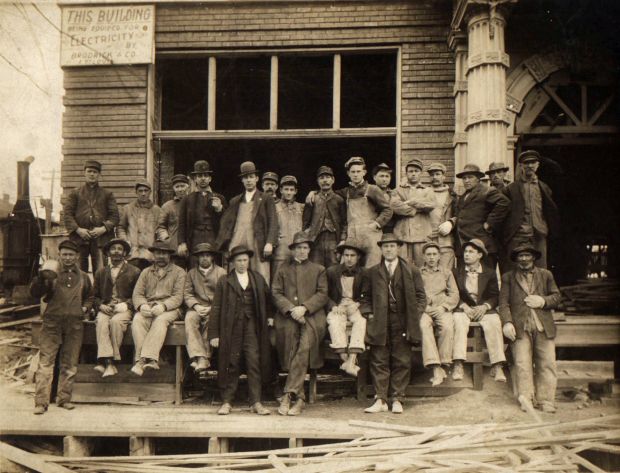
Construction laborers in East St. Louis pause for a photograph, probably about 1900.
East St. Louis saloon, 1900

A tavern on St. Clair Avenue in East St. Louis, about 1900. So many taverns were located along St. Clair Avenue by the Stock Yards that the zone was nicknamed "Whiskey Chute." Farmers leaving the Stock Yards with pockets full of money from the livestock auctions were favorite targets of saloon keepers and vice operators.
St. Louis Police Department's first squad car, 1902
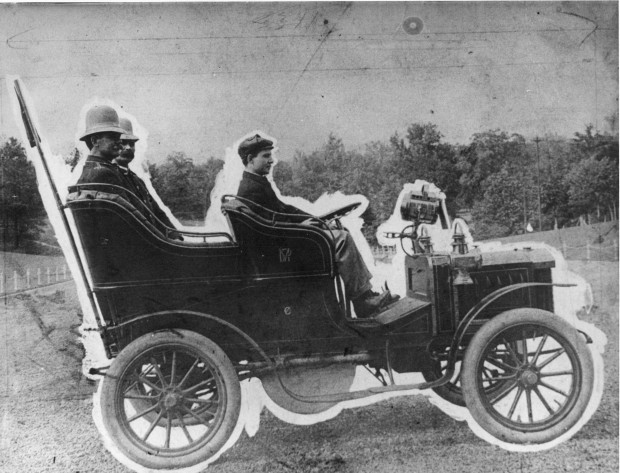
The St. Louis Police Department's first automobile, shown in 1902. Built by the St. Louis Motor Carriage Co., it was called the "skiddoo car" and used to chase speeders. Powered by a one-cylinder engine, the skiddoo could reach a relatively blistering 25 mph. The mast on the left is for a flag, not a radio. The city didn't begin installing radios in patrol cars until 1930. The white paint outlining the car was a common device used in newsrooms then by artists to overcome the inadequacies of printing presses and photo reproduction. Post-Dispatch file photo
Mark Twain in 1902

Mark Twain, far right, at a 1902 ceremony to place commemorative plaque on the Eugene Field House in St. Louis. Next to Twain is David R. Francis, president of the 1904 World's Fair.
Downtown, 1903
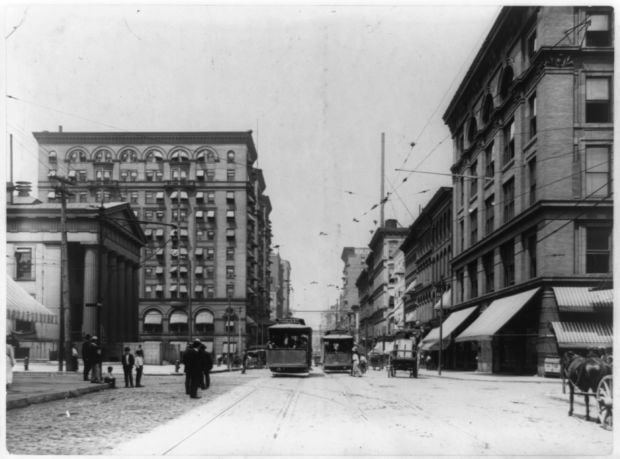
A view looking north on Fourth Street from Market Street in about 1903. The Old Courthouse is at left. Photo courtesy Library of Congress.
Washington Avenue, 1903

St. Louis' wholesale district, Washington Avenue looking west from Eighth Street, in 1903. Photograph by George Stark, courtesy Missouri History Museum
Flooding, 1903

A horse cart at Wharf Street and the railroad trestle at the levee in downtown St. Louis during the flood of June 1903. The crest of 38 feet on June 10 is the 13th highest on record at St. Louis. At the time, it was the second highest here after the flood of 1844. The 1903 flood broke levees and overwhelmed meager defenses along railroad lines in the Metro East, flooding all or part of East St. Louis, Cahokia, Madison, Venice and Granite City. It was the worst flood ever in East St. Louis. It led to creation of that city's first levee system. Missouri History Museum image
Exposition hall, 1904

The St. Louis Exposition and Music Hall, at Olive and 14th streets, site of the 1904 Democratic National Convention, as well as the party's 1888 convention. It was to have been the site of the 1896 Republican convention, but renovations forced construction of a temporary meeting hall near City Hall. The Exposition and Music Hall was opened in 1884, expanded three years later and demolished in 1906. St. Louis Central Library, opened in 1912, is built upon the former site of the old exhibition hall. Image courtesy Missouri History Museum
Exposition hall, 1904

An interior view of The St. Louis Exposition and Music Hall main auditorium. The building, at Olive and 14th streets, was site of the 1904 Democratic National Convention, as well as the party's 1888 convention. Image courtesy Missouri History Museum
World's Fair, 1904

A view of south lagoon from grand basin west at the Louisiana Purchase Exposition — better known as the World's Fair. The fairgrounds were traversed by a railway and a network of canals. Photo courtesy of the Missouri History Museum
World's Fair
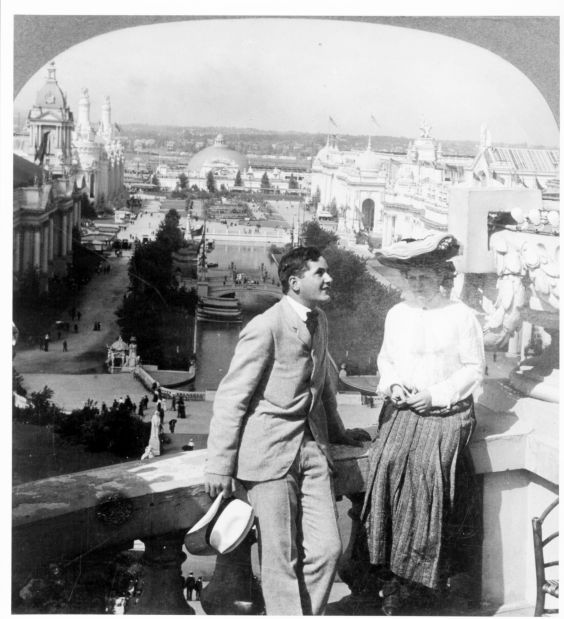
A couple enjoys the World's Fair in 1904. Exhibit palaces were grand structures but built to be temporary. Missouri Historical Society
Re-enacting battles at the World's Fair

Model ships were used in a large pond at the St. Louis World's Fair to re-enact sea battles during the Spanish-American War. The United States won lopsided naval engagements with the Spanish navy at Manila Bay, in the Philippines, and Santiago, Cuba, during the brief war in 1898, six years before the fair was held. Image courtesy Missouri History Museum
Ice cream at the World's Fair, 1904

A woman and her children enjoy ice cream cones at the 1904 World's Fair. Missouri Historical Society image
Festival Hall, World's Fair, 1904

Festival Hall and Cascades at the World's Fair. Photograph by the Official Photographic Company. Missouri Historical Society
Ferris' Wheel

"Ferris' Wheel" at the 1904 World's Fair in St. Louis' Forest Park. Photo courtesy of Missouri Historical Society
Olympics, 1904

St. Louis hosted the third modern Olympics in 1904, the same year as the World's Fair. This photo shows Dr. G.H. Sheldon, winner of Olympic "fancy diving" competition. Missouri Historical Society
Sledding Art Hill, 1904-05
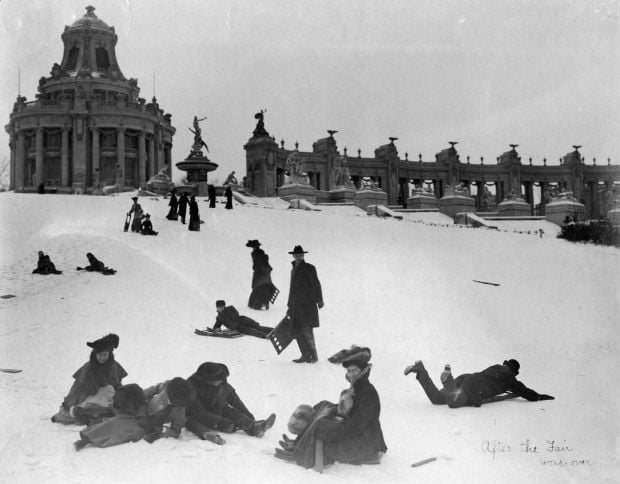
Sledders take to Art Hill in Forest Park sometime after the World's Fair ended on Dec. 1, 1904. News reporting of an icy snowstorm beginning Jan. 8, 1905, refers to sledders on the hill. Employees from the fair's administrative office used folding chairs with some success, as the photo indicates. Ever since, the hill has been a popular gathering place for winter fun. Photograph by Jessie Tarbox Beals, courtesy Missouri History Museum
East St. Louis, 1905
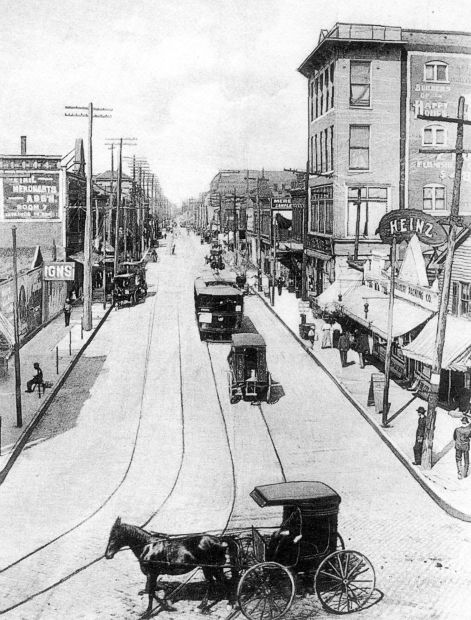
This drawing from about 1905 shows Collinsville Avenue in East St. Louis.
Train shed at Union Station, 1907

Interior of train shed at Union Station in a photo about 1907 by Emil Boehl. Image courtesy Missouri Historical Society
Downtown shopping, 1910

A crowd outside Boyd's, which became the center for men's fashion in St. Louis, near Sixth and Olive streets. Photo courtesy of Missouri Historical Society
Newsie, 1910

A boy selling newspapers in downtown St. Louis on May 7, 1910. This photo was taken by Lewis Hine, who traveled the country documenting child labor practices. Photo courtesy Library of Congress
Newsies, 1910

Boys selling newspapers, including the Post-Dispathc, stand outside Burley's Branch Office, on 23rd Street near Olive Street on May 4th, 1910. This photo was taken by Lewis Hine, who traveled the country documenting child labor practices. Photo courtesy Library of Congress
Child labor, 1910
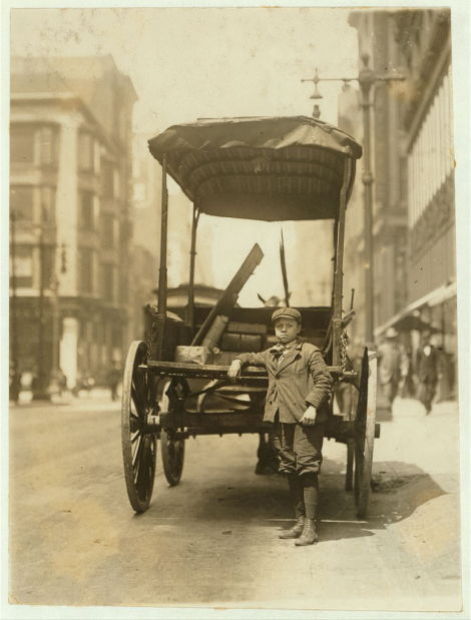
One of the many young boys working as assistants on delivery wagons, photographed on May 13, 1910. This photo was taken by Lewis Hine, who traveled the country documenting child labor practices. Photo courtesy Library of Congress
Newsies, 1910

Young newsboys at Sixth and Pine streets on May 10, 1910. This photo was taken by Lewis Hine, who traveled the country documenting child labor practices. Photo courtesy Library of Congress
Little newsie, 1910

A 5-year-old newsie named Francis Lance in May 1910. He sold papers regularly on Grand Avenue and ovten jumped on and off moving trolley cars "at risk of life," according to the caption by photographer Lewis Hine, who traveled the country documenting child labor practices. Photo courtesy Library of Congress
Newsies

Truants selling papers at Jefferson and Washington avenues on May 9, 1910. It was 11 a.m. on a school day. This photo was taken by Lewis Hine, who traveled the country documenting child labor practices. Photo courtesy Library of Congress
Newsies, 1910

Johnnie Merkle, a 6-year-old boy who worked selling newspapers, in May 1910. Father owns this house and butchers shop. This photo was taken by Lewis Hine, who traveled the country documenting child labor practices. Photo courtesy Library of Congress
Newsies, 1910

Newsies who work from a pool room at Chouteau and Manchester avenues in St. Louis. They play pool and smoke while waiting for papers to arrive. The younger boy is 9. This photo was taken by Lewis Hine, who traveled the country documenting child labor practices. Photo courtesy Library of Congress
East St. Louis police, c. 1910

East St. Louis police officers about 1910.
Downtown, c. 1915

In this photo from about 1915, attorney Leighton Shields peers out at the photographer from entrance to the Third National Bank, 506 Olive Street. His firm, Shields and Orthwein, had their offices on the 12th floor. Missouri Historical Society
Women want the vote, 1916

A woman advocates for the right to vote during a speech from a car on National Women's Suffrage Day, May 2, 1916. Photo from the Missouri Historical Society.
Faust's beer, 1916

An advertising card for the Faust label of beer, brewed by Anheuser-Busch and served at Faust's restaurant. In 1996, the brewery briefly brought back Faust's beer as one of its specialty lines. Image courtesy Missouri History Museum
Free Bridge, 1917

Crowds gather on the Free Bridge approach in St. Louis on Jan. 20, 1917, for the grand opening of the road deck. The railroad approach is on the left, but the bridge wasn't yet connected by rail with East St. Louis. In March 1942, three months after America's entry into World War II, aldermen renamed the bridge in honor of Gen. Douglas MacArthur. Image courtesy Missouri History Museum
East St. Louis riot, 1917
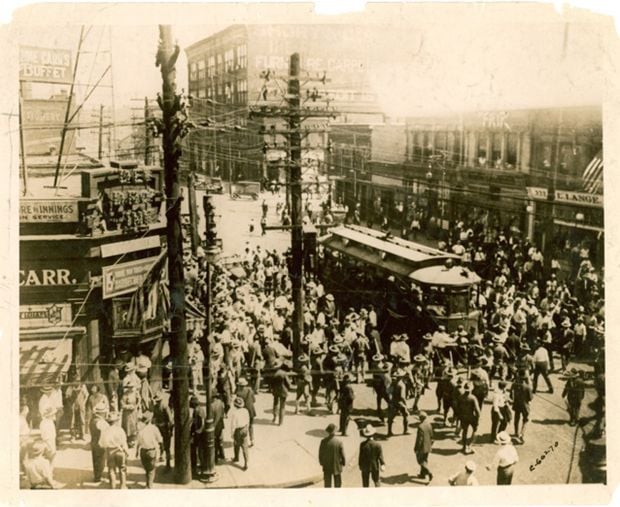
A white mob surrounds a street car during the riots in East St. Louis in 1917. Racial tension that brewed as black workers moved here from the South for jobs, sometimes working as strikebreakers, boiled over in July. White mobs shot and beat blacks, including children, as police officers and state militiamen largely stood by. The official death count was 39 blacks and nine whites, although police estimated a death toll closer to 100. Nobody knows, largely because local investigations were inept. Image courtesy W.E.B. Du Bois Papers, Special Collections and University Archives, University of Massachusetts Amherst.
East St. Louis Race Riots, 1917

Smoke rises from some of the fires in East St. Louis on July 2, 1917, during a riot by white mobs upon black residents. The view is from the Eads Bridge across the Mississippi River from St. Louis. Along the riverbank are railroad freight stations. At least 39 blacks and nine whites were killed during the rampage, although the death toll probably was higher. Southern Illinois University Edwardsville, Bowen Archives
Riot victim, 1917

A victim of white rioting in East St. Louis on July 2, 1917. (Southern Illinois University Edwardsville, Bowen Archives)
Bevo Mill, built 1917
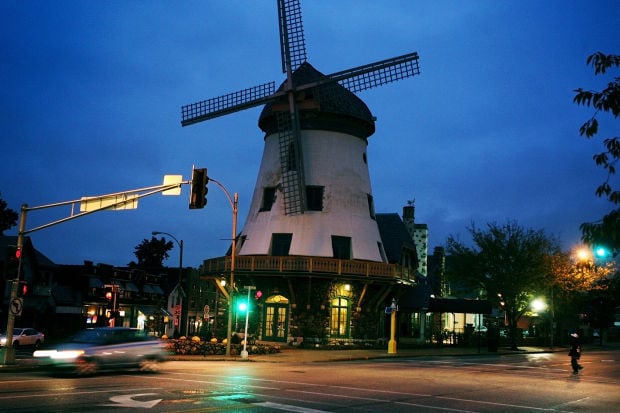
August A. Busch Sr. built the Bevo Mill in 1917 roughly halfway between his mansion on Gravois Road and the brewery south of downtown. The landmark is seen here on Oct. 15, 2009. Photo by Erik M. Lunsford of the Post-Dispatch
Veterans return, 1919

St. Louis' own 138th Infantry Regiment returns from World War I with a parade through the city on May 9, 1919. The formation is marching south on 12th Street (now Tucker Boulevard) at Olive Street. Just out of view to the left was the Shubert-Jefferson Theater in the Union Electric Co. building, where organizers of the American Legion were holding their first meeting in America on the same day. The city had erected the pillars to make 12th Street a "hall of honor" for veterans returning from the Great War. The building at top right was at the time the home of the Post-Dispatch. File photo
Welcoming soldiers home, 1919
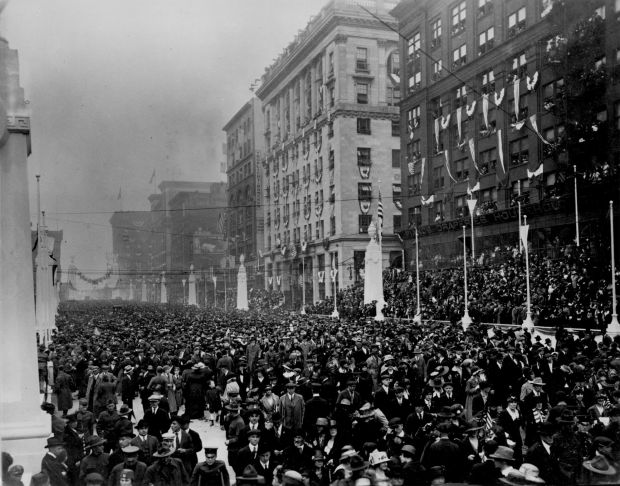
"The greatest crowd St. Louis ever saw massed in Twelfth Street" for a parade for returning soldiers, reported the Post-Dispatch in the caption accompanying this photograph from May 1, 1919. As the last men of the 128th Field Artillery marched south, the throng of spectators surged from the grandstands to follow them into the parkway at City Hall, "where relatives greeted their kin just back from France." The city threw huge parties — sometimes several in a week — to welcome St. Louis units home from World War I. Photo taken from Twelfth (now Tucker) and Olive Street. At upper right is old May-Stern Furniture Co. and next to it is the building that housed the Post-Dispatch at the time, erected in 1916.Missouri Historical Society image.
Grand Center, 1921

Commuters board a southbound streetcar on North Grand Boulevard in a photo looking north from Olive Street, in 1921. At right is the Metropolitan Building, 508 North Grand. Photograph by W.C. Persons. Courtesy Missouri History Museum
Josephine Baker, 1920s

Josephine Baker on stage in Berlin. Baker was born Freda Josephine McDonald in 1906 in the Mill Creek valley, west of Union Station. She was a teenager when she left St. Louis about 1919 with a vaudeville troupe. She performed in New York before heading for Paris with Le Revue Negre, a black dance company, and became a sensation for sultry dances wearing only a few feathers or a skirt of bananas. She returned to St. Louis for a performance at Kiel in 1952 on behalf of the Citizens Protest Committee on Overcrowding in the Negro Public Schools, a local group raising money to fight segregation. Baker entertained an integrated audience of about 8,000 people for two hours, then let her hometown have it. "I ran away from St. Louis, and then I ran away from the United States, because of that terror of discrimination," Baker said, reading from her script. "The hate directed against the colored people here in St. Louis has always given me a sad feeling. ... How can you expect the world to believe in you and respect your preaching of democracy when you yourself treat your colored brothers as you do?" The Post-Dispatch and Globe-Democrat, St. Louis' two daily newspapers, ran short stories on inside pages about the performance without describing audience reaction.
The U.S. Custom House and Post Office, 1922

The U.S. Custom House and Post Office, at Eighth and Olive streets, in 1922. The federal building and courthouse was opened in 1884. The construction in the foreground on the near side of Olive is for the Arcade Building. The former courthouse know is called the Old Post Office, and is home to the Missouri Court of Appeals. Post-Dispatch file photo
Lemp Mansion, 1922

The Lemp Mansion, at 3322 South 13th Street, a few days after William Lemp Jr. shot himself to death in his office on Dec. 29, 1922. Three members of the brewing family killed themselves in the house at different times. Post-Dispatch file photo
Streetcar's heyday, 1925

A busy streetcar loop at Third Street and Washington Avenue downtown on July 24, 1925. At far right, people are boarding a double-decker bus — a sign of the future for public transportation. Missouri History Museum image
Dance contest, 1925

A Charleston dance contest in front of St. Louis City Hall on Nov. 13, 1925. Missouri Historical Society image
Garment district, 1926

FILE PHOTO: Women textile workers in factory of Jonaline Inc. in a downtown building on Sept. 22, 1926. Photograph by Eugene Taylor. Missouri Historical Society
Sportsman's Park 1926

An aerial view of Sportsman's Park on Sept. 12, 1926, the final day of the season. The St. Louis Cardinals defeated Pittsburgh. Post-Dispatch file photo
Lindbergh in St. Louis, 1927

Charles Lindbergh, shown in 1927 at Lambert Field, named his plane the Spirit of St. Louis to honor Col. A.B. Lambert and other St. Louis backers of his flight. The plane now hangs in the Smithsonian Institution in Washington D.C. A 1928 replica hangs at the Missouri History Museum in Forest Park.
Lindbergh visits, 1927

A crowd on Art Hill in Forest Park greets Charles A. Lindbergh as he flies over in the Spirit of St. Louis on June 19, 1927. Photograph by Ralph A. Rugh. Missouri Historical Society.
Flying high with Lindbergh, 1928

Charles Lindbergh in his Spirit of St. Louis plane performed for 27 minutes over the riverfront on Feb. 14, 1928. A crowd of 60,000 watched Lindbergh circle and dip. Newspaper accounts said Lindbergh flew low but that he did not fly under the Eads Bridge, something that many of the children insisted he did. Lindbergh flew here from Havana, Cuba. Post-Dispatch file photo
St. Louis Arena, 1929
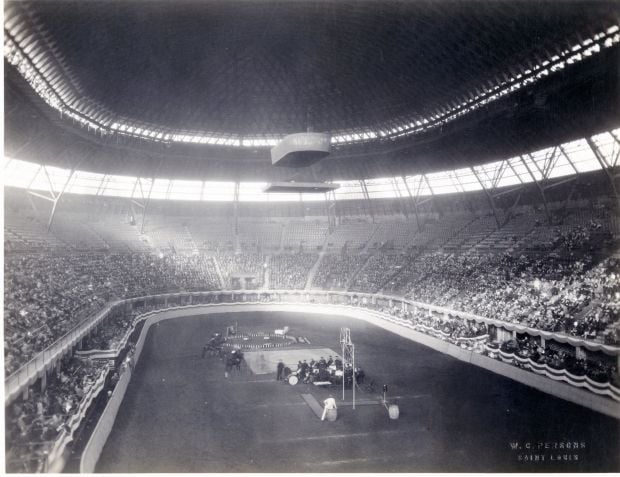
A circus at the St. Louis Arena, shortly after it opened in 1929. Photograph by W.C. Persons. Missouri Historical Society
River Des Peres, 1929

Work under way in August 1929 on the massive concrete sewer tube that carries the River Des Peres beneath Forest Park. At left is Lindell Boulevard, just east of DeBaliviere Avenue. The long-talked-about enclosure of the river was finally put into motion after flooding in 1915. Post-Dispatch file photo
River Des Peres, 1929

An aerial view of the sewer tube under construction in Forest Park in September 1929. In the center is the Jefferson Memorial, now the Missouri History Museum. The street on the left is Lindell Boulevard. In the flood of August 19-21, 1915, almost all of the ground visible in this photograph was under water. Post-Dispatch file photo
Fox Theatre, 1929

The Fox Theatre in a 1929 image. Photograph by W.C. Persons. Missouri History Museum Archives.
Prohibition in the 1920s

Boys join other onlookers Dec. 6, 1922, in watching thousands of gallons of bootleg mash washing into the sewer from a building at 11 South Third Street downtown, where the Interstate 70 depressed lanes now run. Prohibition agents said they found two stills inside the four-story building that could produce 500 gallons of whiskey daily. They called it one of the biggest raids to date in Missouri. No one was in the building when agents raided it, but agents found fires under the stills and a half-eaten lunch. Post-Dispatch file photo
Prohibition in the 1920s

In a raid on bootleggers, police dump barrels of fermenting corn mash out the windows of a home on Howard Street, just north of downtown, in February 1921. It was a quick method of disposal that surely gave the neighborhood a strong aroma. Post-Dispatch file photo
Route 66 across the Chain of Rocks, 1929

Opening day in July 1929 on the old Chain of Rocks Bridge, which became the way across the Mighty Mississippi for travelers on Route 66. The bridge, which closed to traffic in 1968, has been reopened for walker and cyclists. Post-Dispatch file photo
1931 World Series

Crowds gather outside Hunleth Music Co. at 516 Locust Street to listen to the radio broadcast of the St. Louis Cardinals playing against the Philadelphia Athletics during the fourth game of the 1931 World Series on Oct. 6. Though the Cardinals lost the game, the St. Louis team won the series. The photograph was taken by Harold Sneckner and is part of the Sievers Collection, Missouri Historical Society.
Hoping for the end of Prohibition 1932

Drinkers in a local speakeasy toast the anticipated end of Prohibition some time in late 1932. Debate began in Congress in December 1932, and a proposed 21st Amendment to abolish the 18th was sent to the states three months later. While state legislatures were considering repeal, Congress abolished the federal Volstead Act, the enforcement statute for Prohibition. Getting rid of Volstead allowed for the sale of 3.2 beer beginning April 7, 1933. The 21st Amendment went into effect on Dec. 5, 1933. Illinois went fully wet immediately, but the Missouri Legislature dithered for a month before allowing full fare in taverns. Post-Dispatch file photo
Repeal of Prohibition, 1933

A scene from the party at the Hotel Jefferson, 12th (now Tucker) Boulevard at Locust Street, in the first hour of April 7, 1933. More than 600 people had made reservations for the ballroom in anticipation of legal beer, and cheered loudly when the first deliveries pulled up outside. Post-Dispatch file photo
Repeal of Prohibition, 1933
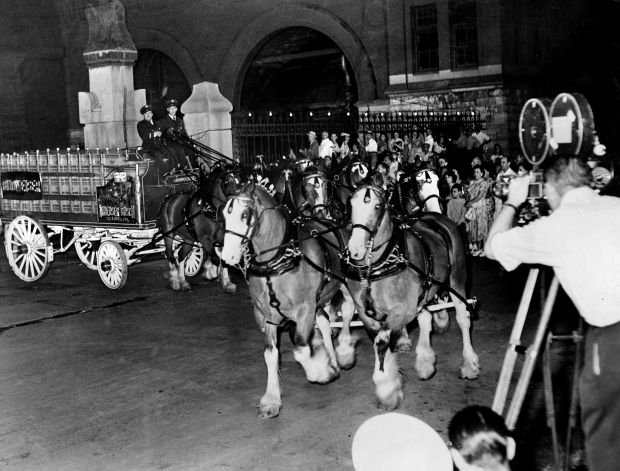
After the end of Prohibition in 1933, the first wagon filled with beer leaves the Anheuser-Busch brewery, pulled by Clydesdales and recorded by a movie cameraman. The brewery also dispatched a truck to Lambert Field for shipment of beer by air to the White House. August A. "Gussie" Busch praised President Franklin D. Roosevelt for his support during a live national radio broadcast from the brewery at midnight. Post-Dispatch file photo
End of Prohibition, 1933

Adophus Busch (left), August A. Busch Sr., and August A. Busch Jr. with the first case of post-Prohibition beer produced by Anheuser Busch in 1933. Photo courtesy Anheuser-Busch
Lambert Field, 1933

A TWA Ford Tri-Motor parked in front of the then-new Lambert Field terminal at its grand opening in June 1933. The $152,000 terminal, built on the north end of today's Lambert-St. Louis International Airport, served travelers until 1956, when the existing terminal was opened. Post-Dispatch file photo
Arch planning, 1933

An aerial view of the St. Louis riverfront taken in 1933, when local leaders began discussing a major urban-renewal project to honor President Thomas Jefferson with a riverfront memorial. Local lawyer Luther Ely Smith suggested clearing a wide swath of the old riverfront commercial area for the memorial. Beginning in 1939, the city would demolish 486 buildings, sparing only the Old Courthouse, the Old Cathedral and Manuel Lisa's Rock House at Chestnut and Wharf (now Leonor K. Sullivan) streets. By the 1930s, many of the buildings and warehouses along the riverfront were vacant or underused, and many had deteriorated. But the area also included a few gems, such as the Old Customs House at 218 North Third Street. All was swept away, something probably unthinkable today. Post-Dispatch file photo
Construction of Municipal Auditorium, 1933
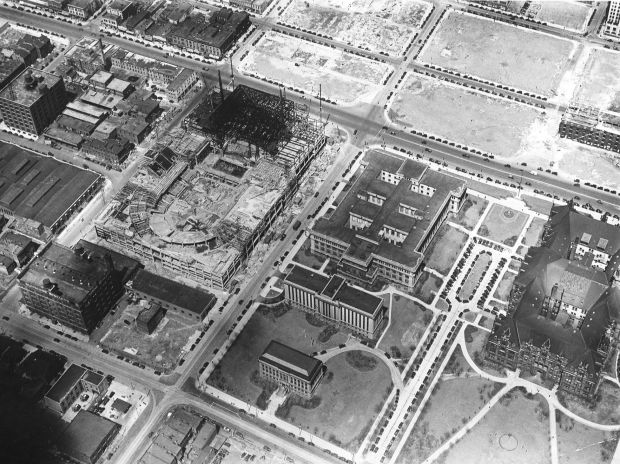
An aerial view of construction of the Municipal (later Kiel) Auditorium in April 1933, showing the steel superstructure of the future opera house and the first rows of the auditorium. It was built atop the former Targee Street. Post-Dispatch file photo
Municipal Auditorium, 1934
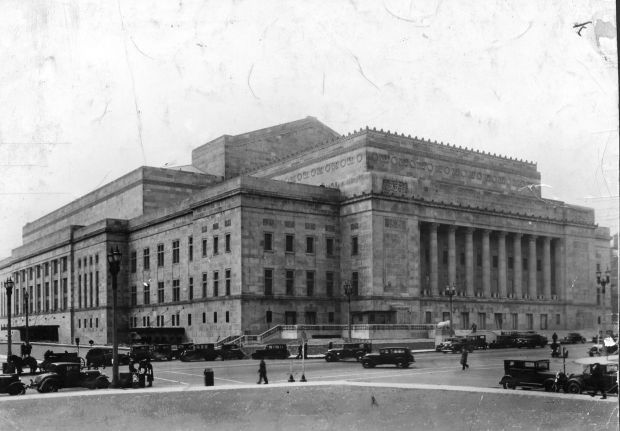
The Municipal Auditorium on dedication day, April 14, 1934. The city renamed it in honor of former mayor Henry Kiel shortly after his death in 1942. He had been mayor when city voters passed a major bond issue for numerous improvements, including the auditorium and opera house. Post-Dispatch file photo
'Showboat' at the Muny, 1934

The large "Show Boat" ensemble gathers on the Muny stage before dress rehearsal in 1934. The cast is racially integrated — unusual for its day but vital to the show. It's one of the the most popular shows in Muny history, with more than a dozen productions since 1930.
Riverfront before Arch, 1938
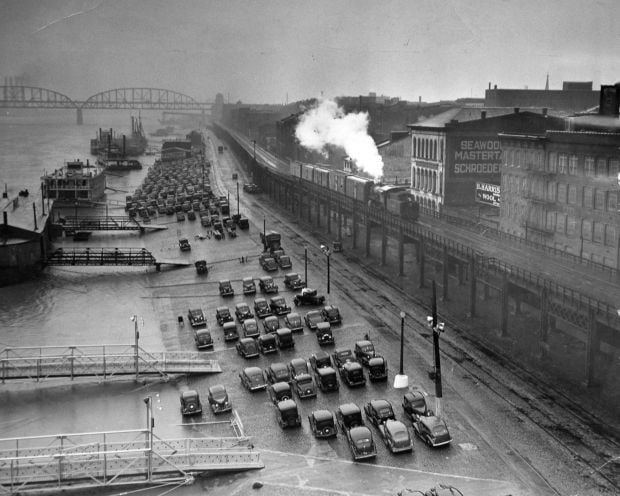
This photo shows cars parked on the cobblestone levee in front of the future Arch grounds in May 1938. At right, a switching locomotive hauls boxcars along the riverfront railroad trestle. Owned by the Terminal Railroad Association, the trestle wasn't removed until the early 1960s, when the track was rerouted on the tunnels and cuts running through the Jefferson National Expansion Memorial. Moving those tracks proved to be one of the major sources of delay for the project. Post-Dispatch file photo
Riverfront before the Arch, 1939

Warehouses looking south along Wharf Street in 1939. The photo was taken beneath the old railroad trestle that ran along Wharf Street. Post-Dispatch file photo
Demolition for the Arch, 1939

An arrow points to St. Louis Mayor Bernard F. Dickmann on Oct. 9, 1939, the first day of demolition on the riverfront to make way for the future Gateway Arch grounds. In the background is the railroad trestle, the single biggest reason why work wouldn't begin on the Arch for another two decades. Railroads wanted to keep the busy trestle. Post-Dispatch file photo
Old Cathedral, 1940

The Old Cathedral in May 1940, before surrounding buildings were demolished for the Arch grounds. Library of Congress image
Clearing for the Arch, May 1940

Scene of the demolition in the riverfront business district in May 1940 to make way for the future Gateway Arch riverfront park. America's entry into World War II nineteen months later stopped work on the Jefferson National Expansion Memorial. Construction leading to the arch didn't begin until 1959. Post-Dispatch file photo
Aloe Plaza, 1939

Demolition underway in August 1931 to make room for Aloe Plaza and the Milles Fountain north of Union Station. The idea was to create a more visually pleasing doorway to St. Louis for people who arrived by train at Union Station. The street on the left is 18th Street, intersecting with Market Street. The work was financed by part of the city's 1923 bond issue. The project also called for widening both streets. Post-Dispatch file photo
The Admiral, 1940

The Admiral turns into the current of the Mississippi River after casting off from the levee a few days after its first cruise on June 12, 1940. In the background is the St. Louis Municipal Bridge, renamed the MacArthur Bridge shortly after the United States entered World War II. There is no Poplar Street Bridge, of course. Post-Dispatch file photo
Aloe Plaza, 1940
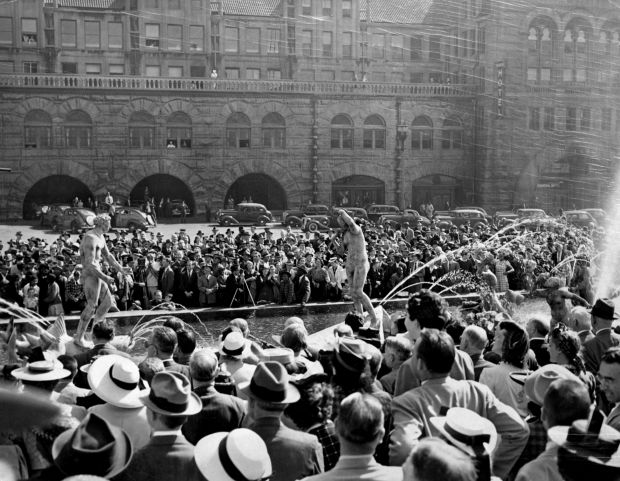
Crowds gather at the unveiling of Carl Milles' fountain "The Meeting of the Waters" outside Union Station on May 11, 1940. The main sculptures were of men and women facing one another to represent the Mississippi and Missouri rivers. About 3,000 people attended the dedication, and most were enthusiastic, though there was a kerfuffle about the nudity of the statues. Post-Dispatch file photo
'Black Tuesday' 1939

The morning of "Black Tuesday," Nov. 28, 1939, the smoke-choked day that became known as the worst day of a nasty winter season — and was the impetus for redoubled city action to significantly reduce coal-smoke pollution. The view is of the Central West End looking eastward from the roof of the Park Plaza Hotel, at Kingshighway and Maryland Avenue. Barely visible through the smoke is the St. Louis Cathedral, only three blocks away. Less than five months later, the Board of Aldermen voted to ban the burning of soft Illinois coal except in mechanically-stoked furnaces, which didn't include homes or many businesses. Shippers had to bring in high-grade "hard" coal from Arkansas and West Virginia. The ban inspired outrage from the coal interests but soon led to a noticeable lessening of pollution. Post-Dispatch file photo
Coal smoke, 1940

Men standing in the smoky air in front of the St. Louis Main Library downtown in January 1940. Coal smoke made St. Louis a dirty place before a new ordinance that year began making the air cleaner. Post-Dispatch staff photo
Coal smoke ordinance results, 1941

Men pose in the same location one year later, in January 1941, another effort to show the contrast in haze since the Board of Aldermen enacted the city's hard-coal ordinance in April 1940. Post-Dispatch file photo
Forest Park Highlands, 1941

Happy faces on the Comet ride at the Forest Park Highlands amusement park in 1941. Most of the riders appeared to be enjoying the run. Photo by Arthur Witman of the Post-Dispatch
Muny chorus, 1942

For many years Muny chorus members worked the entire season, not just one or two shows. That meant they started rehearsals before the first show opened, then performed at night and rehearsed their next show during the day. It was a tough schedule, but performers competed hard to make the cut. Most of the 1942 female dancers are from the St. Louis area. From left, by row, they are: (first row) Mary Ann Hickey, Susan Scott, Eunice Kagan, Jean Haumueller, (second row) Rosemary Powell, Leonore Hines, Jane Bauer, Carol Ossman, (third row) Doris Jean Rathman, Virginia Hashagen, Lillian Cross, Virginia Conrad, (fourth row) Lillian Ann Merod, Virginia Lee Green, Marie von Behren, Betty Herbert, (fifth row) Nancy McCabe, Jackie Bonder, Kay Eibert, Suzanne Schmitz, (last row) Mary Foster, Josephine McCann, Dortha Maie Wicker and Mary Jo Zucchero. Photo by Jack January of the Post-Dispatch
Muny chorus, 1942

The men's vocal chorus warms up for the 1942 season at the Muny, which included "Show Boat," "Roberta" and "The Wizard of Oz." The performers are, from left (front row) Bob Herman, Kenneth Cantrill, Bill Thompson, Fred Schneider, Everett Young, Lyndon Crews, (second row) Randles Watkins, Vernon Gutjahr, Wilbert Liebling, George Irving, James Stanley, George Mueller and Eden Nichols. Photo by Jack January of the Post-Dispatch
1942 Carter Carburetor

Racial discrimination kept some wartime workers out of the factories, and more than 300 St. Louisans demonstrated in protest in 1942. The marchers, led by a man with a large American flag, walked quietly from Tandy playground at Cottage and Pendleton avenues to Carter Carburetor Corp.'s war manufacturing plant on North Spring Avenue, carrying placards with slogans like "Fight the Axis - don't fight us." Leaders of the protest include, from left, Theodore D. McNeal, Constable Jordan W. Chambers and David M. Grant, a former assistant circuit attorney. Post-Dispatch staff photo
Riverfront demolition area, 1942

A view of the future Jefferson National Expansion Memorial, looking southeast above Washington Avenue and Third Street in 1935. At left is the streetcar station for service over the Eads Bridge to East St. Louis. To the far right is the Municipal Bridge, renamed the MacArthur Bridge in 1942 in honor of Gen. Douglas MacArthur. Post-Dispatch file photo
Clearing land for Arch, 1942
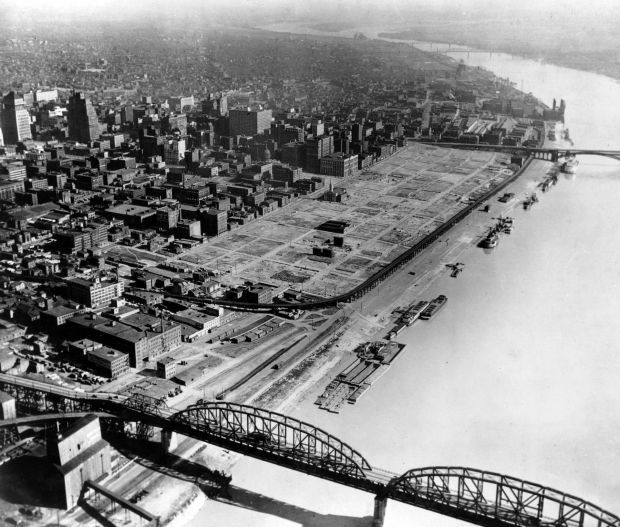
The riverfront was cleared for a memorial to Thomas Jefferson by February 1942. World events halted even the luxury of considering how to create a memorial. France had fallen, England was weathering the Nazis' rain of bombs, and Japan had attacked the United States Navy at Pearl Harbor. A world war would have to be won before St. Louisans could again contemplate creating a monument that would rise to its purpose. File photo
World War II worker, 1943-44
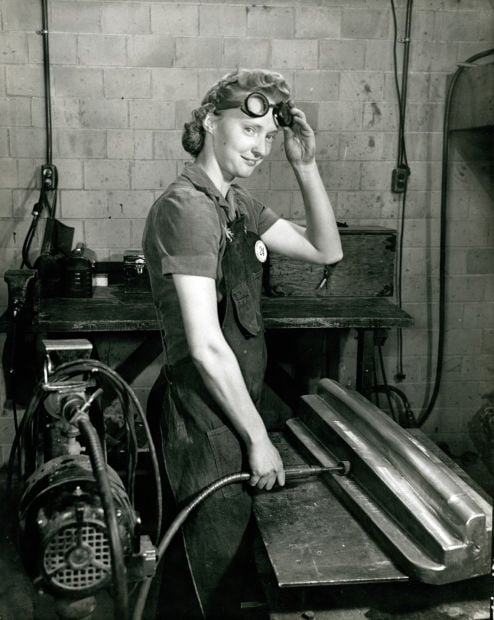
Woman grinding machined part at Curtiss-Wright Aircraft at Lambert Field. Photograph by F. Dale Smith, 1943-44 Missouri History Museum Photograph and Print Collection.
World War II factory work

Jeanne Clyne taps bolt holes into a mounting brace for an airplane gun turret at Emerson Electric Co. in Ferguson in 1943. The original photo caption says Clyne was one of the plant's most skilled machinists. Post-Dispatch file photo
Browns and Cardinals World Series, 1944

Fans leaving Game 3 of the 1944 World Series, on Oct. 6, head for streetcars and buses on North Grand Boulevard. The Cardinals defeated the Browns in the all-St. Louis "Streetcar Series." (Post-Dispatch archives)
Parade for Army Gen. Omar Bradley, 1945

Gen. Omar Bradley was honored in St. Louis on June 11, 1945, with a massive parade downtown and a dinner at the Hotel Jefferson. One month before, he had led the million-man Twelfth Army Group to victory in Germany. Americans were still dying on Okinawa and in the air over Japan, but the homefront deserved a break. Here he waves to adoring crowds as the parade in his honor rolls along on Olive Street. At right is his wife Mary. At left is Margaret Kaufmann, wife of Mayor Alloys Kaufmann. Photo by Art Witman of the Post-Dispatch
V-J Day, 1945

Jubilant St. Louisans charge through piles of paper on Olive Street downtown on the morning of August 14, 1945, the day Japan surrendered, which became known as V-J Day, for Victory in Japan. Unofficial reports of the surrender were broadcast over St. Louis radio stations about 2:30 a.m., and people who bothered to go to work that morning threw reams of paper out the windows of their office buildings. President Harry Truman confirmed the surrender at 5 p.m. central time. The United States had been fighting in World War II for three years and nine months. Post-Dispatch file photo
V-J Day, 1945

Two young women celebrate V-J Day on Washington Avenue in downtown St. Louis on Aug. 14, 1945. Post-Dispatch file photo, Missouri History Museum archives
St. Louis, 1946

A 1946 aerial view of St. Louis and nearby area made from an altitude of 16,000 feet with infrared film and filter. Mississippi River in foreground; Missouri River in background. Photo by Art Witman of the Post-Dispatch
1946 World Series
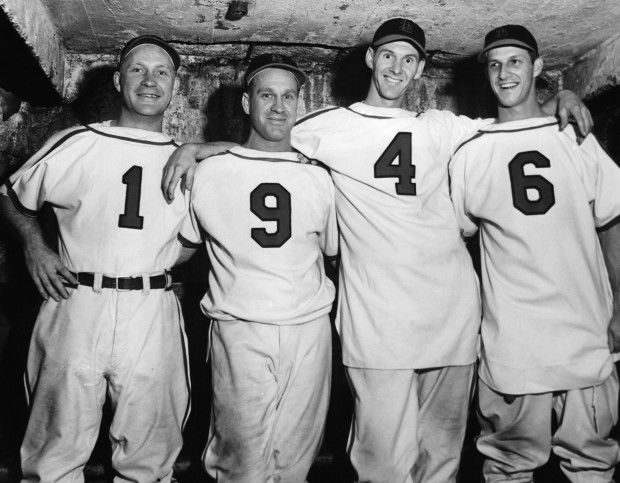
(From left) Whitey Kurowski, Enos Slaughter, Marty Marion and Stan Musial turn their jerseys around to display the year the Cardinals won their third World Series in the 1940s. (Post-Dispatch archives)
Pacific Local stops in Webster Groves, 1946

The Pacific Local, the commuter train from Pacific, Mo., to Union Station, stops at a station in Webster Groves in January 1946. Post-Dispatch file photo
Kirkwood commuters, 1946

Passengers at the ticket desk in Union Station in 1946. The desk was next to the doorway to the tracks beneath the vast train-shed roof. Photo by Jack Gould of the Post-Dispatch
Protesting Jim Crow, 1946

Members of the local NAACP branch and other organizations march outside the American Theater on Nov. 17, 1946, to protest segregated seating. It was opening night for "Carmen Jones," a musical about black characters, but if black patrons wanted to attend, they had to sit in the balcony. With the NAACP were members of the Citizens' Council for Democracy, American Youth for Democracy and the National Negro Congress. Post-Dispatch file photo
Jim Crow demonstration, 1947

Paul Robeson (left), internationally famous actor and singer, joins the picket line outside the American Theater on Jan. 25, 1947. Robeson had performed the night before to an integrated audience at the Kiel Opera House, but refused to play segregated theaters. The American Theater segregated audiences, with black patrons relegated to the balcony. Protesters targeted the theater beginning in 1946, but it was six years before the American Theater was integrated. Post-Dispatch file photo
Catholic school integration, 1947
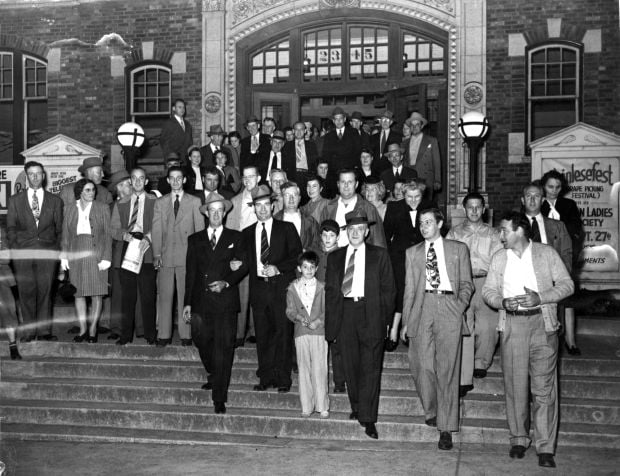
White Catholics who opposed Archbishop Joseph E. Ritter's instructions to integrate Catholic schools leave a meeting attended by 700 at the St. Louis House, 2345 Lafayette Avenue, on the evening of Sept. 21, 1947. It was the third such large gathering of angry parents, who threatened to remove their children from schools and planned a lawsuit to block Ritter. At the time, segregation of schools was Missouri law. But the morning of the big meeting — a Sunday — Ritter had all priests read a letter during all Masses. It threatened excommunication to anyone to took part in such a lawsuit. The letter threw the meeting into turmoil, and the new segregationist organization, the Catholic Parents Association, disbanded two weeks later. Photo by Buell White of the Post-Dispatch
Golden Eagle steamboat, 1947

The Golden Eagle pulls away from the St. Louis levee on May 14, 1940, for a trip down the Mississippi River. The Golden Eagle, a coal-fired sternwheeler, was the last wooden-hulled excursion boat on the river. It was built in 1904 to haul cotton. Eagle Packet Co. was the last St. Louis-based steamboat company that offered passenger service to other cities. Post-Dispatch file photo
Smoky plant, 1947

Coal smoke belches from Union Electric's Cahokia power plant on Sept. 16, 1947. This photo shows that downtown St. Louis' air is cleaner — and that even one major industry could produce heavy smoke by burning sooty coal. Post-Dispatch file photo
Dewey doesn't defeat Truman, 1948
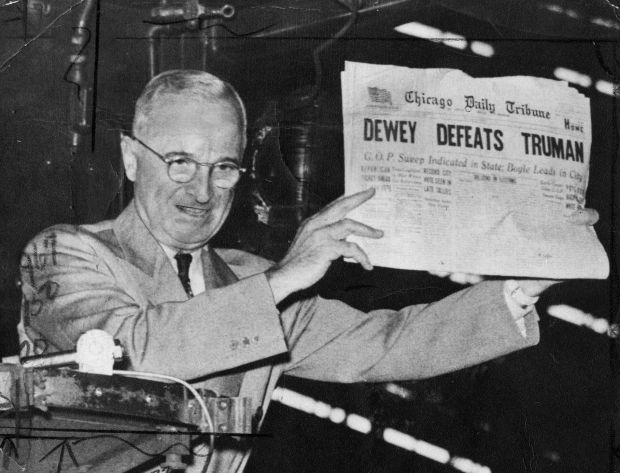
During a stop at Union Station in St. Louis on Nov. 3, 1948, President Harry Truman happily waves an early edition of the Chicago Tribune that splashed the editors' wrong bet on the result of the Nov. 2 presidential election. Truman and his family had stopped on their return trip from Independence, Mo., to Washington, and were met by about 13,000 happy supporters. Former congressman C. Arthur Anderson of Mehlville had a copy of the paper and passed it up to Truman, who mugged for the news photographers. Photo by Louis Phillips of the Post-Dispatch
Fairground Park mob, 1949
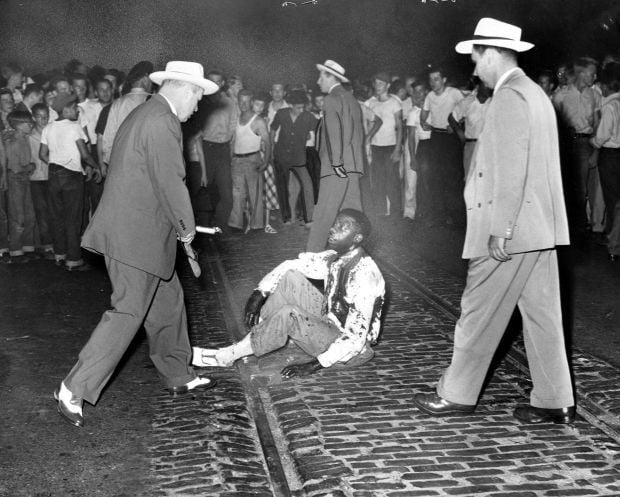
A blood-stained man sits in the middle of Kossuth Avenue after suffering a beating from a mob who chased him through Fairground Park on June 21, 1949, the day the swimming pool in the park was integrated. The men in hats are detectives who arrived to protect the man. Several hundred whites rioted after the city integrated the pool. More than a dozen people were injured. It took 400 police officers 12 hours to restore order. Photo by St. Louis Post-Dispatch
Trains in 1949
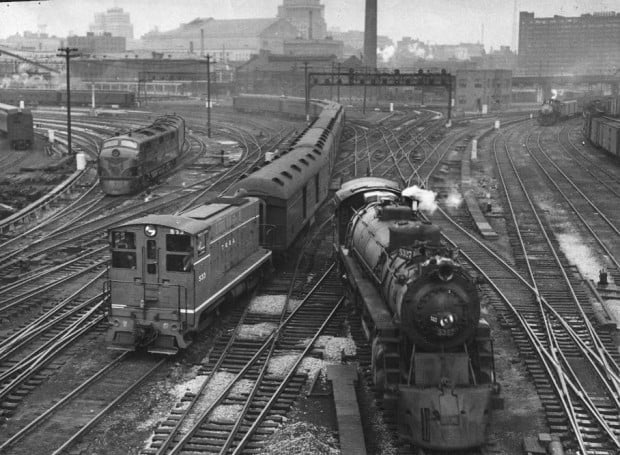
A Terminal Rail Road Association diesel switcher, at left, passes a Missouri Pacific steam locomotive near Union Station in December 1949. The sight was common in the decade after World War II, as railroads were converting from steam to diesel. Post-Dispatch file photo
Mill Creek, 1948

An alley in the Mill Creek Valley area, in a photo probably taken in 1948. Post-Dispatch file photo
Mill Creek Valley area housing, 1952

Mill Creek Valley area housing in St. Louis about 1952. Post-Dispatch file photo
St. Malachy in Mill Creek Valley, 1959

The steeple of old St. Malachy Church, 2904 Clark Avenue, tumbles on Dec. 7, 1959, during the massive demolition of the Mill Creek Valley area west of downtown. St. Malachy served black Catholics in the decades before its closing and, for a time, had a school. Photo by Renyold Ferguson of the Post-Dispatch
Pruitt-Igoe housing project goes up, 1954

An aerial view of the Pruitt and Igoe housing complexes under construction northwest of downtown in August 1954. The 57-acre complex of 33 buildings, each of 11 stories, provided 2,868 apartments for low-income people. Federal housing appropriations paid most of the $36 million to build them. The city began clearing the old DeSoto-Carr neighborhood in 1952. At the groundbreaking, Mayor Joseph M. Darst said, "These two projects are tangible evidence of progress in the continuing war against slums and decay." Many of the residents came from apartments in buildings built during the 19th Century, some of which still lacked running water. At the far left of Pruitt and Igoe is the intersection of Jefferson and Cass avenues. Surrounding the complex are decaying neighborhoods that the city later cleared out. Taking their cue from the big thinking that helped win World War II, federal and local housing planners thought that building high-rise apartment buildings for the poor would give them pleasant new apartments and save on real estate. Time would not bear them out. Photo by William Dyviniak of Post-Dispatch
Chuck Berry, 1950s

A youthful Chuck Berry performs his trademark "duck walk." This vintage photo now hangs in the Duck Room at Blueberry Hill in University City, where Berry still performs. Berry also has a sidewalk star on the St. Louis Walk of Fame.
Red Schoendienst, 1953

New member of the family- Red Schoendienst introduces his wife and daughters, Cathleen, 10 months, and Colleen, 2, to his new puppy bird dog, presented to him by Paul B. Schurmann, secretary Treasurer of the Hanover Star Milling Co. of Germantown, Ill., on Aug. 19, 1953. Photo by Renyold Ferguson of the Post-Dispatch
Beating the heat in 1954

As the temperature reaches 109.3 degrees during a brutal stretch in July 1954, St. Louis Dairy route man Kenneth Hogan proves a good neighbor, handing out big chips of ice to children who live near the Clinton Peabody Housing Project on the near south side. One day that July, the temperature reached 115, the highest recorded here. Photo by Renyold Ferguson of the Post-Dispatch
Muny performers, 1954

In 1954, the Muny tried to beat the heat by pouring a thin film of water over the concrete slabs under the seats. This turns out not to work as well as everyone hopes, because the combination of water and St. Louis summers can make things steamy. Still, while the water runs the performers enjoy it. Lunch hour brought a break from the heat to singers Barbara Craven (top), Sara Smith (seated below Craven), Kaye Geith (left, second row), Harlene Pomroy (right, second row) and Carolyn Hill.
Grand Center, 1954

St. Louis Movie Theater at 718 North Grand Avenue in 1954, with Missouri and American Theater marquees in the distance. Photograph by Dorrill Studio. Missouri History Museum Archives.
Integration of schools, 1955

Black and white students at McKinley High School in St. Louis join together for the first time in the auditorium at the beginning of the school term in January 1955, following the ruling of the U.S. Supreme Court outlawing segregated school systems. Post-Dispatch file photo
Blanchette Bridge, 1957

Work underway on the new bridge over the Missouri River at St. Charles as of February 1957. The view is looking westward into St. Charles County. Photo by Renyold Ferguson of the Post-Dispatch
Train commute, 1957

The Pacific Local commuter train ran from Pacific, Mo. to downtown St. Louis with stops in places like Kirkwood and Webster Groves along the way. In this August, 1957 photo, members of the Rattlers, an informal social club of commuters who took the Pacific Local, throw a party on the train for one of its members, Fred Tibbetts, upon his retirement from International Shoe Co. The Rattlers genuinely enjoyed Tibbetts' company, but never needed much inspiration for a good party. Tibbetts is at center, in suit and silly hat, enjoying a joke with Nugent Weis. Seated at right, with refreshment, is Loraine Bakker. Ridership dwindled and the Pacific Local took its last trip in 1961. Photo by Sam Caldwell of the Post-Dispatch
Stan Musial, 1958
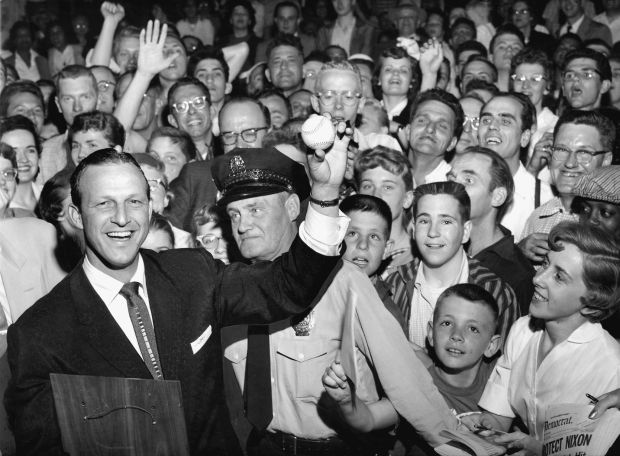
Holding high the baseball that figured in his 3,000th hit, Stan Musial responds happily to a noisy reception by fans at Union Station on May 13, 1958. The crowd gathered early to greet the 11:15 p.m. arrival of the train from Chicago, bringing the Cardinals home after a successful two-day trip. Musial, batting in place of Sam Jones, hit a double that drove in a run in a winning rally. The Redbirds won 5-3, for their sixth straight triumph. Keeping the crowd in check is Patrolman Joseph F. Haney of Central District. Post-Dispatch file photo
Ralston Purina fire, 1962

A grain-dust explosion ripped through the Ralston Purina feed mill south of downtown on Jan. 10, 1962. The resulting fire was one of the biggest ever in St. Louis, with temperatures in the single digits hampering firefighting efforts. Two workers were killed in the blast and a fire captain died of a heart attack while at the fire scene. Dozens more workers and firefighters were injured. The Purina headquarters tower was built on the site. Photo by Arthur Witman of the Post-Dispatch
Gaslight Square, 1961
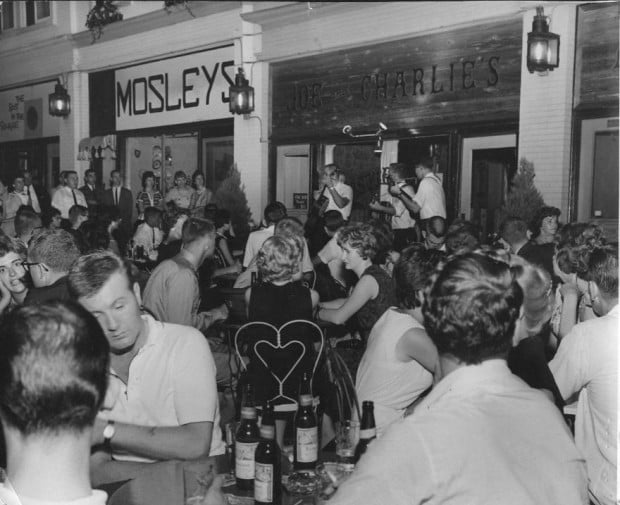
A sidewalk scene on Gaslight Square in summer 1961. That March, the St. Louis Board of Aldermen had caught up with public interest by officially renaming two blocks of Olive Street as Gaslight Square. For a few years, the area was a lively collection of restaurants, taverns, night clubs and coffee houses. Photo by Jim Rackwitz of the Post-Dispatch
Gaslight Square, 1961
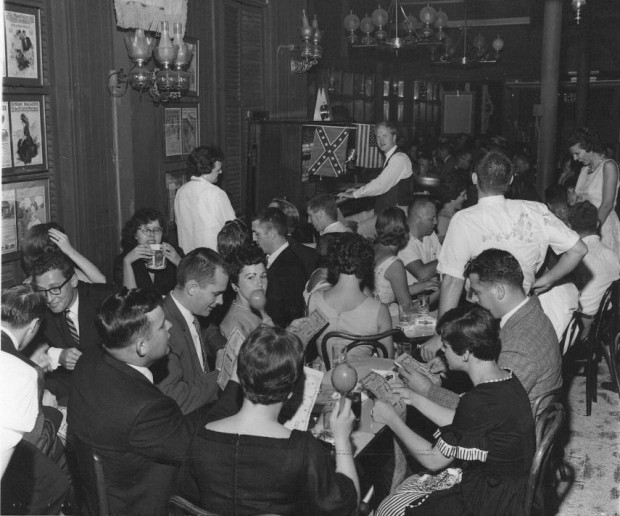
Derby O'Downey at the piano leads a sing-along in the Golden Eagle Saloon, 4263 Gaslight Square (Olive Street), in 1961. He's playing Yankee Doodle. The flags suggest he also took turns playing Dixie. Photo by Jim Rackwitz of the Post-Dispatch
Gaslight Square fire, 1962

A fire heavily damaged the Musical Arts Building on the evening of Jan. 10, 1962, the same night the St. Louis Fire Department fought a major blaze at the Ralston Purina mill just south of downtown. The three-story building, on the southwest corner of Gaslight Square (Olive) and Boyle Avenue, was built in 1904 and was home to several Gaslight Square establishments. It was renovated and rebuilt, but burned again in 1970 and demolished for good in 1971. Photo by Lloyd Spainhower of the Post-Dispatch
Civil Rights protest, 1963

A crowd of black demonstrators sit in the middle of Locust Street during rush hour in St. Louis on June 21, 1963, and protest against what they termed re-segregation in the city's schools. The peaceful demonstration was staged in front of the school board building. Spectators crowded the sidelines to observe the demonstration. (AP Photo/Fred Waters)
East St. Louis bank protests, 1963

East St. Louis police arrest protesters seeking more jobs for African-Americans in the city's banks in the summer of 1963. The protests helped inspire similar actions in St. Louis. Photo by Jack January of the Post-Dispatch
Protestors, 1963

Pickets demonstrate in front of the Westmoreland Place mansion of city school board President Daniel L. Schlafly in August 1963. Local civil rights organizations were upset with Schlafly and the board because they believed they were not moving fast enough to implement the U.S. Supreme Court's full integration decision of 1954.
Jefferson Bank protests, 1963
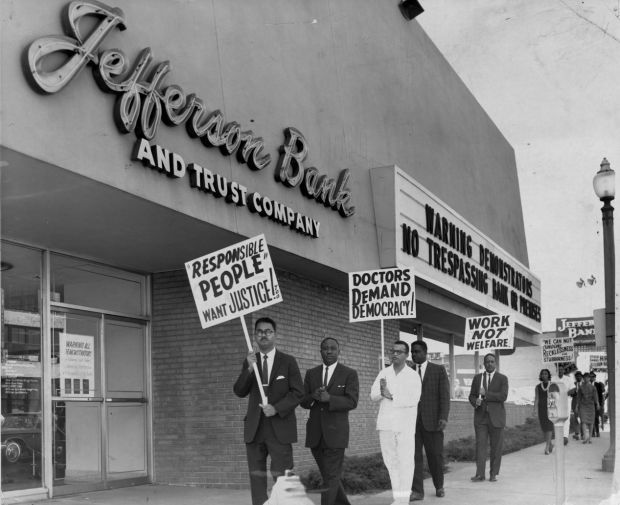
Protesters demonstrate against job discrimination at Jefferson Bank and Trust Co. at Jefferson Avenue and Washington Boulevard on Oct. 10, 1963. That day's demonstration by physicians and business professionals was peaceful and brief, lasting about 40 minutes. The protests at Jefferson Bank persuaded many companies to hire and promote more African-Americans.
Stan Musial retires, 1963

Stan Musial, listening to speakers praise him as player and man, looks down during ceremonies marking his retirement as a player with St. Louis Cards on Sept. 30, 1963. With him are his wife, Lillian, and their daughters Jeannie, left, and Geraldine, right. AP photo
World Series 1964

After the Cardinals defeated the Yankees in Game 7 of the 1964 World Series, fans rush onto the old Busch Stadium field (formerly called Sportsman's Park) to celebrate. Post-Dispatch file photo
JFK mourned in St. Louis

Some of the 30,000 people who marched downtown on Sunday, Nov. 24, 1963, in memory of President John F. Kennedy. The scene is looking eastward from the Old Courthouse toward the legs of the Gateway Arch, in the early stages of construction. Photo by Jim Rackwitz of the Post-Dispatch
August A. Busch Jr. and son toast a beer, 1964

To celebrate production of the ten millionth barrel of beer, August A. Busch Jr. (right) and his son August III share a toast with other officials of the company on Dec. 15, 1964. Post-Dispatch file photo
Cleared riverfront, 1961
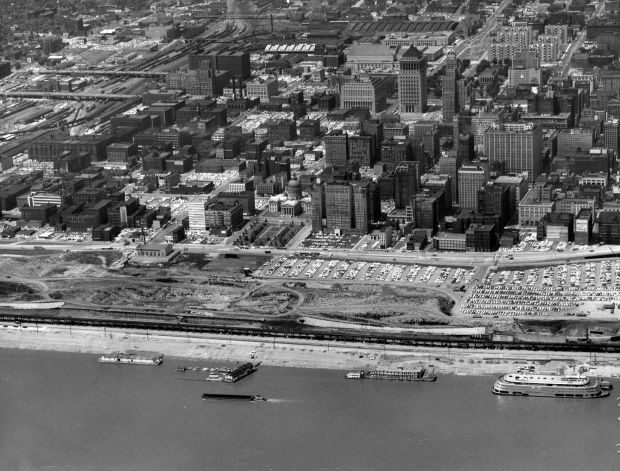
An aerial view of the cleared riverfront and downtown in 1961, before construction began on the Arch. Much of it had been used for downtown parking since the 1940s. Note the old S.S. Admiral excursion steamer, moored at right. Post-Dispatch file photo
A lot going on in St. Louis, 1964

An aerial view of the projects underway in and near downtown St. Louis in March 1964. The two legs of the Arch are rising on the park grounds. The old railroad trestle is gone, replaced by new track in the tunnels and cuts through the park that exist today. In the middle of the Mississippi River, workers have begun sinking piers for the Poplar Street Bridge. At far left is the recently cleared land of the Mill Creek valley, the city's biggest urban-renewal project. The cluster of 33 light-colored buildings beyond downtown is the Pruitt-Igoe public housing project, then only a decade old. Lester Linck of the Post-Dispatch
Gateway Arch construction, 1964

Workers had a spectacular view as the Arch went up, but focused on construction. Here a worker prepares reinforcement rods for hydraulic stretching in September 1964. Photo by Arthur Witman of the Post-Dispatch
St. Louis' Chinatown

The south leg of the Gateway Arch rises in the background in this February 1965 photograph of "Hop Alley," St. Louis' Chinatown. The area was bounded by Market, Seventh, Walnut and Eighth streets, and was demolished for the Civic Center Redevelopment Corp. project that included the first Busch Stadium downtown. Photo by Buel White of the Post-Dispatch
Searchlight city, 1965

Rays from a 30-inch carbon arc searchlight produce more than 400 million candlepower, creating an aurora borealis-like effect above the St. Louis riverfront on March 9, 1965. The St. Louis Army Mobility Equipment Center put on the demonstration. The light, which was placed on the Jefferson National Expansion Memorial grounds just east of Third Street, was powered by a mobile generator and was 100 times more powerful than the searchlights used in World War II. File photo
Arch construction

During Arch construction, two workers in the foreground monitor the round hydraulic-pressure gauges to ensure that two jacks are widening the Arch legs at the same speed. Seated at rear right, with hand to face, is Hans Karl Bandel of Severud & Associates, New York, who led the engineering work on Eero Saarinen's design. In the background is the second Busch Stadium, under construction at the same time. Photo by Arthur Witman of the Post-Dispatch
Gateway Arch comes together

A safety net is stretched beneath the legs as they close to the finish in September 1965. No one fell into the net, and no worker died on the job. Photo by Renyold Ferguson of the Post-Dispatch
Busch Stadium under construction in 1965

Workers install part of the seating areas in Busch Stadium on Oct. 26, 1965, two days before the final piece of the Arch was slipped into place. Post-Dispatch file photo
Gateway Arch Construction 1965

The next-to-last piece of the Arch is moved into place on Oct. 19, 1965. Later, workers with their hydraulic jacks would stretch open the gap to make room for the last one. Post-Dispatch file photo
Gateway Arch construction

The next-to-last piece of the Arch is moved into place on Oct. 19, 1965. Later, workers with their hydraulic jacks would stretch open the gap to make room for the last one. Photo by Jack January of the Post-Dispatch
Busch Stadium, 1966
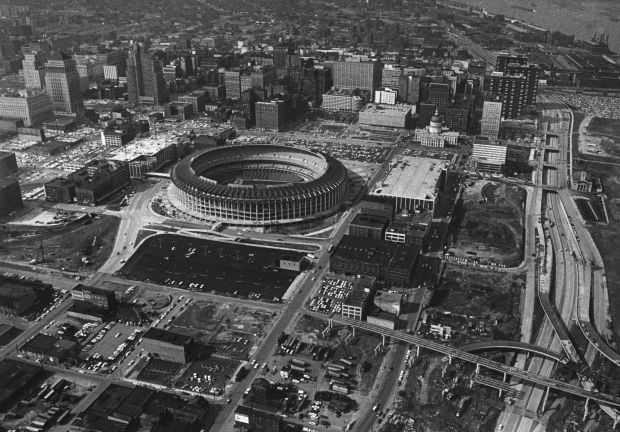
Busch Stadium on May 12, 1966, shortly before the Cardinals played the first game at their new downtown home. The Cardinals beat the Atlanta Braves 4-3 in 12 innings. Work is underway in the foreground for the elevated lanes of Highway 40 and the approaches to the Poplar Street Bridge, which opened the following year. Arthur Witman of the Post-Dispatch
Home plate from old Busch Stadium is flown to Busch II in 1966

The KMOX helicopter arrives at new Busch Stadium on May 8, 1966, with home plate from the old Busch Stadium, formerly Sportsman's Park, in north St. Louis. There were ceremonies at both stadiums for the transfer of the plate. Photo by Edward Burkhardt of the Post-Dispatch
Peering down from the Arch
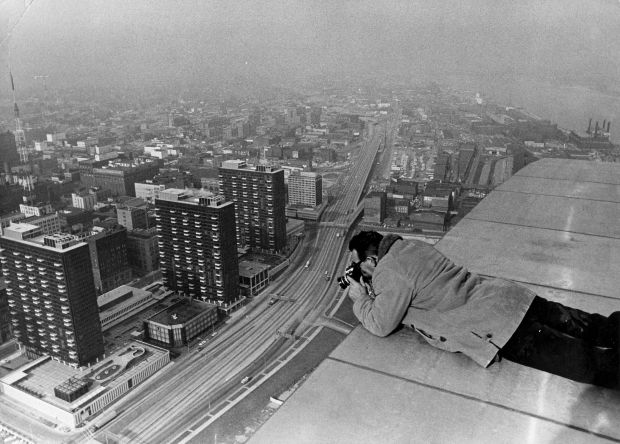
Post-Dispatch photographer Renyold Ferguson, prone on top of the Arch, photographing the city below in February 1967. Ferguson's photo was taken by fellow staff photographer Arthur L. Witman
The Beatles at Busch, 1966

The Beatles perform at Busch Stadium in 1966. Post-Dispatch file photo
TWA air hostesses, 1967

TWA hostess graduating class of July 20, 1967.
Enjoying popcorn, 1968

Children seated on the trunk of a car eating popcorn on June 2, 1968. Photograph by James M. Carrington of the Globe-Democrat. Missouri Historical Society
Supreme Court ruling in housing discrimination case, 1968

Joseph Lee and Barbara Jo Jones, who filed suit in U.S. District Court in September 1965 after a sales agent for Alfred H. Mayer Co., then St. Louis County's largest homebuilder, refused to sell them a lot in the Paddock Woods subdivision because of Joseph Jones's race. They were living on 4585 Carter Avenue in north St. Louis when they toured Paddock Woods, under construction off Parker Road, north of Interstate 270 and Lewis and Clark Boulevard in north St. Louis County. They picked out a four-bedroom model and a lot on Hyde Park Drive, but the agent refused their offer. On June 17, 1968, the U.S. Supreme Court issued a landmark decision in the Jones' favor, ruling that a private seller had no right to refuse to sell because of a prospective buyer's race. The Jones had been married in 1961 in Madison, Ill. He had grown up in Mississippi, she in Kirkwood. He was 33 and she was 31 when they filed suit. At the time, they both worked for the Veterans Administration in St. Louis. Photo by Buel White of the Post-Dispatch
Downtown in 1969

Aerial view of St. Louis riverfront and city looking northwest toward the Gateway Arch on Jan. 25, 1969. Photo by Ted McCrea, Missouri History Museum Photograph and Print Collection
Downtown with USS Inaugural, 1970
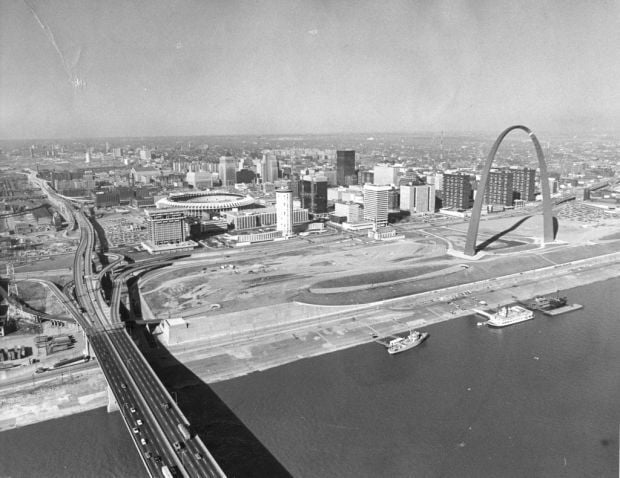
An aerial view of downtown St. Louis in December 1970. The USS Inaugural, an old World War II minesweeper, is the ship at the left. The Inaugural was tied alongside a Burger King barge when the flood crest of Aug. 1, 1993, tore them from their moorings and pushed them into the Poplar Street Bridge, seen in the left foreground. Photo by Renyold Ferguson of the Post-Dispatch
USS Inagural, 1987
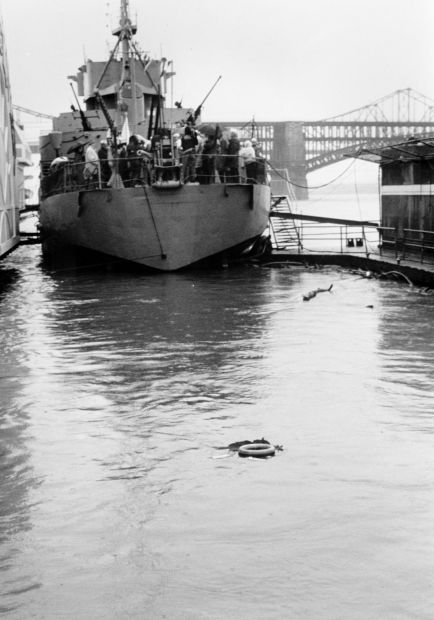
Members of the local chapter of the Pearl Harbor Survivors Association watch a wreath drift from the stern of the USS Inaugural at the riverfront downtown Dec. 7, 1987. The association held its gatherings for several years on the Inaugural, a former minesweeper turned into a tourist attraction. The Inaugural broke free during the Great Flood of 1993, and sank on Sept. 23, 1993, while moored south of the riverfront . Photo by Robert LaRouche of the Post-Dispatch
Pruitt-Igoe housing project comes down, 1972

One of the Pruitt-Igoe buildings being brought down by dynamite implosion on April 29, 1972. The series of demolitions attracted spectators, some of whom took their viewing posts with lawn chairs. Photo by Michael J. Baldridge of the Post-Dispatch
The St. Louis Arena, 1980
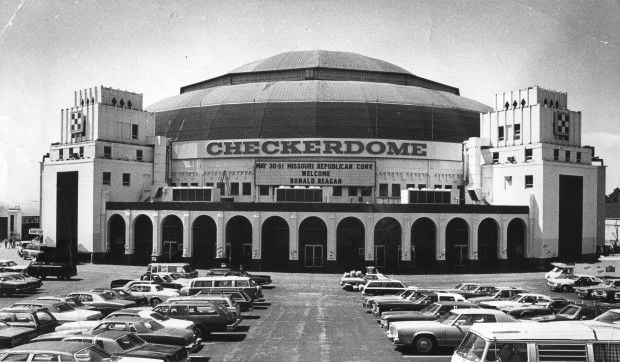
The St. Louis Arena, dubbed the Checkerdome when Ralston Purina bought the building and the St. Louis Blues hockey club in 1977, is shown here during a May 31, 1980, visit by presidential candidate Ronald Reagan. Post-Dispatch file photo.
St. Louis mob wars, 1980

Police investigate the scene of Jimmy Michael's murder by car bombing on Sept. 17, 1980. He had lunch downtown and was driving south on Interstate 55 to his home in Mehlville when a bomb shattered his Chrysler Cordoba just short of the Reavis Barracks Road exit. Michaels was 75 when he was killed. Paul Leisure's gang had set the bomb and detonated it by remote control from a van they used to follow Michael's car. Photo by Kathy Kuper of the Post-Dispatch
St. Louis mob wars, 1980

The wreck of Paul J. Leisure's 1979 Cadillac outside his home at 4908 Nottingham Avenue on the morning of Aug. 11, 1981. Leisure had just sat behind the wheel when the bomb exploded, critically injuring him. Investigators believed it was retaliation for the murder of Jimmy Michaels. From his hospital bed, Leisure vowed to "get them all." Photo by Renyold Ferguson of the Post-Dispatch
Buck and Caray, 1982
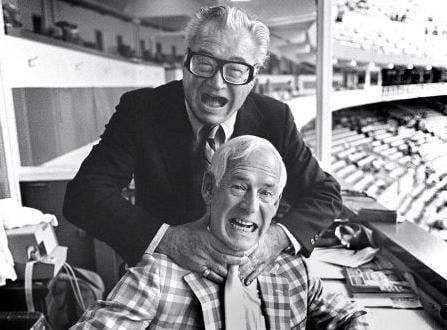
Announcers and old friends Harry Caray (top) and Jack Buck clown around in the KMOX booth at Busch Stadium before a game between the Cardinals and Cubs in 1982.
Deseg program, 1983
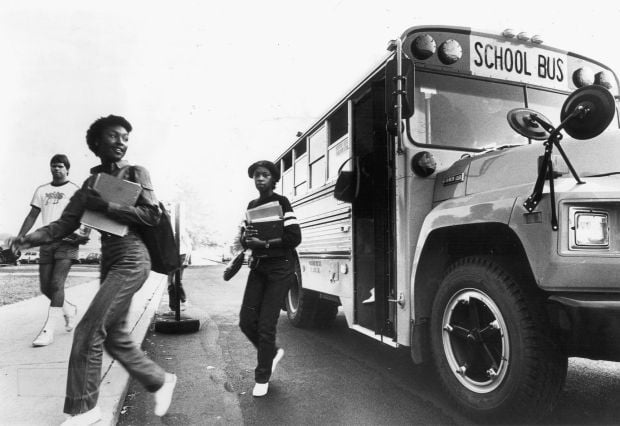
St. Louis students arrive for classes by bus in the August 1983 at the start of court-ordered school desegregation program here.
Ozzie flips, 1985

St. Louis Cardinals shortstop Ozzie Smith does a flip as he takes his position on the field during the 1985 World Series in St. Louis. Smith, regarded as the finest-fielding shortstop ever, was elected to the Hall of Fame on his first try by an overwhelming margin on Jan. 8, 2002. AP Photo/Peter Southwick
Wickenheiser "Monday Night Miracle" goal in 1986
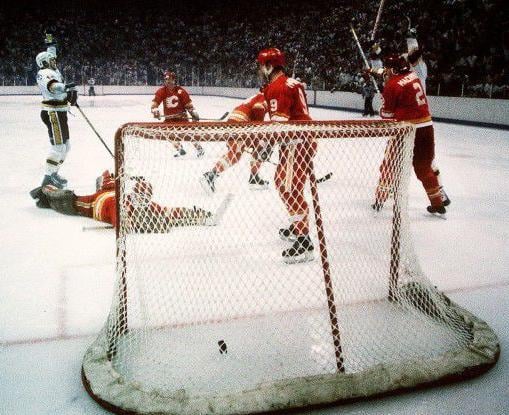
The Blues' Doug Wickenheiser (left) exults after scoring the "Monday Night Miracle" goal against Calgary in overtime of Game 6 of the Campbell Conference finals at the St. Louis Arena on May 12, 1986. Photo by Kevin Manning of the Post-Dispatch
Ted Drewes, 1988

Ted Drewes of frozen custard fame in a 1988 photo.
Chuck Berry honored, 1989

Chuck Berry, the St. Louis native who gave us classic 1950s rock 'n' roll songs such as "Johnny B. Goode" and "Maybelline," is honored with a star on Delmar Boulevard's Walk of Fame in 1989.
Satellite view of St. Louis, 1991

The St. Louis area as seen from space in a 1991 NASA image. See the full-size image here. The Missouri, Mississippi and Illinois rivers, originally runoff from melting glaciers, merge into the fertile bottomland of the great confluence. The city was founded on high land just to the south.
Flood of 1993 flood satellite image
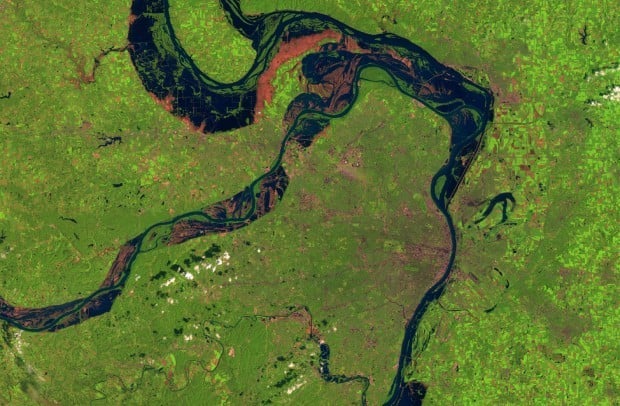
This NASA satellite photo shows swollen rivers in the St. Louis area during the height of the Flood of 1993. See a larger version here.
The Great Flood of 1993

The Mississippi River roars through a levee on Aug. 1, 1993, demolishing a farm near Columbia, Ill. The trees at right reveal part of the crushed farmhouse. Photo by Jim Rackwitz
The Great Flood of 1993

An aerial view shows widespread flooding in an industrial area in Chesterfield Bottoms on August 1, 1993. This photo was taken the morning after the Missouri River burst through the Monarch levee. Photo by Larry Williams
Ted Drewes, 1993

Keith Baizer, vice president of Art Mart, tosses a concrete at Ted Drewes in this 1993 image. Photo by Larry Williams of the Post-Dispatch
Coral Court Motel, 1995
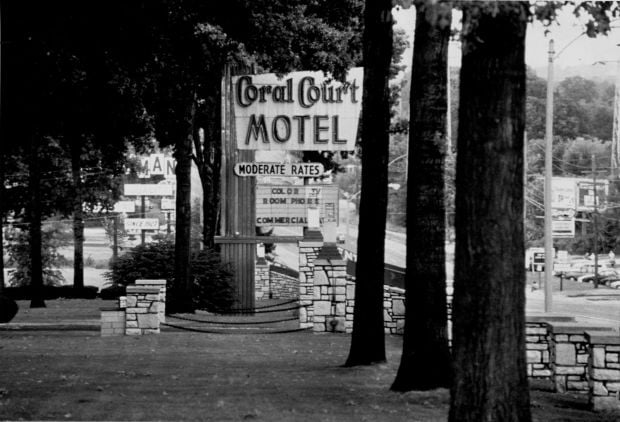
One of the most storied motels along Route 66 was the Coral Court, scene of mystery and afternoon romance, on Watson Road in Marlborough Village. In fall 1953, notorious kidnapper Carl Austin Hall stayed at the motel before his capture. Hall and Bonnie Heady kidnapped and murdered 6-year-old Bobby Greenlease of Kansas City. For years, rumors persisted that the missing ransom money, $300,000, was hidden in the distinctive blocks of the motel cabins. The Coral Court was torn down in 1995.
John Goodman, 1997

Actor John Goodman, a native of Affton, hams it up at the site of his star on the St. Louis Walk of Fame in University City on May 18, 1997. Photo by Ted Dargan of the Post-Dispatch
1998 Brett Hull

Brett Hull puts his arm around goaltender Grant Fuhr after the Blues defeated the Red Wings on May 17, 1998, to force a game 6 in the conference semifinals of the Stanley Cup playoffs. The rest of the Blues were busy in an end-of-game fight, which Hull and Fuhr were watching. Detroit won game 6 to eliminate the Blues on their way to a Stanley Cup. Photo by Kevin Manning of the Post-Dispatch
Super Bowl stop
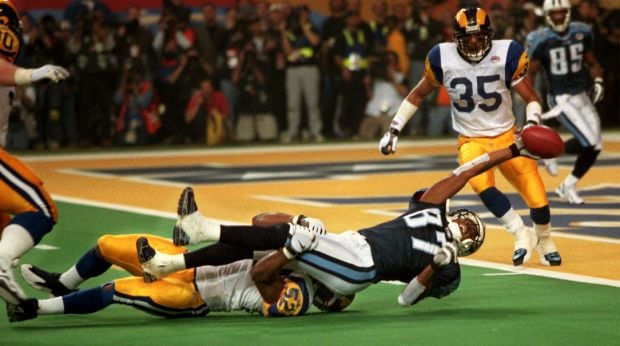
Rams linebacker Mike Jones stops Kevin Dyson's attempt to reach the end zone on the final play of Super Bowl XXXIV between the St. Louis Rams and the Tennessee Titans on Jan. 30, 2000. (Photo by Laurie Skrivan, lskrivan@post-dispatch.com)
The St. Louis Arena, 1999

It took less than 15 seconds and 250 well-timed explosions on Feb. 27, 1999, for the Arena to fold toward the earth in a domino-like motion. After the old barn was reduced to rubble, many thousands cheered. "But you know, when all that smoke cleared away and I saw what was left, I was kind of sad," said Norma Wheelehan of Shrewsbury. "All those years of going to the Arena. Gone." Photo by Jamie Rector of the Post-Dispatch
Pope visits, 1999

More than 100,000 worshipers participated in a Mass with Pope John Paul II at the Trans World Dome on Jan. 27, 1999. The replica of the Arch was 45 feet tall. Photo by Jerry Naunheim Jr. of the Post-Dispatch
Pope visits, 1999

During his visit to St. Louis, Pope John Paul II prays in the Blessed Sacrament Chapel at the St. Louis Cathedral before the evening prayer service on Wednesday, January 27, 1999. Photo by Odell Mitchell Jr. of the Post-Dispatch
A new millennium, 1999
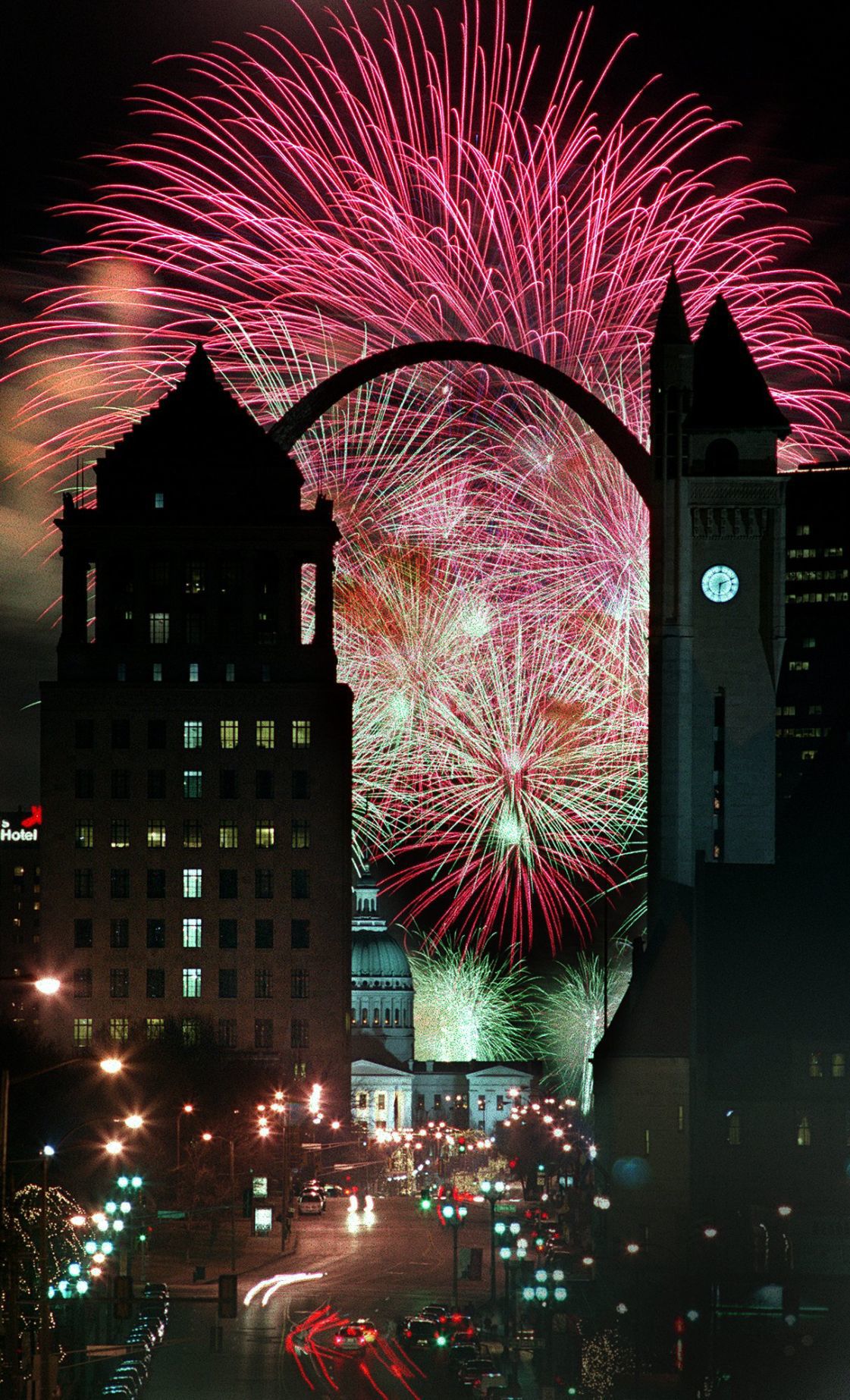
Fireworks, framed by the Arch, the Civil Courts and Old Courthouse buildings on the left and Union Station on the right, signaled the start of the St. Louis First Night celebration on New Year's Eve, Dec. 31, 1999. Photo by Jim Rackwitz of the Post-Dispatch
TWA, 2001

A TWA passenger aircraft lands at Lambert-St. Louis International Airport in St. Louis with an American Airlines passenger plane in the foreground on March 5, 2001. American Airlines took over TWA later that year. Lambert, an important hub at the time, faded in importance after the deal. (AP Photo/James A. Finley)
Praxair, 2005

On June 24, 2005, a fire at Praxair Inc. near Lafayette Square erupted during daytime hours and brought part of St. Louis to a standstill by forcing the closure of Highway 40 and the evacuation of nearby homes and businesses. Photo by Anthony Souffle of the Post-Dispatch
Anheuser-Busch 2008
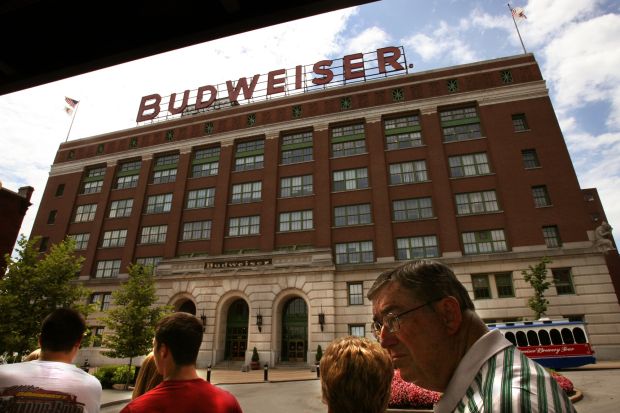
Visitors on the Anheuser-Busch public tour on July 11, 2008. Photo by Robert Cohen, rcohen@post-Dispatch.com
Union Station, 2012
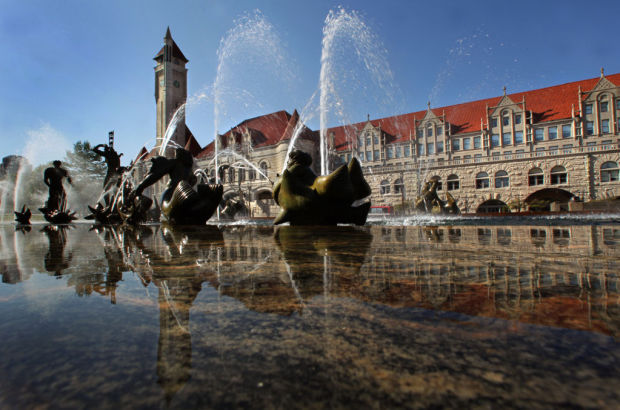
"The Meeting of the Waters," a sculpture by Carl Milles sits across Market Street from Union Station Wednesday June 20, 2012. Photo by Robert Cohen, rcohen@post-dispatch.com
'Little Bosnia,' 2013

Uma Alickovic, owner of Coffee Bolero, brings dinner to patrons on Friday, June 7, 2013. For 11 years, Alickovic has owned the restaurant on Gravois Avenue near the Bevo Mill in the area known as "Little Bosnia." Bosnian immigrants have helped revitalize the area. Photo by Laurie Skrivan, lskrivan@post-dispatch.com
Jon Hamm, sports fan

Actor Jon Hamm reps his St. Louis roots at a 2013 World Series game in Boston and at an outdoor hockey game in Los Angeles in January 2014.
Lighting the Stan Musial Veterans Memorial Bridge

Lights come on over the Stan Musial Veterans Memorial Bridge for the first time following a ceremony on the span on Friday, Feb. 7, 2014. Public events including an early morning 6K run and vintage car crossing will be held Saturday before the bridge officially opens to traffic on Sunday. Photo by Robert Cohen, rcohen@post-dispatch.com
Most Popular

This list was originally published in 2018.


