


The city population grew in leaps during the 19th century, with the surrounding countryside a patchwork of independent towns.
Sprawl was another century away.
From 4,600 residents in 1820, St. Louis blossomed to 160,800 in 1860 and 575,200 in 1900. Unincorporated St. Louis County was home to only 50,000 people when the 20th century began.
Back then, the metro expanse of today was mostly farmland, woods and prairie. Cahokia, founded in 1699 and the area's oldest permanent European village, remained small. The few other colonial-era settlements included St. Charles and Florissant. Places like Ballwin and Des Peres were country crossroads.
People are also reading…
Edwardsville created its first town government in 1819 and was named after an early resident, Ninian Edwards, first governor of the Illinois territory. Clayton was farmland until after St. Louis city and county were formally separated in 1877.
Railroad-building during the mid-19th century inspired whistle stops such as Kirkwood on the Pacific Railroad and Ferguson on the North Missouri (later Wabash) Railroad. The towns of O'Fallon in Missouri and Illinois were named after John O'Fallon, an early St. Louis railroad baron whose estate in St. Louis became O'Fallon Park.
Here are stories of a few of the earliest communities, with apologies to the rest:
Belleville

A bird's eye view of Belleville in 1859. The town, established in 1814, had more than 7,000 residents by 1860, mainly because of immigration from Germany.
Belleville, the German town with the French name ("beautiful city"), was founded in 1814 by American transplants who wanted to move the St. Clair County seat from the flooding and French ways of Cahokia. George Blair donated a lot for the town square.
Belleville was small until German immigration grew quickly after the 1848 European revolutions. By 1860, two-thirds of the city's 7,500 residents were of German origin. Early discovery of coal deposits fueled industry in Belleville and St. Louis.
East St. Louis
East St. Louis began in 1797 as the landing for James Piggott's ferry across the Mississippi River to St. Louis.
Known as Illinois Town until 1861, it became a booming railroad junction and industrial center after completion of the Eads Bridge in 1874.
Its flat expanse near coal mines attracted smoky factories and clusters of humble housing for workers.
Then as now, it was a hardscrabble place.
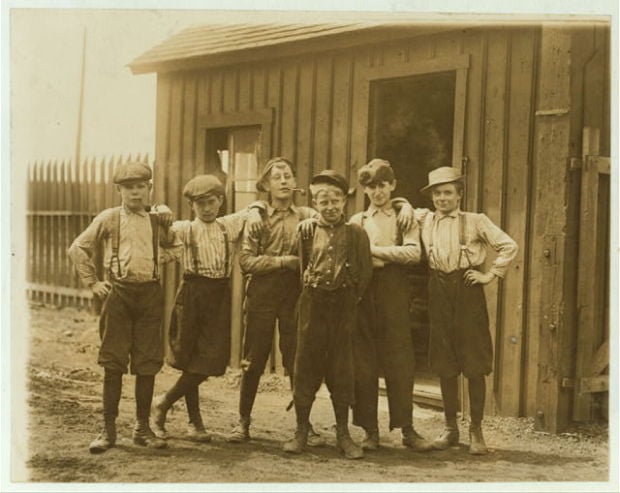
Boys who worked at Obear-Nestor Glass Co. in East St. Louis in a 1910 photograph by Lewis Hines, who was documenting child labor across the United States.
Alton
Alton was established in 1818 by Rufus Easton, the first St. Louis postmaster, who named it after one of his sons.
It soon prospered from the river trade, growing to 3,000 residents by 1830. It was the site of the first Illinois Penitentiary in 1833, the murder of abolitionist editor Elijah Lovejoy during a riot in 1837 and one of the Lincoln-Douglas debates in 1858.
After the Civil War, Alton grew as a regional industrial center.
St. Charles

Main Street in St. Charles in the late 1870s. Louis Blanchette founded the town in 1769.
St. Charles was founded about 1769 by fur-trader Louis Blanchette, namesake of the Interstate 70 bridges over the Missouri River.
The Spanish called the village church San Carlos, which the Americans translated to St. Charles.
It was Missouri's capital from 1821 to 1826 while construction was underway in Jefferson City. St. Charles, population 1,200 in 1840, prospered as a ferry point across the Missouri between the St. Charles (Rock) Road to St. Louis and Boone's Lick Trail to the west.
A railroad bridge was completed in 1871, three years before the Eads Bridge in St. Louis.
Fenton
Fenton, settled in 1818, became a ferry landing on the Meramec River linking Gravois Road to points west.
A covered toll bridge was built in 1858. Founder William Long laid out 80 parcels for development, but Fenton had only 160 residents in 1900.
Herculaneum

A drawing of Herculaneum on the Mississippi River in 1817, with one of the shot towers on the bluff. The sketch was used on a $20 note issued by the Bank of St. Louis. Moses Austin was a major investor in the bank.
Herculaneum, on Joachim Creek, was settled in 1808 by lead-smelting operators, including Moses Austin, to ship refined metal on the Mississippi River.
It soon included three stone shot towers, which made bullets by dropping beads of molten lead into water.
It was the first seat of Jefferson County, ceding that distinction to Hillsboro in 1839. The St. Joseph Lead Co. built a smelter in Herculaneum in 1890.
Austin's son, Stephen Austin, was a founder of Texas.


