
On Oct. 5, 1918, the city health department issued this warning: “Avoid persons with colds.”
Dr. Max C. Starkloff, health commissioner, knew that wasn’t nearly enough. Two days later, with Mayor Henry Kiel’s strong backing, he issued an emergency order closing schools, theaters, pool halls, playgrounds and other public places. Starkloff quickly added churches and taverns, and restricted attendance at funerals. Streetcars were limited to seated passengers.
The strategy was known as “social distancing,” and the motive was to fight the Spanish flu that was sweeping the world. The misnamed influenza would kill many more people than the ghastly meat-grinder known as the Great War.

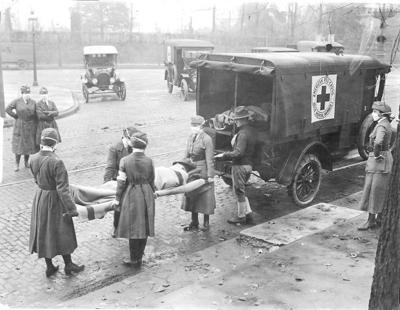
Members of the Red Cross Motor Ambulance Corps in St. Louis transport influenza patients from a house at Etzel and Page avenues. The Spanish Flu epidemic killed 1,703 in St. Louis in fall and winter 1918-19, but the city's draconian order closing schools, churches and many other public places helped to make the local death rate the lowest among the nation's largest cities.
The order was extreme, but it worked — St. Louis’ death rate was the lowest among major American cities.
On the day Starkloff and Kiel announced the order, two soldiers died of the virus at Jefferson Barracks, the likely origin of the local outbreak. Six more died there the next day, and eight civilians died at St. Louis City Hospital. In two days, the number of local cases doubled to 1,150 patients.
People are also reading…
Most survived, but some died within a day of infection. It was especially hard on young adults, whose robust immune systems could go into deadly overdrive.
Among the victims was U.S. Rep. Jacob Meeker, who married his secretary, Alice Redmon, in Jewish Hospital, seven hours before he died Oct. 16. Meeker had toured Jefferson Barracks six days before.
The disease got its name because of high death rates in Spain, but it probably originated at Fort Riley, Kan., and hitched to Europe with the doughboys to the Western Front. It ravaged its way through the trenches. With all the killing already underway, the epidemic wasn’t noticed soon enough.
Kiel and Starkloff enforced their quarantine with vigor. Police arrested defiant barkeeps. Colleges and high schools canceled football games. Judges told officers not to arrest people on “trivial” matters, lest sick people infect others in holdover cells.
On Oct. 20, 1918, Starkloff ordered a restriction of business hours from 9:30 a.m. to 4:30 p.m. for downtown. This included retail stores and saloons.
Business owners howled to City Hall, but city welfare director John Schmoll said, “It is a case of get the dollars and lose lives or save the lives and lose the dollars.” Kiel said he backed Starkloff because, “I do not want a single soul to die.”
In Europe, the war was surging to an exhausted conclusion. On Nov. 9, Starkloff expanded the list of closings. But two days later — Armistice Day — people poured into the streets in jubilation.
The city allowed schools to reopen a few days later and lifted the quarantine Nov. 18. But cases rebounded, and Starkloff again closed schools and banned gatherings such as dances and banquets. The epidemic peaked here Dec. 10, with 60 deaths from flu, then began losing its fury. In the first week of January 1919, the death total was 16.
In the last three months of 1918, flu and flu-related pneumonia killed almost 3,000 St. Louisans. The city’s death rate was the lowest among the nation’s 10 largest cities. It was less than half the rates in Pittsburgh and Philadelphia.
East St. Louis, which followed St. Louis’ example, recorded 342 deaths. Belleville, which didn’t, had one of the highest rates in Illinois.
The pandemic probably killed about 670,000 people in the United States. Worldwide, estimates have ranged from 20 million to 40 million. The butcher’s bill for World War I was 8.5 million.
St. Louis held down the death toll of the world's worst pandemic by closing public places, including churches and schools, and prohibiting dances and banquets.
Look Back: 1918 Spanish Flu epidemic
Members of the Red Cross Motor Ambulance Corps in St. Louis transport influenza patients from a house at Etzel and Page avenues. The Spanish Flu epidemic killed 1,703 in St. Louis in fall and winter 1918-19, but the city's draconian order closing schools, churches and many other public places helped to make the local death rate the lowest among the nation's largest cities.

U.S. Rep. Jacob Meeker, who died Oct. 16, 1918, of Spanish Flu in Jewish Hospital. He had toured Jefferson Barracks the week before and probably contracted it there. Seven hours before he died, he married his secretary, Alice Redmon, in the hospital. Meeker, a Republican, represented part of St. Louis. (Post-Dispatch)

St. Mary's Infirmary, at 1536 Papin Street, one of more than 50 hospitals in St. Louis at the time of the Spanish Flu epidemic. Among patients who died there of the flu were Clara Breunig of 2585 Hebert Street, her son Edward, 5, and her daughter, Dolores, 4. They died within three days of each other in December, 1918, and were buried in Hermann, Mo. The hospital, built in 1877 and a predecessor to St. Mary's Health Center in Richmond Heights, closed in 1966 and later was a state prison honor center. Long vacant, it is partially collapsed. (Post-Dispatch)

At left is Barnes Hospital, Kingshighway and Euclid Avenue, in 1921. Among the patients who died there of Spanish Flu was Dr. Roscoe Healy, 24, who contracted it while treating patients as a staff doctor. He died Dec. 7, 1918. The building at rear right was the Washington University School of Medicine. That building and some of the hospital remain as parts of the Washington University Medical Center. (Post-Dispatch)
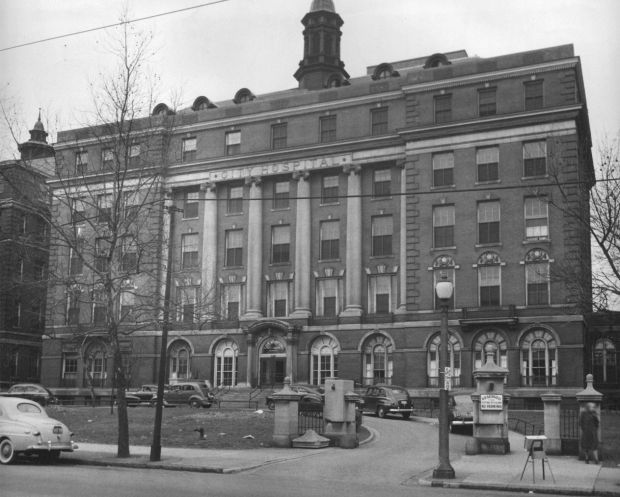
St. Louis City Hospital, 1515 Lafayette Avenue, circa 1940. The hospital cared for many patients during the Spanish Flu epidemic in 1918-19. The hospital, built in 1907 to replace one that was destroyed in the 1896 tornado. The city closed it in 1985, and has been converted into condos. (Post-Dispatch)

Members of the Red Cross Motor Ambulance Corps prepare to deliver broth and food to influenza patients in St. Louis during the Spanish Flu epidemic of 1918-19.
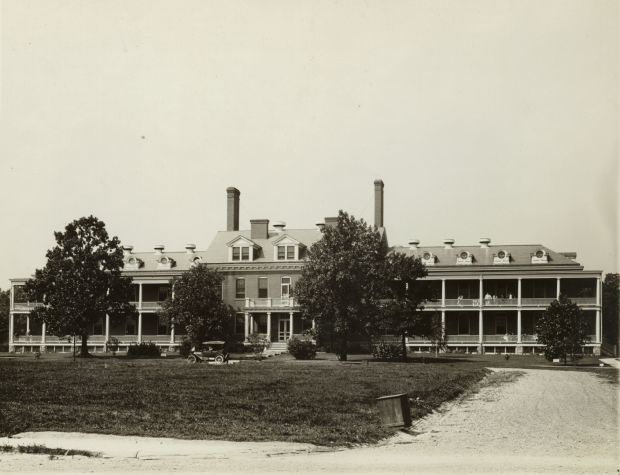
The hospital at Jefferson Barracks in south St. Louis County around the time of World War I. American soldiers spread the Spanish Flu to Europe, and the barracks was the likely source of the outbreak in St. Louis. On the day Dr. Max Starkloff, city health commissioner, ordered the closing of schools and most public places, two soldiers died at the base hospital.
(Missouri History Museum)

Alice Redmon, who married U.S. Rep. Jacob Meeker in Jewish Hospital on Oct. 16, 1918, the day he died of Spanish Flu. Redmon, a widow, was his secretary. She formerly had been secretary of the Republican City Central committee. (Post-Dispatch)

Ida Britton and Grace Semple, both members of the Red Cross Motor Ambulance Corps in St. Louis, wear masks while caring for influenza patients during the Spanish Flu epidemic.
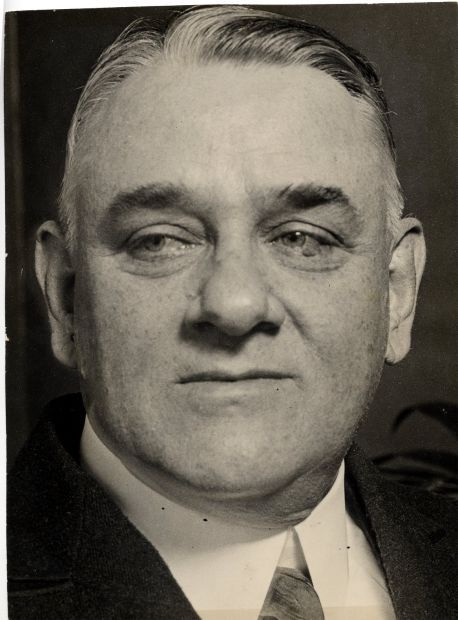
Mayor Henry Kiel, who served in office from 1913 to 1925, backed Dr. Max Starkloff in the draconian order closing many public places during the Spanish Flu epidemic. Kiel said many businessmen lobbied hard to loosen the order, but he stuck with the health commissioner. (Post-Dispatch)

Dr. Max Starkloff, city health commissioner for 30 years. On Oct. 7, 1918, Starkloff ordered and enforced the closing of schools, churches, taverns, pool halls and other public places to reduce the spread of Spanish Flu, a deadly influenza that killed many more people worldwide than did World War I. His effort is credited with keeping the St. Louis death rate the lowest among major American cities. (Post-Dispatch)
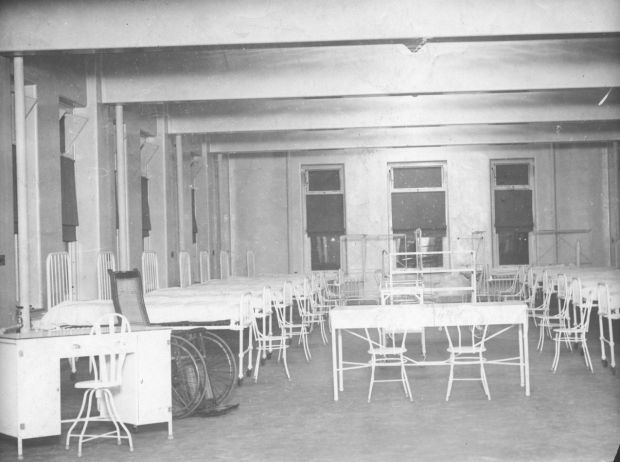
A ward in Barnes Hospital in 1914, the year the hospital opened. Information on the photograph describes the scene as "one of the spacious and brilliantly lighted medical wards" at the new hospital. (Post-Dispatch)