
Travel was easy when Trans World Airlines was the big bird in town.
The airline made St. Louis Lambert International Airport hum during the late 20th century, when St. Louis was its main domestic “hub” — a central site for numerous connecting flights. In 2000, TWA accounted for two-thirds of Lambert’s 600 daily departures and 75 percent of that year’s 15.2 million boardings.
Just more than half of those passengers simply changed planes here, but TWA’s network gave St. Louis a wealth of direct destinations. It made Lambert the nation’s 10th busiest airport.
Chronic flight delays during bad weather led to the construction of an additional runway in Bridgeton, a move that provoked bitter opposition in the bulldozed neighborhoods. Before work was completed, the bottom fell out of the local airline business.
People are also reading…
After three bankruptcies, TWA was absorbed in 2001 by rival American Airlines, which already had hubs in Chicago and Dallas-Fort Worth. Predictably, American slashed flights to Lambert. The $1.1 billion runway was finished in 2006, allowing Lambert to handle dual flight approaches in bad weather. But boardings were down by half since 2000.
In 2014, the airport logged 220 average daily departures. Southwest Airlines now has half of Lambert’s boardings, American 15 percent. Lambert was 31st on the busy-airport list. (In March 2026, U.S. Department of Transportation statistics had Lambert at 34th on the list, based on departures. The airport had 20 carriers. Southwest's share of passengers was at 65%, with American at 9%.)
Air travel got its start here on May 17, 1836, when “celebrated aeronaut” Richard Clayton lifted from Fourth and Market streets in a gas-filled balloon. The St. Louis Commercial Bulletin said the streets were filled with people “anxious to see the intrepid Clayton take his leave and know his fate.”
He landed six miles south near the village of Carondelet.
With the arrival of flying machines, aviators created a short-lived flying field at Kinloch Park, a former racetrack just north of today’s Lambert — where Theodore Roosevelt became the first former president to ride on an airplane in 1910. The Army Signal Corps established Scott Field in Illinois in 1917 to train military pilots. Forest Park’s Aviation Field, which endures as a sports complex, briefly hosted air-mail service to Chicago in 1920-21.
Maj. Albert Bond Lambert, maker of Listerine and St. Louis’ premier aviation promoter, led the creation of a new air strip in 1920 called the St. Louis Flying Field. Soon renamed in his honor, Lambert sold it to the city eight years later. City voters adopted a $2 million bond issue to pave a runway and build a two-story terminal.
In 1930, Transcontinental & Western Air, forerunner of TWA, inaugurated coast-to-coast all-air travel on Ford Tri-Motor airplanes. Lambert Field was a daily stop for the 38-hour flight, which included an overnight in Kansas City.
In the 1940s, the city seriously considered building a new airport on the Columbia Bottoms in far North County, near the confluence of the Mississippi and Missouri rivers. Airline executives objected, fearing floods. In 1970, Illinois Gov. Richard Ogilvie proposed building one in the Metro East, and soon recommended a site between Columbia and Waterloo.
Most Missouri officials fought the idea, but St. Louis Mayor Alfonso J. Cervantes endorsed it to protect downtown as “the center of the metropolitan area.” In 1977, President Jimmy Carter scrubbed it at the urging of Monroe County farmers and the Missouri congressional delegation.
Illinois finally built its own, MidAmerica Airport, which opened next to Scott Air Force Base, in 1997. It has struggled ever since to attract service, and houses one commercial airline, Allegiant.
Other big events in St. Louis aviation
1910: Tom Baldwin flies beneath the Eads and McKinley bridges.
1912: Albert Berry parachutes from 1,500 feet over Jefferson Barracks, the first jump ever from an airplane.
1929: Dale Jackson and Forest O'Brine stay aloft over the city for 17½ hours, setting an endurance record that lasted for one year.
1943: Mayor William Dee Becker and nine others were killed in the crash of a St. Louis-built Army glider at Lambert Field during a demonstration flight.
1956: Lambert's new main terminal, designed by Minoru Yamasaki, opens. The three arched sections later were expanded with a fourth.
1973: An Ozark Air Lines turbo-prop plane crashes on approach during a storm, killing 38. Six survive Lambert's deadliest accident.
1986: TWA buys Ozark, a longtime regional carrier with distinctive swallow-tail logos on green-and-white airplanes.
2009: The last F-15 Eagles of the Missouri Air National Guard depart for other bases, ending a military aviation presence that began in 1923.
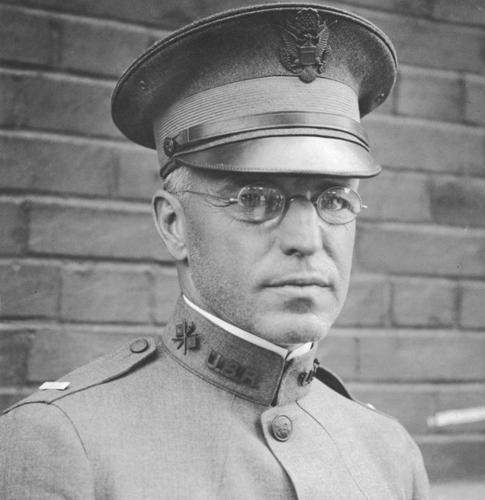
ALBERT BOND LAMBERT

Maj. Albert Bond Lambert, early aviation leader in St. Louis and namesake of Lambert-St. Louis International Airport. Post-Dispatch file photo
Albert Bond Lambert's family made Listerine mouthwash. His passion was aviation.
Lambert helped create the St. Louis Aero Club in 1907. He taught Army balloon cadets during World War I at a field near South Grand Boulevard and Meramec Street.
In 1920, he led a group in establishing the St. Louis Flying Field in north St. Louis County. The airport soon was named after him, and he sold it to the city in 1928, shortly after he got out of the mouthwash business.
Lambert also served on the St. Louis Police Board from 1933 to 1941, including four years as its president.
Until his death in 1946, he lobbied hard for the region to expand Lambert and buy land for a second airport.
CHARLES A. LINDBERGH
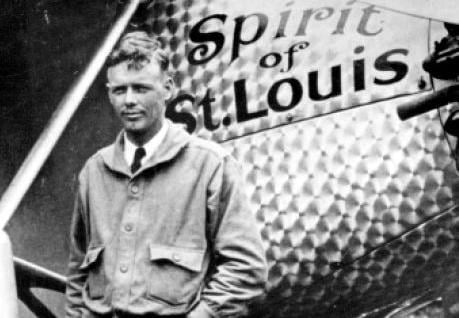
Charles A. Lindbergh with his Ryan monoplane, the Spirit of St. Louis, which he flew non-stop from New York to Paris in 1927. The achievement made him an international hero. Before his flight, he had been an air-mail pilot based at Lambert Field. Post-Dispatch file photo
Charles Lindbergh grew up in Minnesota and was an Army pilot before he began flying mail between Lambert Field and Chicago in 1926.
He bet his $2,000 savings and attracted local backers, including Albert Bond Lambert, to buy an airplane dubbed the Spirit of St. Louis. He sought the Orteig Prize, offered for the first nonstop flight from New York to Paris.
He did it on May 20-21, 1927. Returning to St. Louis a hero, he was greeted by 12,000 people at Lambert and was hailed with a ticker-tape parade downtown. Another 100,000 admirers jammed Art Hill to hear him speak.
His airplane is at the Smithsonian Air and Space Museum in Washington. A replica is at the Missouri History Museum in Forest Park.
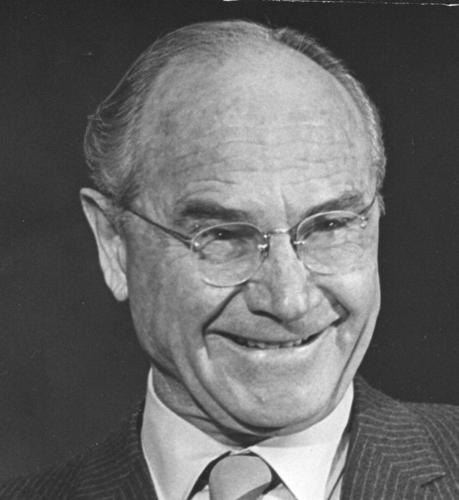
JAMES S. McDONNELL

James S. McDonnell, founder of McDonnell Aircraft Corp. in St. Louis, maker of military jets and spacecraft. Post-Dispatch file photo
James McDonnell grew up in Little Rock and earned a master's degree in aeronautical engineering from MIT. In 1939, he founded his own company at Lambert Field with 12 employees.
In 1946, the firm delivered the Phantom fighter, the first jet to fly from an American aircraft carrier. The company grew quickly with more successful designs, especially its Phantom II, a rugged fighter-bomber. McDonnell made 5,057 of them.
The company also built the Mercury and Gemini space capsules and F-15 and F/A-18 military jets. At its busiest, 40,000 people worked there.
McDonnell Aircraft bought Douglas Aircraft Corp. in 1967. James McDonnell died in 1980. Boeing bought the company in 1997.
Gallery: A fly-by look at St. Louis' aviation history

Andrew Drew, a pilot and the first aviation editor of the Post-Dispatch, prepares for takeoff from Kinloch Flying Field in 1912. Drew died in an aviation accident in Ohio one year later. Post-Dispatch file photo

Former president Theodore Roosevelt with pilot Archibald Hoxsey at Kinloch Flying Field on Oct. 11, 1910. Roosevelt was visiting an aviation show, and accepted a ride. He was the first former president to fly. Post-Dispatch file photo

The St. Louis Flying Field in north St. Louis County in 1923. Albert Bond Lambert, local aviation enthusiast, helped establish the field in 1920 and soon became its namesake. Lambert sold the field to St. Louis in 1928, and the site grew to become Lambert-St. Louis International Airport. Post-Dispatch file photo
Maj. Albert Bond Lambert, early aviation leader in St. Louis and namesake of Lambert-St. Louis International Airport. Post-Dispatch file photo
Charles A. Lindbergh with his Ryan monoplane, the Spirit of St. Louis, which he flew non-stop from New York to Paris in 1927. The achievement made him an international hero. Before his flight, he had been an air-mail pilot based at Lambert Field. Post-Dispatch file photo
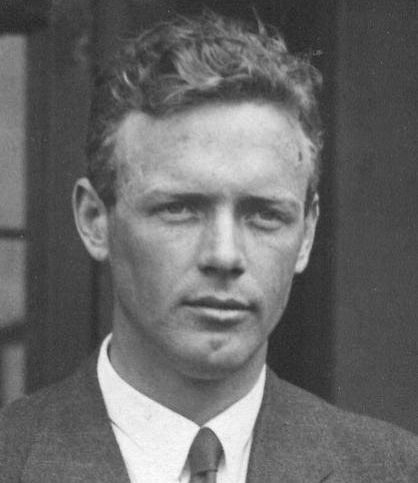
Charles A. Lindbergh, an air-mail pilot in St. Louis, flew the "Spirit of St. Louis" non-stop from New York to Paris in 1927. Post-Dispatch file photo

Thousands of St. Louisans turned out to applaud Charles Lindbergh with a ticker-tape parade on June 18, 1927, after he returned in glory from his historic non-stop flight from New York to Paris. In some parts of downtown, the crowd was reported to have been 20 people deep. St. Louis Public Library photo

Charles Lindbergh speaks to a crowd that filled Art Hill on June 19, 1927, one of the mass events welcoming Lindbergh back to St. Louis after his historic non-stop flight from New York to Paris. Post-Dispatch file photo

Charles Lindbergh in his Spirit of St. Louis plane performed for 27 minutes over the riverfront on Feb. 14, 1928. A crowd of 60,000 watched Lindbergh circle and dip. Newspaper accounts said Lindbergh flew low but that he did not fly under the Eads Bridge, something that many of the children insisted he did. Lindbergh flew here from Havana, Cuba. Post-Dispatch file photo

Pilot Charlie Fowler flies through downtown past the Railway Exchange Building in 1928. Atop the plane is his wing-walking wife, Marie Meyer. Post-Dispatch file photo

A dirigible hangar at Scott Field in October 1928. The Army air station was home to dirigibles and blimps in the years before World War II. The Army established Scott in 1917. Known today as Scott Air Force Base, it is the third oldest continuously operating Air Force flying field. Post-Dispatch file photo
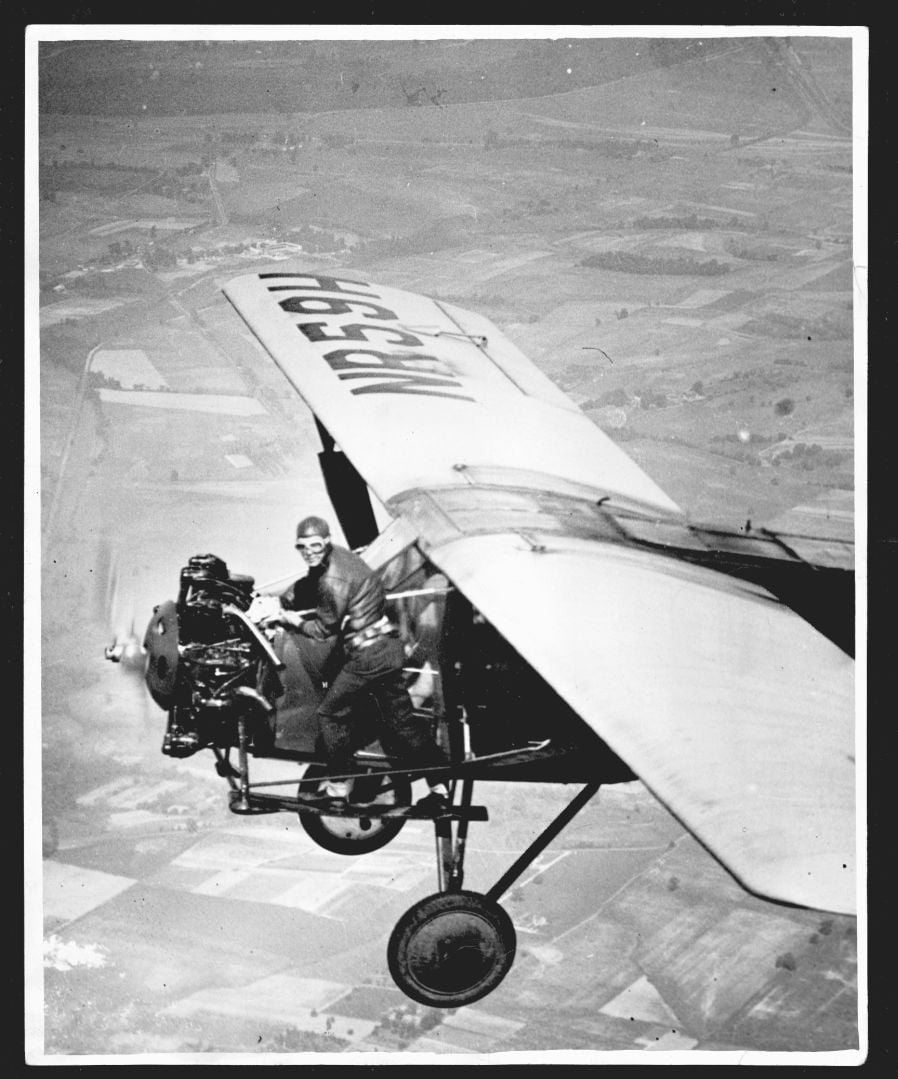
Forest O'Brine, one of two pilots of the St. Louis Robin, services the engine while standing on a narrow catwalk during their 17½-day endurance flight in July 1929. O'Brine and fellow pilot Dale Jackson held the record for one year. The flight was intended to demonstrate the reliability of the St. Louis-built airplane — and make the kind of aviation headlines that people couldn't get enough of in the years between the world wars. Post-Dispatch file photo

Lambert Field in 1930. The city bought the airport from its founder, Albert Bond Lambert, in 1928 and paved the runway and made other improvements, including eventual construction of a two-story terminal building. Post-Dispatch file photo

The hangar of the Missouri Air National Guard at Lambert Field in 1932. Charles A. Lindbergh was a member of the unit during the 1920s. Post-Dispatch file photo

A Transcontinental & Western Air (TWA) airliner, a Ford Tri-Motor, is parked in front of the Lambert Field terminal at the building's grand opening in June 1933. The airline, originally called Transcontinental Air Transport (TAT), became known as Trans World Airlines in 1950. Post-Dispatch file photo

A Chicago & Southern Airlines plane skidded onto its nose during an attempted takeoff in June 1938 at Lambert Field. Many airlines were founded with names that were similar to the railroads that customers were more familiar with. Post-Dispatch file photo

St. Louis Mayor William Dee Becker (on right side, furthest from camera) just before a demonstration flight Aug. 1, 1943, of an Army glider built by Robertson Aircraft Co. at Lambert Field. It crashed when a wing collapsed, killing all 10 aboard. The others are, from left, city officials Charles Cunningham and Max Doyne; Lt. Col. Paul Hazelton; Chamber of Commerce president Thomas Dysart; Maj. William Robertson, glider company president and co-founder of Lambert Field; company chief engineer Harold Krueger and Judge Henry Mueller. Also killed were pilot Capt. Milton Klugh and mechanic Jack Davis. Photo by Buel White of the Post-Dispatch

An Army C-47 transport plane (right) pulls the doomed Robertson glider from the runway at Lambert on Aug. 1, 1943. Photo by Buel White of the Post-Dispatch

The glider, its right wing ripped away in flight, plunges to the ground at Lambert Field on Aug. 1, 1943. Mayor William Dee Becker and all nine others on the glider were killed. An Army investigation traced the accident to low-quality metal used in fittings that held the wings to the fuselage. Photo by Buel White of the Post-Dispatch

Workers pour concrete for a new terminal at Lambert Airport in July 1954. The terminal had three sections of the arch design and opened two years later, replacing one that had been built in 1933. The airport expanded the new main terminal in 1966 with a fourth arched section. Post-Dispatch file photo

Missouri Air National Guard ground-crew members work on the unit's F-84 Thunderstreaks at Lambert Airport in October 1961 to prepare for a deployment in Europe. The guard unit, formed in 1923, also flew P-51 Mustangs, F-100s Super Sabres, F-4 Phantom IIs and F-15 Eagles from Lambert until its last aircraft were moved to other air bases in 2009. Photo by Lester Linck of the Post-Dispatch
James S. McDonnell, founder of McDonnell Aircraft Corp. in St. Louis, maker of military jets and spacecraft. Post-Dispatch file photo

The hijacking of a plane in June 1972 took an especially bizarre turn when an angry citizen rammed the hijacked American Airlines Boeing 727 with his car as the jet sat at Lambert Airport. The wreck of the Cadillac Eldorado sits beneath a wing of the plane in this photo. The driver, David Hanley of Florissant, survived. The hijacker, Martin McNally of suburban Detroit, swapped planes and later bailed out of the new jet over Indiana after ordering the pilots to lower the rear staircase in flight. He was arrested and sent to federal prison. Associated Press file photo

An Ozark Airlines jet with the company's swallows logo on the rudder at Lambert-St. Louis International Airport after TWA bought St. Louis-based Ozark in 1986. Photo byRobert LaRouche of the Post-Dispatch

F-15 Eagles of the Missouri Air National Guard at its base at Lambert-St. Louis International Airport in 2003. A nationwide realignment of military forces moved the jets to other bases, and the last of them flew out in 2009. The F-15s were built across the runways at McDonnell Douglas Corp., which became part of Boeing Co. Photo by Huy Mach, hmach@post-dispatch.com
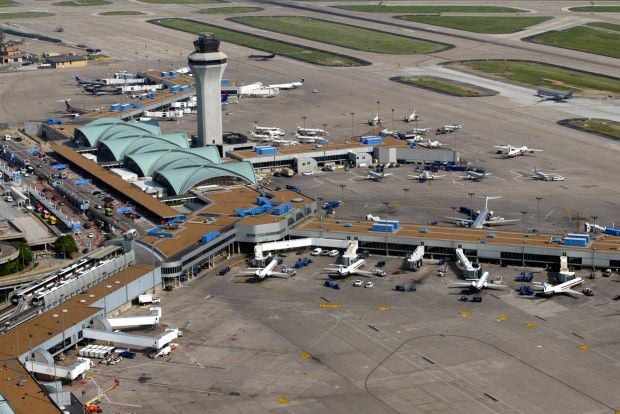
Lambert-St. Louis International Airport. File photo from 2004 by Jerry Naunheim Jr. of the Post-Dispatch

A ground crewman talks with the pilots of a KC-135 military refueling plane at Scott Air Force Base in April 2005. The tankers are part of the Illinois Air National Guard. Photo by Odell Mitchell Jr. of the Post-Dispatch

An American Airlines jet prepares to make the first landing on Lambert-St. Louis International Airport's new runway on April 13, 2006. Photo by David Carson, dcarson@post-dispatch.com

Weeds grow in the parking lot near the terminal at MidAmerica Airport near Mascoutah in July 2013. The airport next to Scott Air Force Base opened in 1997 at a cost of $313 million, but has been unable to attract significant airline service. Photo by Chris Lee, clee@post-dispatch.com