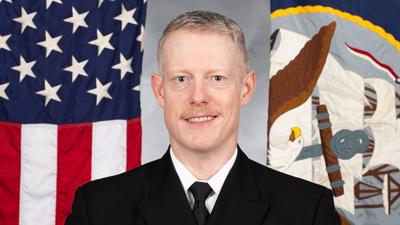

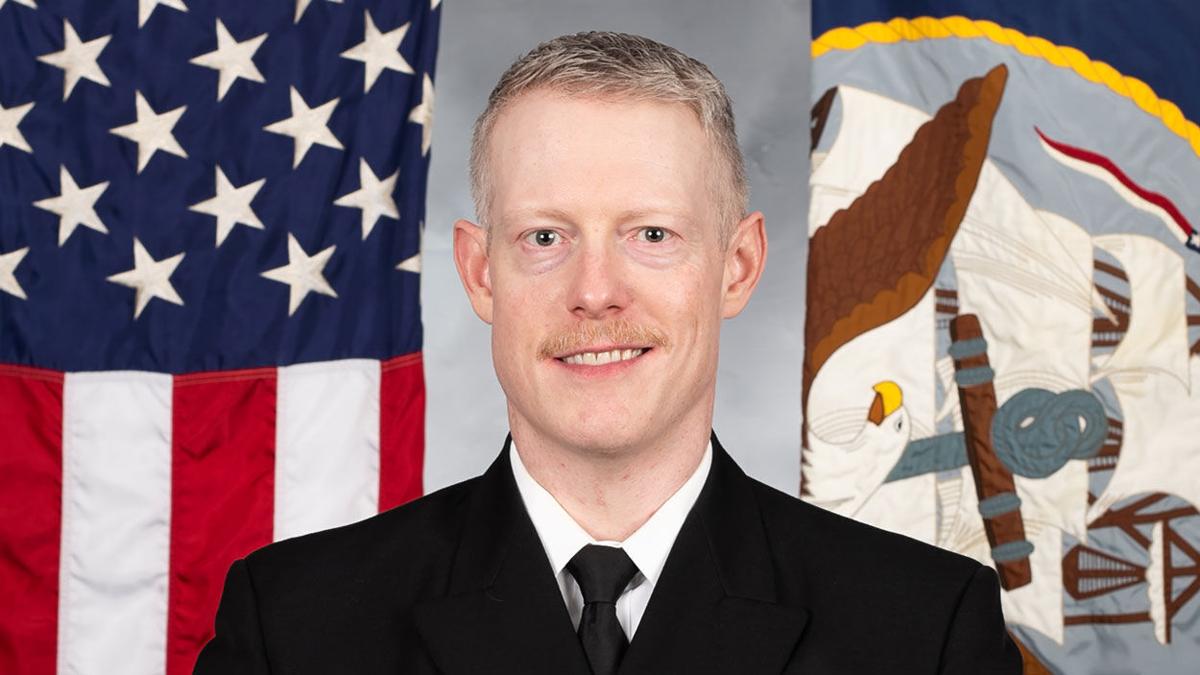
Like much of the rest of the country, Dr. Kyle Dohm was captivated by the Artemis II mission earlier this spring.
On the heels of the excitement generated by NASA’s first crewed lunar flyby in 50 years, he’s looking forward to starting his own exploration with the U.S. space agency. Later this year, Dohm – a 2006 graduate of the University of Missouri–St. Louis College of Optometry who has served in the Navy for the past 20 years – will begin a two-year fellowship in aerospace optometry at NASA focused on spaceflight associated neuro-ocular syndrome (SANS).
SANS is a condition that affects roughly 70 percent of astronauts on long-duration (30 days or more) space missions. Believed to be caused by the headward fluid shifts that occur in weightlessness, as blood and other fluid shifts toward the head, SANS can lead to optic disc edema, chorioretinal folds, globe flattening and shifts in refractive error. As an aerospace optometry fellow with NASA, Dohm’s main task will be to help research SANS and develop better mitigation and prevention strategies so that astronauts can go longer and farther in space.
People are also reading…
“We can’t send people to Mars if their vision is negatively impacted the longer they’re in space,” Dohm said. “We have to solve some big things for the eyes in order to explore further.”
The brand-new aerospace optometry fellowship is the first of its kind at NASA. As the program’s first fellow, Dohm is proud to help chart a new course for others to follow.
“To be able to go there and be part of that community and be able to give any knowledge that I can to help with those efforts will be a great honor,” Dohm said. “I’m excited to work with the people down there and learn from them, and hopefully take away things that I can bring back to the Navy and Navy medicine to utilize for our patients, as well.”
The fellowship is the vision of Dr. Tyson Brunstetter, a SANS specialist at the NASA Johnson Space Center in Houston and retired Navy captain who has been a longtime mentor to Dohm.
Dohm started building his career as an aerospace optometrist in the Navy over two decades ago. After earning his bachelor’s degree in general science from Fort Hays State University in 2002, the Sharon, Kansas, native was one of three students nationwide to receive a four-year scholarship to attend optometry school through the Navy’s Armed Forces Health Professions Scholarship Program.
In UMSL’s College of Optometry, he found a close-knit, collegial community where everyone worked together. After earning his Doctor of Optometry (OD) degree, he reported to his first duty station in San Diego, where he served as a staff optometrist at the Naval Medical Center. He eventually went on to graduate from the Naval Aerospace Medical Institute in Pensacola, Florida, becoming only the 21st naval aerospace optometrist since the program’s inception in 1989.
Naval aerospace optometrists are different from conventional optometrists in that they undergo rigorous aeronautical and aeromedical training. Dohm’s six months of training included didactic instruction in everything from aerodynamics, navigation, engines and weather to aerospace medicine and physiology, as well as ground school and flight time.
“We get actual experience in the air flying, and that’s the piece that’s different than any of the other services,” Dohm said. “They don’t require their flight doctors to have that experience. The Navy’s belief is essentially that experiencing that not only ingratiates you to your aviator patients, but it helps you as a doctor better care for them because you have experienced some of what they actually go through and what their tasks are.”
In the years since, Dohm – who received the Stanley H. Freed Junior Optometrist of the Year Award in 2010 – has built a career in the Navy stretching from Washington state to Japan to, most recently, Maryland. He will remain on active duty in the Navy while completing the NASA fellowship, which he believes will enhance his ability to lead, serve and mentor as a senior medical service corps officer when he returns to the fleet.
“I’m not just there to have a unique and cool experience for myself; I’m there to bring what I learn back to the Navy and to the rest of the military, hopefully,” Dohm said. “Any kind of benefit we can gain for our patients is the ultimate goal of the Navy in sending me there. There is a draw as a Navy optometrist to learn and benefit from new ways of thinking and experiencing new ways of doing things, and then bringing that back to the Navy to potentially implement process improvements. But the research that’s done in space, of course, can help everybody – not only the military, but all of civilization.”
Dohm will start the two-year fellowship in September. He’s excited about its potential to advance both space exploration and military medicine, and he’s also proud to represent the field of optometry as the first fellow in the program.
“Even though this is kind of a new start for naval aerospace optometry, it really is a broader tip of the hat to optometry in general,” Dohm said. “NASA is wanting to gain some more expertise in eyes and vision, and onboarding this new fellowship for Navy optometrists will help meet that need. For our community, our profession, it’s cool that they are asking for assistance from more optometry specialists. I’m going to take great pride in being an optometrist working in this fashion and being able to assist in any way that I can to further the knowledge of mitigation strategies for safe long-distance space travel, potentially aiding our astronauts in new discoveries that may benefit all of humanity.”