


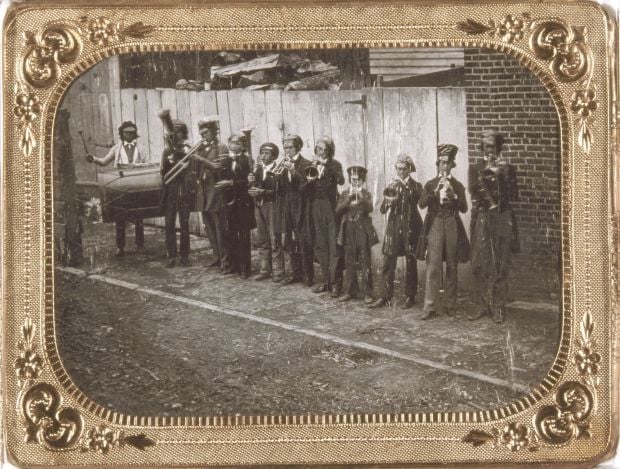
The first St. Patrick’s Day celebration in St. Louis took place in 1820, sponsored by the local Erin Benevolent Society. It was a small gathering.
Back then, St. Louis was a town of only about 4,400 people, its social upper crust still largely of French colonial heritage. The few Irish and German settlers tended to be successful citizens. Most of the newcomers were from mid-South states such as Virginia and Tennessee.
Steamboats and social convulsions in Europe changed all that. By 1860, the eve of the Civil War, half of the crowded city’s 160,773 residents were foreign-born. More than 50,000 were from Germany and 29,000 hailed from Ireland. Lesser numbers were from Bohemia, Italy and other countries.
The Germans were the first to arrive in large numbers, many of them lured by a book. Gottfried Duden, a restless lawyer in Prussia, crossed the Atlantic in 1824 and established a farm near what soon became Dutzow in Warren County. Back in Germany three years later, he promoted the new Rhineland on the Missouri River. Thousands of Germans took his cue, establishing such communities as Hermann.
People are also reading…
Like Duden, many of them were educated. In the Belleville area they were called “Latin farmers” for their books and debating clubs. Others settled in St. Louis, especially in the Bremen neighborhood north of downtown. The city’s first German-language newspaper, Anzeiger des Westens, began publishing in 1835.
The potato famine in Ireland in 1845 brought the first big wave of desperate refugees to St. Louis. The prosperous leaders of the Erin Benevolent Society helped get them settled in neighborhoods roughly along Washington Avenue. The new Irish, poor and uneducated, toiled for low wages in factories and along the riverfront.
Political turmoil in Europe in the late 1840s inspired a second and larger wave of German immigrants to St. Louis. They weren’t as wealthy or educated as Duden’s followers. Many came here to practice religion without trouble from petty nobles. They tended to live south of downtown, and they scrubbed their stoops.
By 1850, St. Louis’ population of 77,860 included 22,000 German immigrants and nearly 10,000 Irish. Their presence irritated many of the more established residents, who considered themselves “real” Americans.
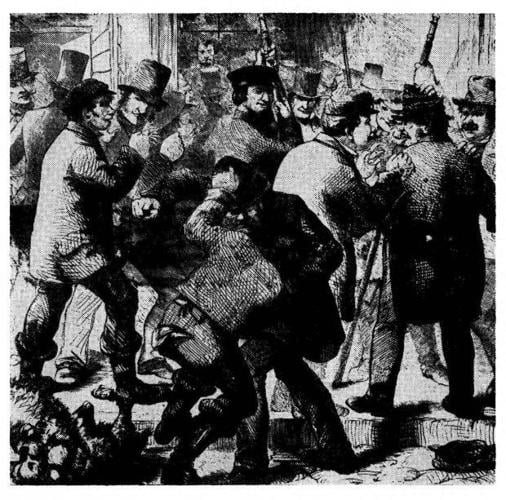
St. Louis became fertile ground for nativist opposition to immigration. Nativists fought several brawls with the Irish, once even with the Germans. The worst ethnic violence here erupted on Aug. 7, 1854.
Fittingly, it was election day. Former senator Thomas Hart Benton sought re-election as a congressman with immigrant support. His challenger, former mayor Luther Kennett, had the nativists. Kennett’s campaign loudly warned of voter fraud.
Violence erupted in the Irish 5th Ward, where poll judges busily disqualified voters. Nativist mobs smashed through Irish homes and businesses and battled counterattacking Irish river workers. Before the riot spent itself two days later, 10 people were dead and 90 Irish buildings damaged.
Kennett won the election, but the steamboats kept bringing more immigrants.
Irish-born John Mullanphy becomes rich, remembers the poor
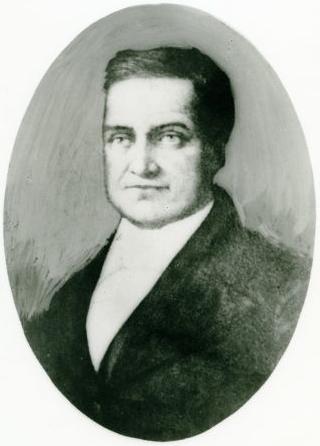
John Mullanphy
John Mullanphy was born in Ireland and served in the French army. He journeyed to America in 1792 and was a successful merchant in Kentucky.
Lured to St. Louis by prominent trader Charles Gratiot, Mullanphy arrived with his wife and five children in 1804. His fluency in French helped him become a respected businessman and citizen.
Mullanphy knew how to make money. He cornered the cotton market in New Orleans shortly before word reached there of the treaty ending the War of 1812, then sold his inventory for six times his investment.
Back in St. Louis, he got richer through real estate.
A devoted Catholic, Mullanphy showered his church with money. He provided the land and money to build the city's first hospital in 1828 and invited the Sisters of Charity to staff it. He built an orphanage and financed medical care during the city's first cholera epidemic in 1832.
Mullanphy died one year later at about age 74. Two of his children, Anne Biddle and Bryan Mullanphy, continued the family generosity to immigrants and the poor. The son also was a city mayor.
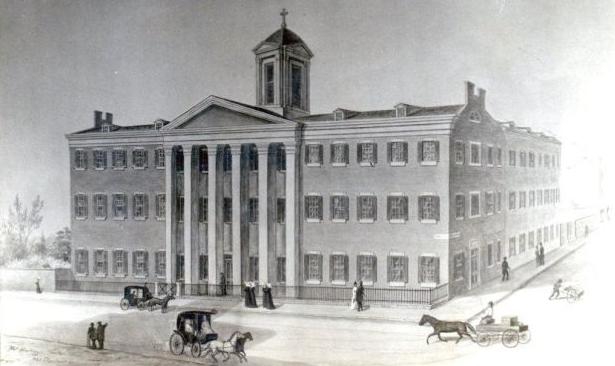
The St. Louis Hospital at 4th and Spruce streets, in a drawing of the expanded building as it appeared in the 1850s.
Gustave Koerner tells Germans to choose Illinois
Gottfried Duden attracted thousands of fellow Germans to the Missouri River valley. One of them was Gustave Koerner, who promoted a detour to Belleville.
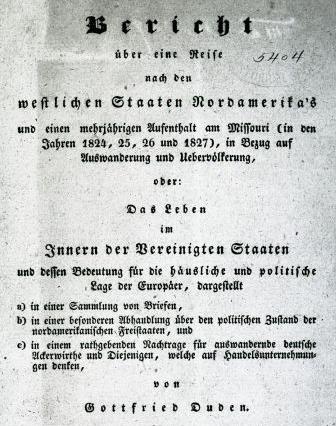
The cover of the book by Gottfried Duden
Duden briefly had a farm near Dutzow. His 1829 book praised the region as a good place for Germans.
Koerner fled his homeland after taking part in a hopeless student revolt in 1833. He followed Duden's advice, but soured on Missouri. Koerner wrote a book saying the weather was too hot. He scolded Missouri for slavery, urging immigrants to head for the free state of Illinois.
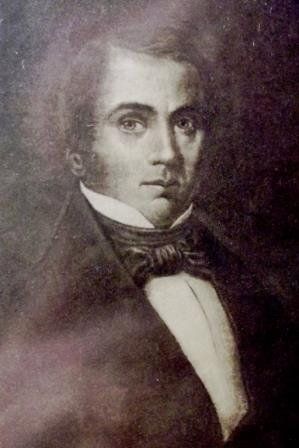
Koerner
Koerner became a lawyer in Belleville and a Democrat. He was elected to the Illinois Legislature, the state Supreme Court and the lieutenant governorship.
He switched to the new Republican Party in 1856 over slavery. Koerner became a close friend of Abraham Lincoln and was a key player in getting him the presidential nomination in 1860.
Five years later, Koerner was one of the 14 pall bearers at Lincoln's funeral in Springfield.
After the Civil War, Koerner practiced law and wrote for newspapers. He died in 1896 at 86. His home in Belleville is being restored.


