
The French-speaking people of this trading village had no particular interest in the American Revolution 800 miles away. Empire-mad kings in Europe had other ideas.
About 700 people lived here when shooting erupted near Boston in 1775. Formal control of St. Louis had changed since its founding, but not daily life. The French lost the Illinois territory to the British and secretly ceded the vast Louisiana colony west of the Mississippi River to the Spanish.
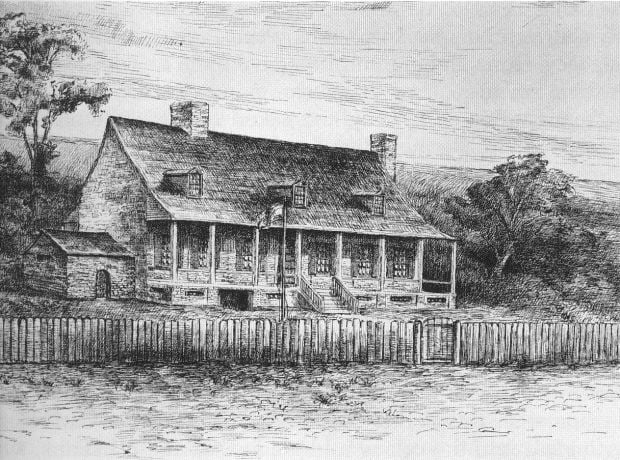
The original residence of Pierre Laclede, founder of St. Louis. By 1780 it was colonial headquarters for the Spanish.
The Spanish governed with a light touch, leaving villagers to their Creole ways. The British posted small garrisons at Cahokia and Kaskaskia.
But Great Britain schemed for Spanish holdings. Spain wanted to retake Florida. France wanted all of its colonies back. In European capitals, maps pointed to St. Louis.
When the revolution began, the British hustled most of their Illinois garrison to the East Coast. That vacuum brought St. Louis its first taste of war.
People are also reading…
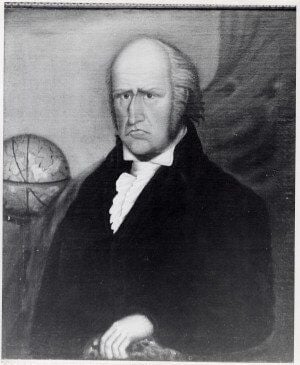
George Rogers Clark, a frontier officer for the American army during the Revolution, whose soldiers captured Cahokia and Kaskaskia in 1778. When the British force attacked St. Louis on March 26, 1780, his detachment in Cahokia defeated a coordinated attack on their side of the Mississippi River.
Virginia Gov. Patrick Henry dispatched Col. George Rogers Clark with 170 frontiersmen to seize Illinois. In July 1778, they surprised the British commander in his bed and took Cahokia without a shot fired.
St. Louis merchants sold supplies to Clark but were frustrated when they realized Virginia didn’t cover its bills.
From Cahokia, Clark’s soldiers headed east, wading bravely across the flooded Wabash River to capture Vincennes in what is now Indiana. About half of his soldiers were of French-speaking origin.
The British took that loss poorly and began gathering Indian allies to subdue St. Louis and Cahokia. But the traders’ grapevine brought the alarm to St. Louis well before any redcoats could get here.
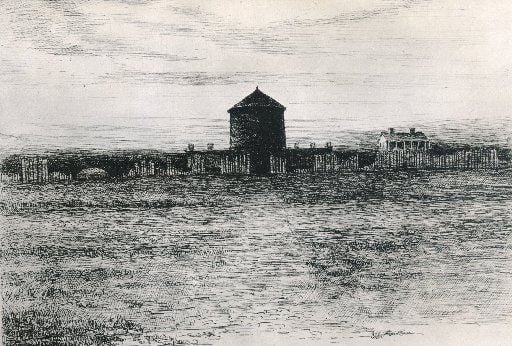
In 1780, Don Fernando de Leyba was the Spanish commander in St. Louis. Nervous about the reports, he ordered a stone tower built near today’s Fourth and Walnut streets and trenches dug, vaguely along the boundaries of today’s Gateway Arch grounds. He wanted two more towers, but there wasn’t time. It turned out there was just enough to prevail.
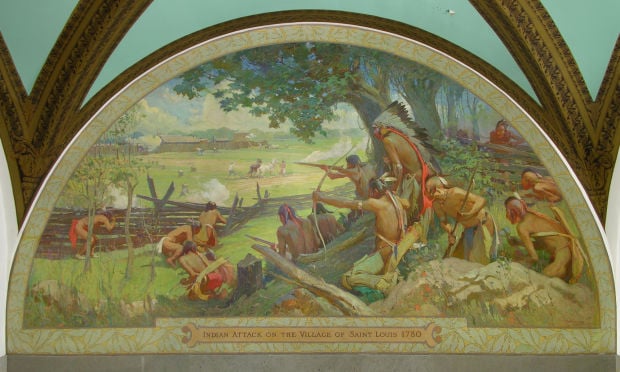
On May 25, 1780, delighted British commanders watched from the woods as St. Louisans snacked casually on wild strawberries in the common fields. But when their warrior allies began a screaming charge the next day, musket and cannon fire stopped them cold. They never reached the trenches.
Clark’s men in Cahokia held off a similar attack. The attackers retreated up the Mississippi.
Loss reports vary. The British claim to have killed 68. De Leyba reported 21 defenders and four attackers dead. Others were killed away from the front lines.
The American government wouldn’t return to St. Louis until its representatives showed up in 1804 to claim the Louisiana Purchase.
Fernando de Leyba, unheralded hero of St. Louis
Don Fernando de Leyba probably saved St. Louis in 1780. You wouldn't know it for the ingratitude he endured.
De Leyba, a native of Barcelona, was Spanish colonial commander during part of the American Revolution. He befriended George Rogers Clark, an officer from Virginia, and lobbied local merchants to outfit Clark's soldiers against the British.
When de Leyba heard about British plans to attack St. Louis with a force of Indian allies, he cajoled residents into financing a defense of their village. He threw in some of his own money.
He rushed a Spanish detachment up from Ste. Genevieve. Under his prudent command, the soldiers and local militia held off the day-long attack.
But St. Louisans turned on him. They grumbled that de Leyba didn't let them counterattack, which would have been foolhardy, and blamed him because the hostilities hurt the fur trade. The latter probably was the real crime, though not de Leyba's fault.
On June 28, 1780, barely a month after the battle, a disillusioned de Leyba died and was buried in the village churchyard next to his wife, Dona Maria. The cause of death isn't known. His death went unmourned. No image of de Leyba is known to exist, and it's not clear where his remains are now.
History has been more kind, belatedly crediting him with energetically protecting the village from potential massacre. A local chapter of the Sons of the American Revolution is named in his honor.