
For the French-speaking founders, the news was electric. Then it wasn’t.
Word reached here in late 1802 that France had reclaimed the vast Louisiana territory from Spain. A few more months under nominal Spanish rule would be a trifle, or so they thought.
But in August 1803, a letter arrived from William Henry Harrison, governor of the American territory of Indiana (and future president). It declared that the United States was the new landlord. Auguste Chouteau, St. Louis’ leading citizen, was shocked that Napoleon Bonaparte, a man he so admired, had sold 512 million acres to America for $15 million (3 cents an acre).
Many of the first families regarded the Americans with reserve, if not suspicion. The Chouteaus had developed strong commercial ties to the Osage and other Indian tribes. Americans mainly wanted Indian land.
People are also reading…
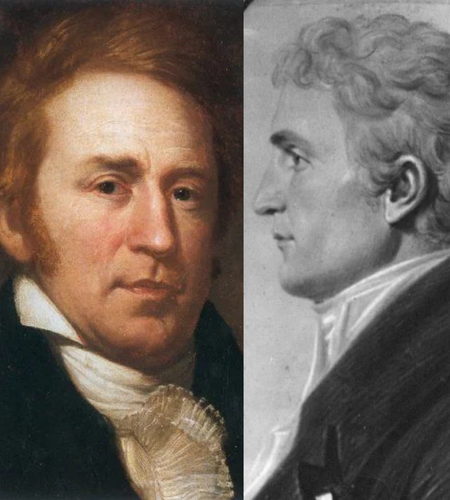
William Clark (left) and Meriwether Lewis
Explorers William Clark and Meriwether Lewis, sent by President Thomas Jefferson, arrived in St. Louis in December 1803 for an expedition to the Pacific Ocean. Their presence demonstrated American resolve.
Chouteau and his half-brother, Pierre, put dismay aside and graciously hosted the American explorers with dinners. They sold them supplies for the expedition. This was, after all, a trading town.
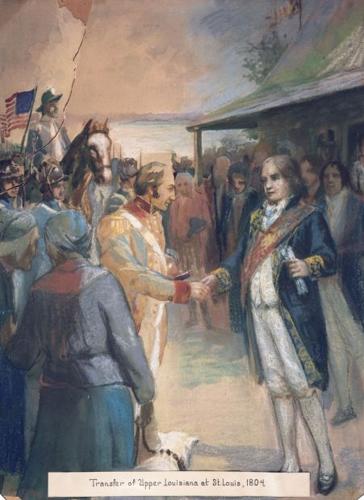
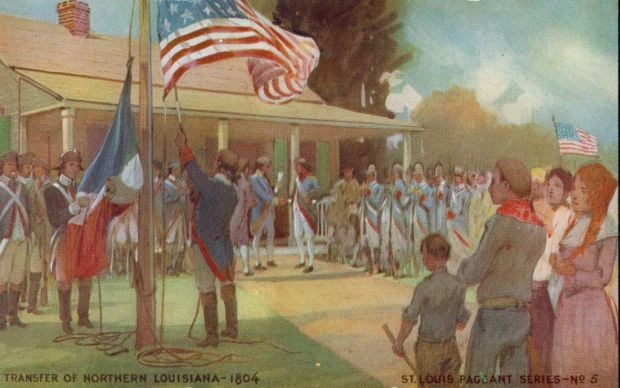
Its 1,050 residents, including 270 slaves, and 70 free blacks, didn’t formally come under American control until March 9-10, 1804, when representatives of Spain, France and the United States gathered outside the colonial office. American Capt. Amos Stoddard doubled as the agent for France, which didn’t send anyone. The small Spanish garrison provided drum rolls.

An artist's depiction of the "three-flags" ceremony making St. Louis part of the United States on March 10, 1804. Missouri History Museum image
After the Spanish flag was lowered, tradition holds that the French Tricolor flag flew overnight. Some townfolk wept as it was replaced the next morning with the Stars and Stripes. The event has become known as the “three-flag” ceremony.
In the crowd were Lewis and Clark, who headed up the Missouri River two months later.
Local government developed haltingly. St. Louisans were offended to learn that America put their town subordinate to Vincennes, in Indiana. Congress relented and carved out the Territory of (upper) Louisiana, with St. Louis as capital.
Slaves in St. Louis were heartened to learn that slavery was outlawed in American territory to the northeast. Stoddard reassured slaveholders that their system was safe, a position reinforced by the strong Southern flavor of many new arrivals.
By summer 1806, the prevailing hunch was that Lewis and Clark were lost. The explorers were treated to cheers and volleys when they reached the city landing on Sept. 23. They wrote their first reports to Jefferson as guests of Pierre Chouteau.
Lewis later served as the second territorial governor. Clark served many years as federal Indian agent and died here in 1838.
Clark’s grave is in Bellefontaine Cemetery.
Daniel Boone found his last frontier on Missouri River
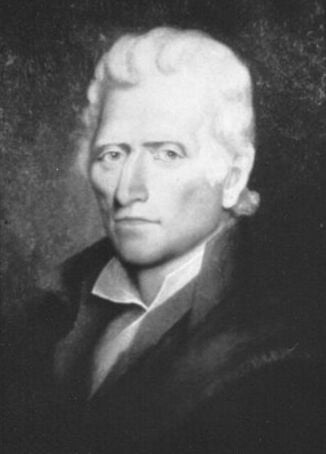
Daniel Boone, explorer and wilderness settler, moved to present-day St. Charles County in 1799, partly to leave behind financial troubles in Kentucky. He remained there until his death in 1820. Missouri History Museum image
DEFIANCE • It’s hard to think of a more genuine American than Daniel Boone. But when he moved here in 1799, he was weary of his native land.
Boone left Kentucky after debts and unwise property speculations burdened the life he had cut from the wilderness. He shook American soil from his boots and moved to present-day St. Charles County, then part of the Spanish empire.
He was 65 years old when he journeyed to yet another new life on the widening frontier. Colonial officials granted him 850 acres in the Femme Osage district.
Boone already was famous as an explorer and settler of the land west of the Appalachians. At Defiance, he hunted, reunited with Shawnee Indians who once held him captive and served as local colonial commander, deciding disputes beneath his “Judgment Tree.”
After the United States obtained the Louisiana country, Boone once again lost many of his land claims. He remained here, dying in 1820 at age 85, and was buried next to his wife, Rebecca.
In 1845, Kentucky sent a team to exhume their remains and took them to Kentucky. Some Missourians still insist they dug up the wrong bones.