


Long before Pierre Laclede showed up, the Osage tribe was the dominant force in present-day Missouri. Its hunting parties ranged for hundreds of miles from home villages on the Osage River.
Numbering perhaps 10,000 when St. Louis was established in 1764, the Osage people were strong enough to fend off Comanches to the west and the Sac and Fox from the Illinois country. Their warriors were tall, many well over 6 feet.
The tribe’s main villages were in today’s Vernon County, 75 miles south of Kansas City, with others along the Missouri River. The Osage wintered in large lodges, raised maize and beans, and hunted beaver, deer and bison for months each year.
Laclede encountered Native Americans shortly after he established his town. About 600 members of the Missouria, a smaller area tribe, showed up and made themselves comfortable. Laclede wisely gave them presents and kind words and talked them into returning home up the river that bears their name.
People are also reading…
St. Louis soon undertook a mutually profitable partnership with the Osage, who harvested pelts in return for guns, powder, kettles and baubles. Laclede descendants stayed for long periods in Osage villages, sometimes taking “country” wives and fathering children. Chiefs visited St. Louis for diplomatic meetings.
The Spanish colonial government, which ruled French-speaking St. Louis, feared the Osage but deferred to the local traders. Auguste and Pierre Chouteau, heirs to Laclede, sought tranquility by building a trading post, called Fort Carondelet in honor of the Spanish governor in New Orleans, near the main Osage villages.
The Louisiana Purchase spelled doom for the arrangement, even though Pierre Chouteau led an Osage delegation to visit President Thomas Jefferson. The American notion of Indian relations largely consisted of removing tribes and taking over the fur business themselves.
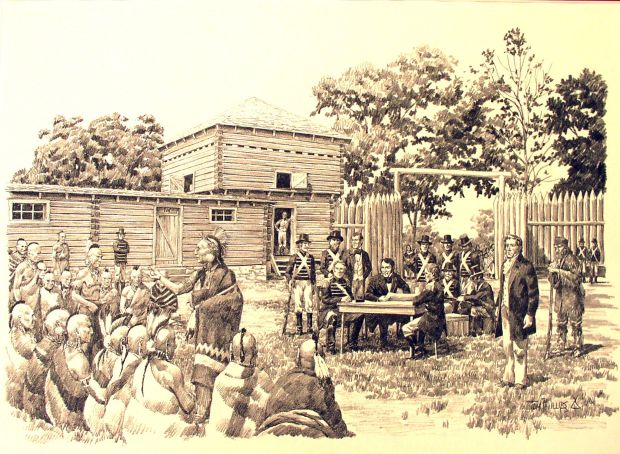
William Clark, co-hero of the expedition to the Pacific Ocean, became federal Indian agent in St. Louis in 1807. He built a new installation, Fort Osage, on the Missouri River east of today’s Kansas City, and instructed the chiefs to gather. Pierre Chouteau, sensing the changing winds, handled negotiations for Clark.
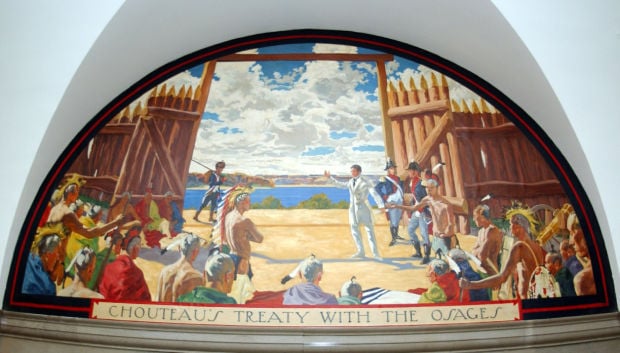
A painting at the Missouri Capitol depicts the treaty with the Osage Indians on Nov. 10, 1808, at Fort Osage, where the tribe ceded most of Missouri to the United States. At center is Pierre Chouteau, who had worked with the tribe for decades and represented the United States in the negotiations. Fort Osage was on the Missouri River east of present-day Kansas City.
In November 1808, the Osage gave up claims to almost all of today’s Missouri and northern Arkansas for $1,200 in cash and merchandise, a blacksmith shop and a $1,500 annual stipend. The Sac and Fox, who had decimated the Missouria in war, signed away nearly 15 million acres in a separate treaty.
The Sac and Fox had taken part in the British-led assault upon St. Louis in 1780. Bands of Osage periodically attacked isolated white settlements, but the tribe never made war against the town. In the end, it didn’t matter whether a tribe was friend or foe.
The Osage signed a second treaty in 1825 giving up what was left in the new state of Missouri. Within a decade, few Native Americans of any tribe called Missouri home.
The Osage own the last Indian mound in St. Louis
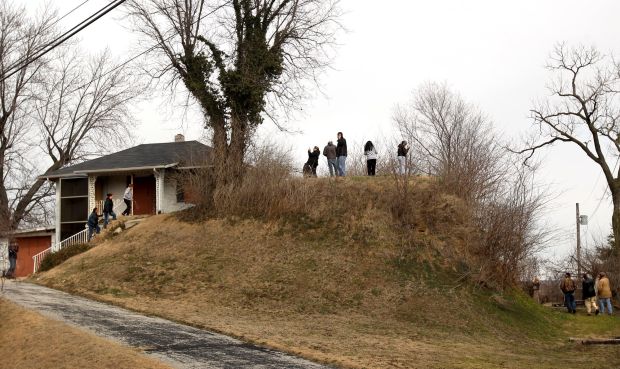
Members of the Osage Nation visit Sugar Loaf Mound, the last remaining Mississippian-era Indian mound in St. Louis, in March 2013. A house with a view of the Mississippi River was built onto the mound. The Oklahoma-based tribe bought it in 2009 and plans to demolish the house, which is vacant, and restore what's left of the mound. St. Louis used to be the site of numerous Mississippian mounds, but the rest were leveled as the city grew. Photo by David Carson, dcarson@post-dispatch.com
When St. Louis was settled, the land on both sides of the Mississippi River was dotted with tall earthen mounds. They were mysteries to settlers and natives.
The Osage, the main tribe in present-day Missouri, knew of them through years of hunting forays. But the Indian culture that built them had disappeared by the 1300s.
The largest is Monks Mound, preserved at the Cahokia Mounds Historic Site. There used to be about 50 in St. Louis, including a cluster just north of today's downtown.
But St. Louisans leveled them to make way for their growing city. The only survivor is Sugarloaf, overlooking the Mississippi near Interstate 55 and South Broadway.
Government treaties and Missouri laws dispatched the Osage to the Kansas and Oklahoma territories by the 1830s. Today, the Osage Nation of 18,000 people is based in Pawhuska, Oklahoma, named after a line of chiefs.
In 2009, the Osage bought Sugarloaf.


