
It was a busy few years even for a raucously growing city in the Gilded Age.
From 1874 to 1876, St. Louis completed a bridge over the Mississippi River, opened Forest Park and hosted the first of five national political conventions. A corruption scandal reaching the White House unfolded in its federal courthouse. A public vote thick with fraud led to the city’s single most fateful decision, its separation from St. Louis County.
E. Anheuser & Co., a brewery on Pestalozzi street, introduced a beer called Budweiser. All that, and the nation celebrated its centennial.
St. Louis grew quickly in population and commerce as it recovered from the Civil War. Compliments of an inflated count in the 1870 federal census, it was anointed the nation’s fourth-largest city.
That kept it officially ahead of Chicago, a booming competitor that caused much fretting here. Chicago already had railroad bridges across the Mississippi River at Rock Island and Quincy, Ill., reaching into Missouri’s farm belt. The transcontinental, completed in 1869, ran through Chicago.
People are also reading…
In St. Louis, passengers and freight had to be shuttled laboriously across the river on ferries. Local leaders had been calling for a bridge since 1839, but the challenges were great.
So was the achievement.
THE BRIDGE

The Eads Bridge under construction, with the ribs completed and the roadways begun. Photo courtesy of the Library of Congress
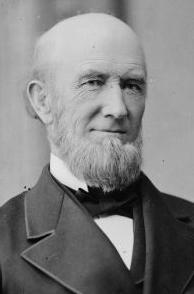
James B. Eads
Opening the St. Louis Bridge, nicknamed ever since for its builder, remains one of St. Louis’ finest moments.
James B. Eads, who made a fortune salvaging river wrecks and then built ironclad gunboats during the Civil War, produced a daring design. Its sweeping arch spans would connect to large stone piers that were anchored on bedrock, far beneath the river’s ever-shifting bottom.
Plenty of rival engineers said it couldn’t be done. Steamboat owners didn’t want it, nor did the Wiggins Ferry Co. monopoly. Chicago interests tried to block the bridge with lawsuits and state laws.
Eads and his stockholders, a who’s who of St. Louis businessmen, began construction in 1869. Eads estimated it would cost $4.5 million.
To reach bedrock, workers dug through sand and silt inside enclosed structures called caissons, which were fed with compressed air to keep out water. It was a new technology — 14 workers died of the “bends,” a blood condition caused by moving too quickly from a high-pressure caisson into surface air.
On May 24, 1874, more than 25,000 people paid a nickel each to walk the roadway. Eads parked strings of locomotives across the rail deck in a final answer to skeptics who didn’t trust his design to hold the weight.
On July 4, massive crowds turned out for the parade and dedication. Trains soon ran through a tunnel downtown to Union Depot, 12th and Poplar streets (Union Station followed two decades later). A railroad bridge over the Missouri River at St. Charles, completed in 1871, linked St. Louis to northern Missouri.
But the bridge cost $9 million, including interest and fees, and its owners defaulted to their New York lenders. Soon, the bridge was controlled by robber-baron Jay Gould, who was gobbling up Midwestern railroads.

A drawing of the busy St. Louis riverfront shortly after the St. Louis Bridge, now known as the Eads Bridge, opened in 1874. The bridge, which allowed railroads to cross the Mississippi River, meant doom for the riverboat business. St. Louis Mercantile Library image
THE WHISKEY RING
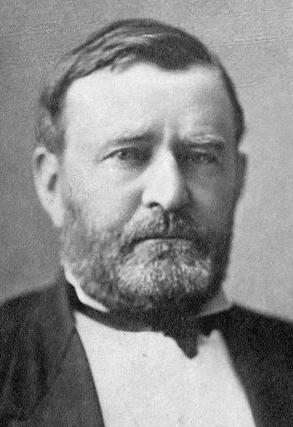
President Ulysses S. Grant
It began as an illegal way to finance politics, then just fed greed. By 1871, a conspiracy of area whiskey distillers, federal revenue agents and backers of President Ulysses S. Grant colluded to under-report production and split the profit on untaxed spirits. The practice took place in other cities as well.
In May 1875, federal marshals arrested the St. Louis ringleaders, including William McKee, co-owner of the newly merged Globe-Democrat newspaper and a Republican patronage chief. (He also was a driving force of the inflated 1870 census.)
Federal juries at the U.S. Post Office and Custom House, a stone fortress at 218 North Third Street, convicted McKee and three others. By then, the story was even bigger.
In December 1875, the grand jury here indicted Orville Babcock, Grant’s White House secretary. Babcock had been with Grant when Confederate Gen. Robert E. Lee surrendered at Appomattox Court House. Prosecutors said Babcock oversaw the frauds from his White House desk.
His trial began Feb. 8, 1876, and ran for 18 riveting days. Crowds gathered daily to watch the nattily dressed Babcock stroll to and from the Lindell Hotel, Sixth Street and Washington Avenue.
Gen. William T. Sherman, Grant’s brother in arms, took the stand to vouch for Babcock. The defendant also had something no other American criminal defendant has enjoyed before or since — a sympathetic deposition from a sitting president, which was read to the jury.
The jury acquitted Babcock after two hours on Feb. 25. With Sherman at his side, Babcock waved to a festive gathering from the hotel balcony.
FOREST PARK OPENS

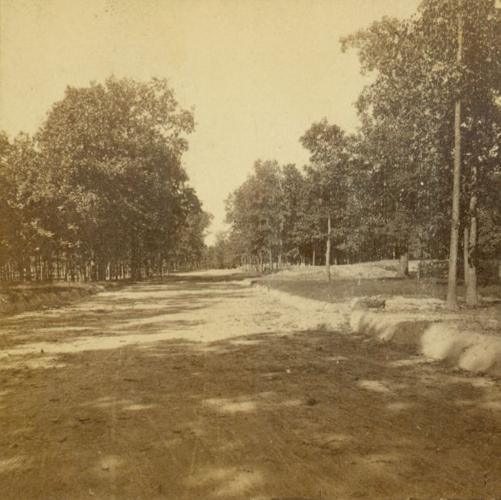
One of the lanes cut for Forest Park in 1875, one year before the park opened.
On June 24, 1876, St. Louis County dedicated its new riding park and country retreat. An estimated 50,000 people, including delegates from the Democratic Convention downtown, showed up by carriage and special trains.
The park’s 1,371 acres were two miles west of the city limit. It had taken a decade to get there.
The Missouri Legislature first gave the county authority to develop a park in 1864, but there was a war on. Another act in 1872 was nullified by the Missouri Supreme Court after lawsuits by landowners, including Charles P. Chouteau, a great-grandson of the city founders.
Prodded to try again by developer Hiram Leffingwell, the father of Grand Boulevard, the Legislature established Forest Park, along with O’Fallon Park in north St. Louis and Carondelet Park to the south. Forest Park was to be larger than New York’s Central Park, one of its selling points.
The county spent $800,000 to buy land from Chouteau, Thomas Skinker, William Forsyth and others. A property tax financed it.
Work proceeded on 19 miles of winding dirt lanes, 11 artificial lakes and a one-mile oval racetrack near today’s Lindell Boulevard. Hundreds of people made the trek from the city to watch work underway.
A railroad line to the park was completed four days before the grand opening. The city soon took the park through its divorce from the county. It has been a civic jewel ever since.
DEMOCRATIC NATIONAL CONVENTION
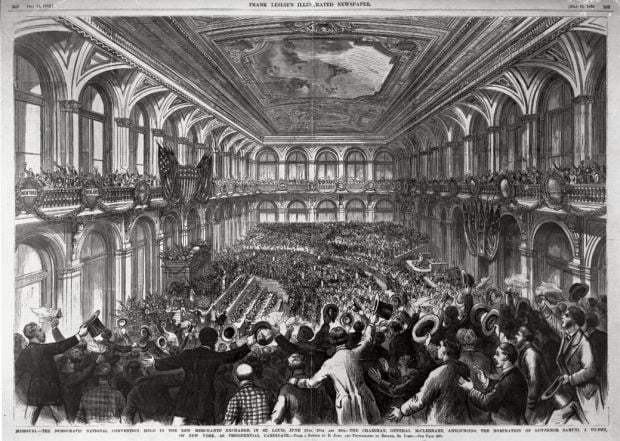
Delegates crowd the main hall of the Merchants' Exchange, at Pine and Third streets, for the Democratic National Convention in June 1876.
St. Louis managed to beat Chicago in the bidding war to host the party’s 1876 convention. It was held in St. Louis’ grandest new building, the Merchants’ Exchange, which opened in 1875 at Pine and Third streets.
The convention began June 27 with parades and commotion at the Southern and Lindell hotels, downtown’s finest. Delegates from New York’s Tammany Hall political machine held court at the Lindell.
Nominees included former Union Gen. Winfield Scott Hancock of Pennsylvania, whose wife, Almira, was from St. Louis. They lived occasionally at her family estate, Longwood, south of the River Des Peres. (He is the namesake of the Hancock Place School District in Lemay.)
The nomination went to New York Gov. Sam Tilden, who lost the presidency to Republican nominee Rutherford B. Hayes in a bitter post-election dispute that ran for four months.
On the last night of the convention, fireworks were shot from the roof of the St. Louis County (Old) Courthouse. The St. Louis Dispatch, in typical 19th-century prose, called the celebration “the greatest, grandest and most indescribable enthusiasm ever manifested by an American people.”
St. Louis last hosted a party convention in 1916. The five gatherings held here — four by the Democrats — neatly fit St. Louis’ 50-year run among the nation’s five largest cities.
THE GREAT DIVORCE
After the Civil War, many of St. Louis’ businesspeople drifted back to the Democratic Party, partly to welcome back former Confederates in a united thrust for growth. State government remained Republican and made sure St. Louis County government oversaw city affairs.
When Democrats retook state government, the Republican constitution written at the end of the Civil War was doomed. St. Louis delegates to a constitutional convention in 1875 added a clause allowing the city to consider separation. One of the delegates was Thomas Gantt, a lawyer.
After 52 meetings, a board of leading citizens proposed a complete separation of city and county. The new boundaries would cover 61.4 square miles and extend the western limit from Grand Boulevard to include Forest Park — far out in the country then, with plenty of room to grow.
County politicians and city ward bosses opposed it. On Aug. 22, 1876, city voters narrowly approved the plan and county voters soundly rejected it. Because it required majorities in both, that should have ended things.
But pro-separation forces cried foul and rushed to court, exposing numerous voting irregularities. The Missouri Appeals Court, including a new judge named Gantt, endorsed a recount, which tossed more than 5,000 ballots. Most of them were “no” votes, giving the proposition a majority of 1,253. The divorce was final.
After the city declared independence in March 1877, the courthouse gang finally caved. Civic leaders began having second thoughts early in the 20th century, but three major attempts to reconcile have failed.