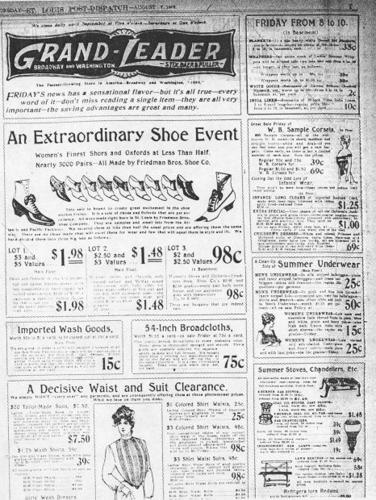


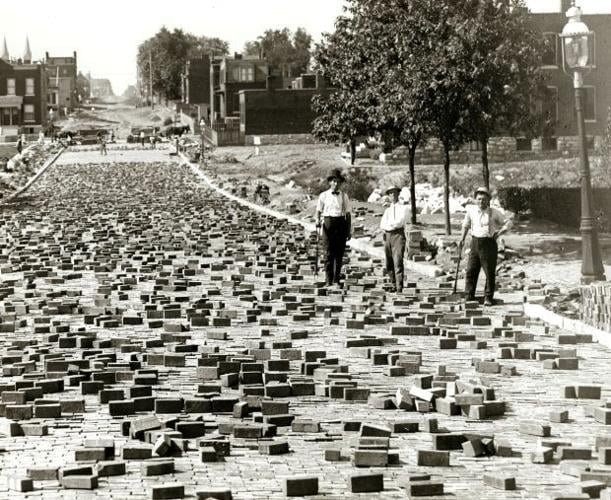

A newspaper advertisement for a downtown department store in 1902, featuring prices for women's shoes and shirtwaists, which were standard garb for women at the time. (Post-Dispatch)
Men’s suits went for $11. Toss in a straw hat for 98 cents. Summer dresses started at $3 for women, 50 cents for girls.
A round-trip ticket on the Burlington Railroad to San Francisco was $47.50. Lodging in a typical rooming house was $1 per week, and $3 more covered meals.
Working in a quarry paid $2 per day. A traveling advertising man could start at $50 per month plus expenses. An in-house female cook made $18 per month.
A used buggy, horse not included, went for $30.
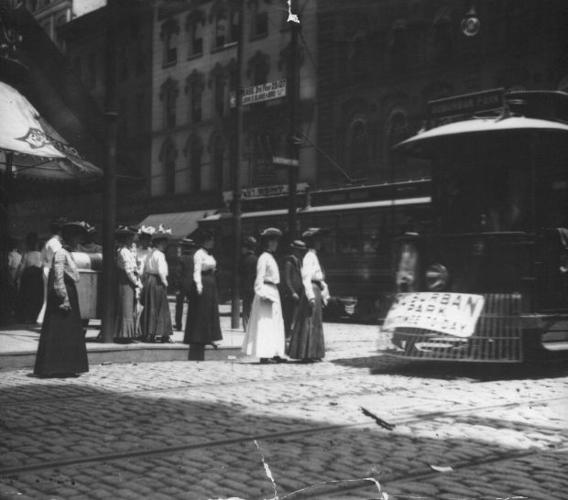
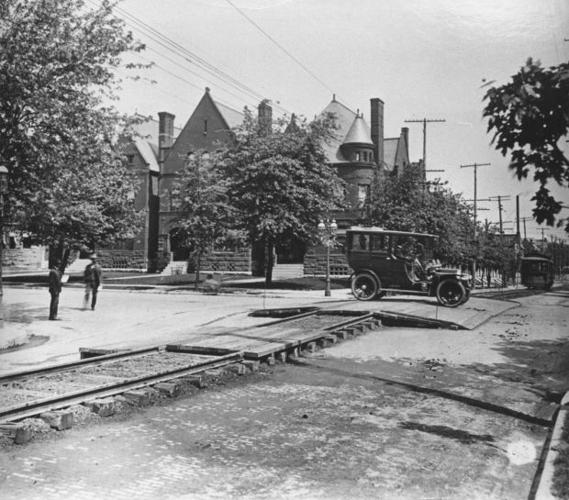
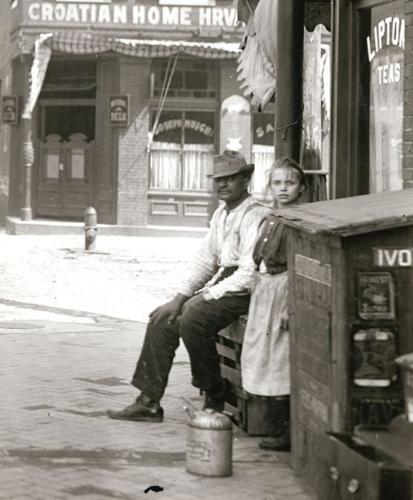
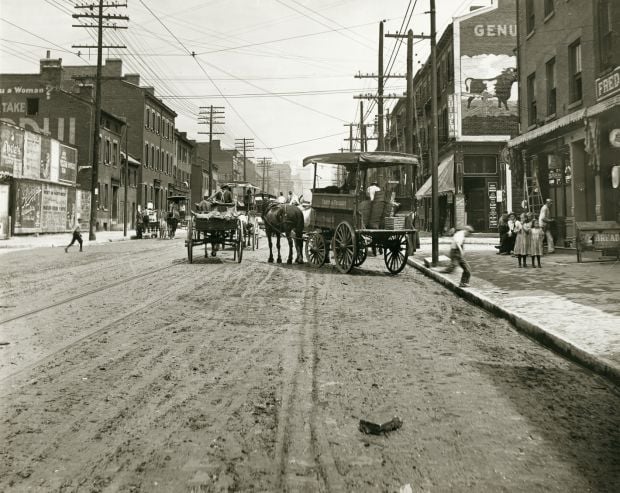
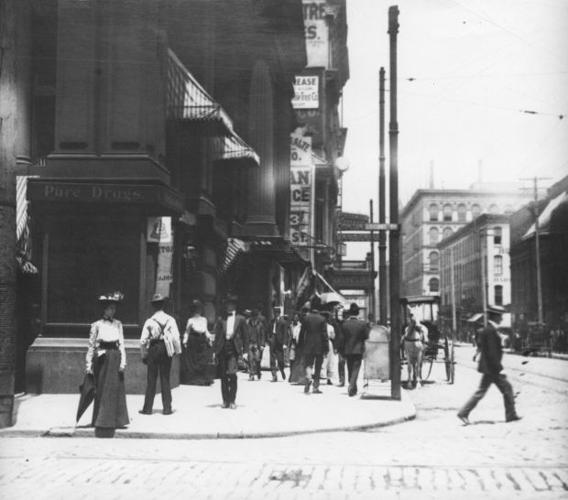
Such were some of the numbers of daily life at the start of the 20th century in St. Louis, which was anointed the nation’s fourth-largest city by the U.S. Census of 1900. Its population was 575,238, behind only New York, Chicago and Philadelphia.
In 1900, the city was home to 70 percent of the residents of today’s metro area. Its street grid reached Skinker Boulevard and filled most of its 62 square miles, except for wide areas of open land south of Arsenal Street and west of Kingshighway.
People are also reading…
In contrast, St. Louis County was largely farmland and woods, home to 50,000 people. Webster Groves and Kirkwood, two pleasant commuter towns on the main railroad lines, had 3,500 and 3,000 residents, respectively. Ferguson, a rural station on the Wabash Railroad, claimed 1,000. Clayton, the county seat since the city-county schism, was but seven blocks square. It wouldn’t be incorporated until 1913.
The county had all of 110 lawyers, 24 restaurants and 12 banks.
There were 8,000 people living in St. Charles, which didn’t extend west of today’s First Capitol Drive. All of St. Charles County had a population of 29,000.
Across the Mississippi River, 150,000 called Madison and St. Clair counties home. East St. Louis, the largest city, had 30,000, Belleville 17,500, Alton 14,200 and Collinsville 4,000. The countryside was pocked by small coal mines.
Other snapshots of St. Louis living at the century’s turn:
• Shopping was easy, with small stores on almost every block. The city had nearly 400 “dry goods” or general merchandise stores, including downtown competitors known as Famous and Barr, not yet merged. The city had 95 hotels, 30 brick factories, 27 breweries and 13 sausage makers.
• Only about one-fifth of city residents owned their own homes. A four-room brick house could be had for $2,000, but an eight-room home might cost $8,000.
• The city had nearly 40 hospitals, including St. Anthony’s at 3520 Chippewa Street, St. John’s at 2228 Chestnut Street, Barnes Medical College at Garrison and Lawton avenues, and St. Luke’s at 1835 Washington Avenue.
• Doctors, druggists and downright quacks offered a long list of salts and potions to promote health. Dr. Branaman, at Ninth and Olive streets, offered “electro-medicated vapor treatments” for $3 per month to fight a long list of chronic ailments.
• There were plenty of social diversions. The list of churches ran seven pages in the city directory. The city had 41 singing societies, nine Elks lodges and six meeting places for the Order of the Eastern Star. The Grand Army of the Republic, the Civil War Union veterans organization, had nine posts. There were more than 120 union locals, including those for marble workers, glass blowers, tinners, brush makers and cigar makers. Cigar packers had their own local.
• The city had 115 parochial schools, most of them Catholic, and 89 public schools, including 13 for black students.
• Readers could choose from six daily newspapers and a tall stack of specialty publications.
• Perry Lewis, who built his own electric car in 1893, took out the first city auto license in 1902, when fewer than 2,000 cars operated in the city. The St. Louis Motor Carriage Co., its first auto factory, opened at 1230 North Vandeventer Avenue in 1898.
• Anyone who wanted or needed to get out of town could choose from among 22 railroads that used the 30 tracks beneath the vast train shed at Union Station.
• At life’s end, 74 undertakers waited to make the right arrangements. Their establishments bore such names as Ambruster, Hoffmeister, Kriegshauser and Ziegenhein.
Three samples of the many ordinary stories that filled the newspaper in August 1902:
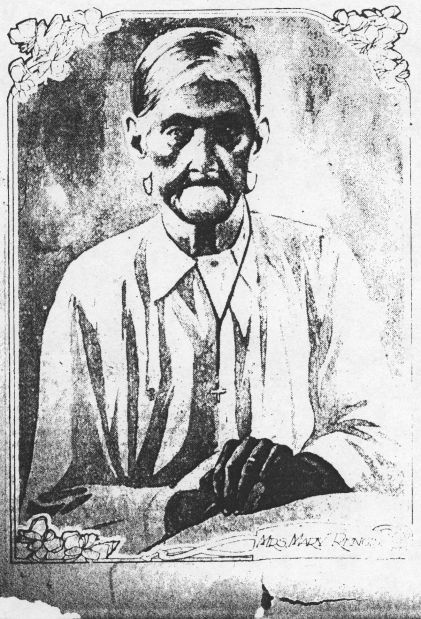
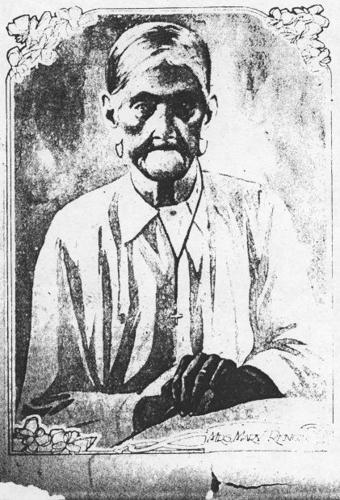
A newspaper sketch of Mary Renois, who died Aug. 3, 1902, at age 90.
Edward Moton, a “wheelman” (bicyclist), saved the day for Raymond Tojo’s little child. Tojo, a local politician, parked his buggy at Main and Broadway in East St. Louis and, leaving the child in his seat, dashed into a store. Something startled his horse, which stomped away. Moton peddled furiously to catch up with the horse and managed to bring it to a halt. The tot was okay.
Mary Renois, the oldest resident of Cahokia, died at age 90. She remembered having witnessed the first steamboat arrival in St. Louis in 1817, when she was 5. Her family often crossed the river by canoe.
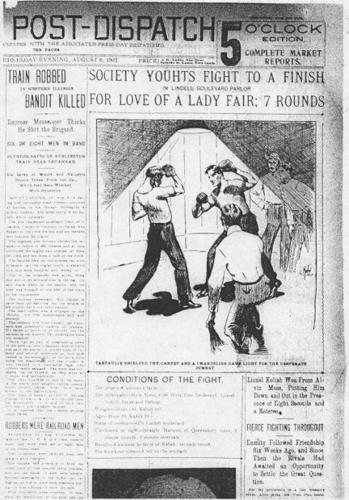
Lionel Kalish and Alvin Moss, two young society gentlemen, battled with boxing gloves in the parlor of a mansion at 4371 Lindell Avenue for “a fair woman’s favor.” A referee directed the contest, which Kalish won in the seventh round. The Post-Dispatch published a lengthy account, complete with drawings. The object of their rivalry was not identified, nor did the newspaper say whether either won her heart.
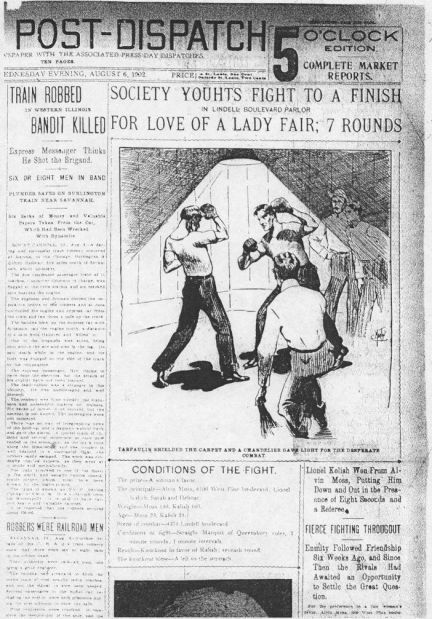
A Post-Dispatch drawing and story, published Aug. 6, 1902, about a boxing match between two young gentlemen for the favor of a society lady. Her name was not used in the otherwise lengthy article. The fight took place in a ring set up in the parlor of a fashionable home on Lindell Avenue. (Post-Dispatch)