
It began as another losing competition to Chicago.
Francis
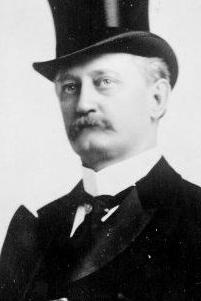
In 1890, Missouri Gov. David R. Francis pitched hard to host a national celebration of the 400th anniversary of Christopher Columbus’ arrival in the New World in 1492. Fresh off a term as St. Louis mayor, Francis gathered pledges of $4 million from local citizens and businesses.
But Chicago bagged the prize, and it stung. Chicago, of all places — the upstart village on Lake Michigan that seized the Transcontinental Railroad and vaulted past St. Louis in population. In 1893, one year late, Chicago hosted the grand Columbian Exposition along its lakefront.
Undeterred, Francis set about hosting the next big cause for national celebration — the 100th anniversary of the Louisiana Purchase, coming up in 1903. Francis gathered endorsements from most of the states within the vast tract, including Louisiana, and local pledges for $10 million. In May 1899, the Post-Dispatch crowed that St. Louis’ plan “promises to surpass in magnitude the World’s Fair at Chicago.”
People are also reading…
In 1901, Congress threw in $5 million. That gave the effort a symbolically powerful reserve of $15 million, what the United States had paid Napoleon for the former colony.
St. Louis leaders had to decide where to hold the fair. And they had two challenges related to water.
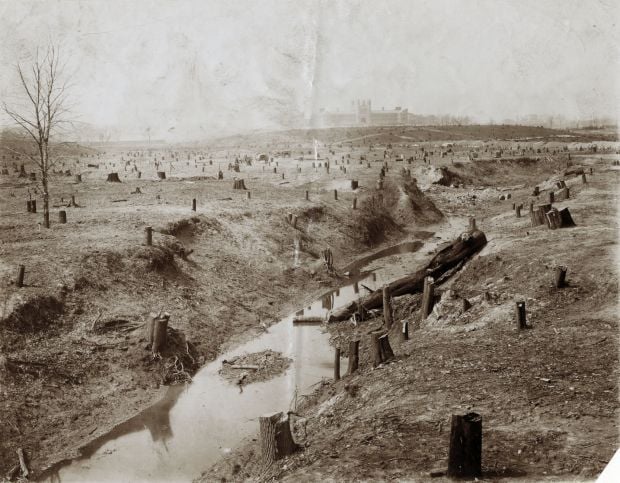
The scarred land along the old River Des Peres in Forest Park in 1902, after workers had cut down hundreds of trees for the World's Fair. In the background is Washington University, which had moved from downtown to its current location in 1899. Image courtesy Missouri History Museum
The first was the River Des Peres, which meandered through Forest Park. The other was the stubborn brown hue of the city water supply. Promoters were horrified by the thought of their fountains and cascades bubbling with river silt.
Downtown interests wanted a fairgrounds along the river. Forest Park, the preferred site of the organizers, had defenders who didn’t want it spoiled. Said Henry Ziegenhein, mayor from 1897 to 1901, “Charges should be brought against a man who would chop down its trees.”
The St. Louis Workingmen’s Protective Association also opposed messing with the country refuge. (The Building Trades Council, however, was all for it.)
Land developers lobbied for Forest Park. Francis wanted to get the fair away from the smoky, crowded city. Because the designated 657 acres of park wasn’t enough, the fair leased an additional 615 acres to the west and north — including 110 from Washington University, which moved from downtown to its current location in 1899. Subsequent public improvements made it a good deal for the university.
Shortly after work began in 1901, city leaders had to delay the fair’s opening by one year. Thus the St. Louis World’s Fair of 1904.
Nearly all of the fair’s buildings were meant to be temporary and were built of wood and slathered in “staff,” a mix of plaster and horsehair. (An exception was the Palace of Fine Arts, now the St. Louis Art Museum.) Many workers lived in tents and shacks on site. Depending upon skills, they made from $1 to $5 per day.
Thousands of sightseers took trains and streetcars out to the park to watch.
To fix the River Des Peres, which had become a flood-prone open sewer, crews straightened and enclosed it in oversized wooden channels (a precursor to the permanent piping job done in the 1920s). The tap water was a bigger challenge.
In 1894, the city completed its new Chain of Rocks water plant with six massive settling tanks, but the brown still got through. Taking a cue from Quincy, Illinois, engineers used lime and iron sulfate to separate the silt. The flow was better, but not clear.
John F. Wixford, water works chemist, decided to dump 10 times more lime into the mix. When the fountains on Art Hill were tested April 19, they “sparkled like jewels in the air,” noted the Post-Dispatch.
The fair opened only 11 days later. Nearly 200,000 people happily mobbed the opening ceremony. The fair had built its own filtration plant, just in case, but never turned it on.
David R. Francis: More than a fair leader
David R. Francis was a former shipping clerk, was president of the Merchants Exchange when he was elected mayor in 1885. During his four-year term, the city began building a new water works on the Mississippi River at Chain of Rocks.
Elected governor in 1888, he took office in Jefferson City shortly before his mayoral term expired. As governor, he tried to make St. Louis host of an exhibition honoring the 400th anniversary of Christopher Columbus' landing in the New World, but lost that bid to Chicago.
He then began pushing for a Louisiana Purchase Exhibition in St. Louis and was the exhibition president.
Francis died in 1927 at age 76. He is the namesake of Francis Park in southwest St. Louis.
Cleaning the river water

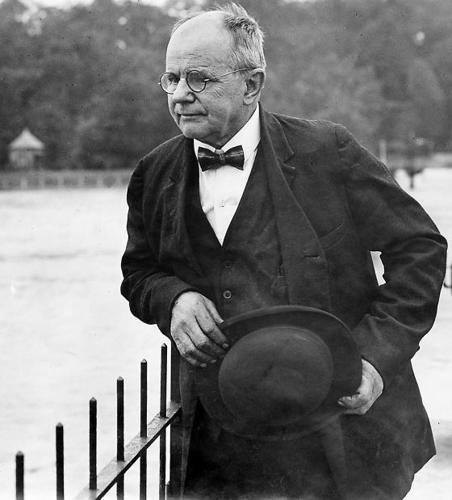
Wixford in 1927
John F. Wixford received an engineering degree from Washington University and joined the city in 1903.
For decades, city water was known for its brown hue, compliments of the silt in the Mississippi River. Wixford took a cleansing formula of lime and iron oxide used by Quincy, Ill., and greatly increased the proportion of lime.
It worked, and the fountains ran clear at the fair. Wixford tried to patent the formula, but Mayor Rolla Wells protested that many people had taken part in its development.
Wixford resigned in 1906 but returned to the water works in 1927. He died in 1935 at age 74.
Look Back • St. Louis prepares for World's Fair
Forest Park, circa 1901

Children play in woods in Forest Park circa 1901, when work began to clear some of the park's trees for the Louisiana Purchase Exposition, or St. Louis World's Fair. The fairgrounds used roughly the western half of the park, much of which was known before then as the "Wilderness." There was some opposition to using the park for the fair. Image courtesy Missouri History Museum
River Des Peres in denuded Forest Park, 1902
The scarred land along the old River Des Peres in Forest Park in 1902, after workers had cut down hundreds of trees for the World's Fair. In the background is Washington University, which had moved from downtown to its current location in 1899. Image courtesy Missouri History Museum
Working on River Des Peres channel in Forest Park

Workers build the underground channel for the River Des Peres in Forest Park. World's Fair planners wanted to straighten and cover the river channel because it was prone to flooding and was becoming more polluted. The wooden sluiceway was temporary. In the late 1920s, the city built the concrete underground culverts that still carry the river beneath the park. Image courtesy Missouri History Museum
Horsepower helps clear fairgrounds
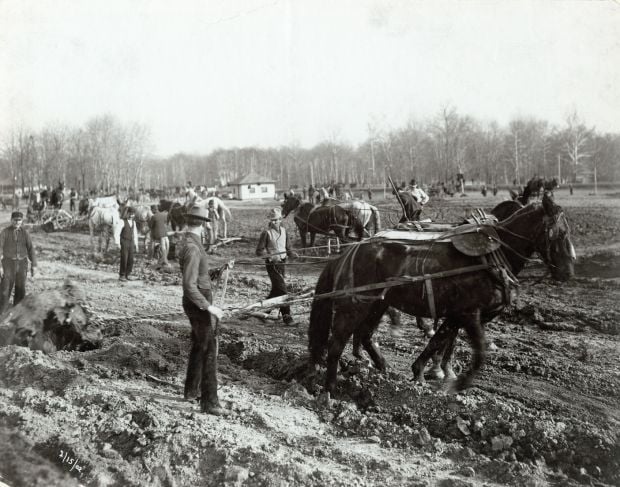
A team of horses pulls a tree stump from the future World's Fair grounds in Forest Park. Workers used some steam-powered shovels in their work, but also relied upon horses and mules. Image courtesy Missouri History Museum
Preparing fair buildings

Work underway for the Palace of Varied Industries, one of the large exhibition halls built for the World's Fair. Because all of the major halls but the future Art Museum were intended to be temporary, they were built mainly of wood covered the "staff," a mix of plaster and horsehair. Image courtesy Missouri History Museum
Work on fair buildings

Another view of work underway on the Palace of Varied Industries. The location, near the Grand Basin, now is part of the Forest Park golf course. Image courtesy Missouri History Museum
Workers at fairgrounds

Some of the workers who built the fairgrounds lived on site in tents, shacks and, in this case, surplus streetcars. Workers earned from $1 to $5 per day, depending upon their skills. Image courtesy Missouri History Museum
Building for World's Fair

Workers raise part of a building for the World's Fair. Because the structures were intended to be temporary, they were built almost entirely of wood. Image courtesy Missouri History Museum
Roadbuilding in Forest Park for World's Fair
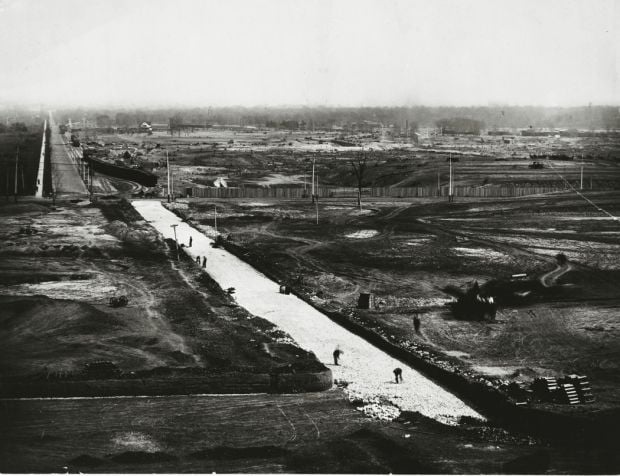
Crews build a road in Forest Park in 1902 for the World's Fair. Image courtesy Missouri History Museum
Building for the fair

A panorama of construction of some of the major exhibition halls on the grounds of the St. Louis World's Fair. The fair opened on April 30, 1904. Image courtesy Missouri History Museum
Fountains at the fair, 1904
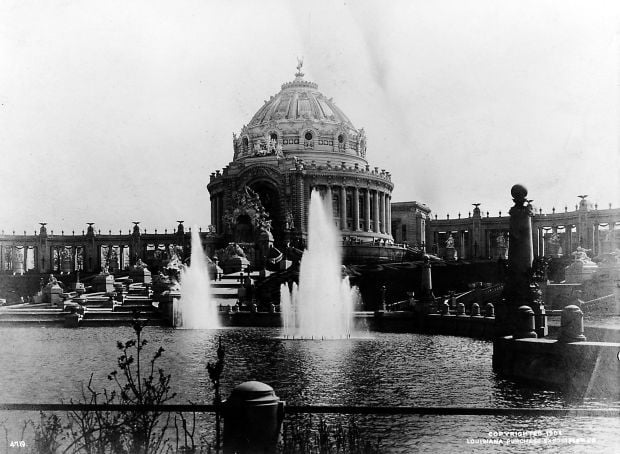
Fountains spouting clear water at the St. Louis World's Fair of 1904. Only a few weeks before the fair began, the city water works succeeded in clearing the city water supply of its distinctive brown hue, imparted by river silt. Fair organizers had feared that their fountains would bubble brown. Image courtesy Missouri History Museum
Fountains at the fair

A close-up of some of the clear-running fountains at the St. Louis World's Fair, compliments of new procedures at the St. Louis city water works. Image courtesy Missouri History Museum
Map of World's Fair

A map of the grounds of the St. Louis World's Fair of 1904. Today, these grounds are split roughly down the middle by Skinker Boulevard. Image courtesy Missouri History Museum
John F. Wixford
Wixford in 1927
David R. Francis
Francis