
Every generation has a collective shock seared in memory — John F. Kennedy, Challenger, 9/11. At 1:31 p.m. local time Sunday, Dec. 7, 1941, radio announcers breathlessly reported the Japanese attack upon Pearl Harbor.
People alive back then remember vividly what they were doing when the word flashed. For the next three years and nine months, their lives would be consumed by World War II. In our history, only the Civil War compares in daily intensity. Certainly, nothing since 1945 has come close.
That afternoon of Dec. 7, 1941, moviegoers booed newsreels showing Japanese diplomats in Washington. Attendance plunged that evening as everyone stayed home, riveted around radios.

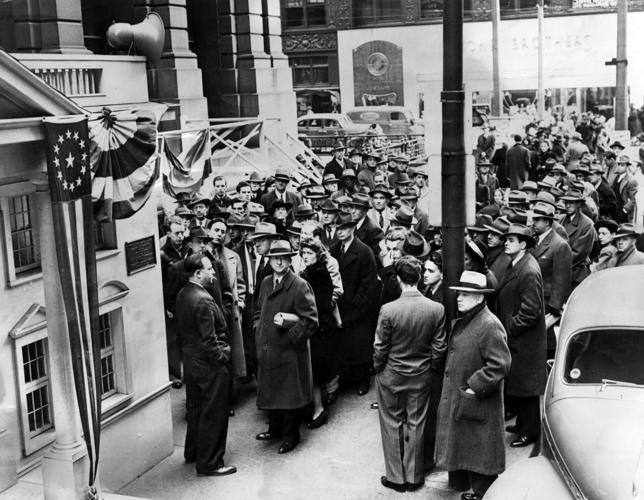
Downtown workers gather around a loudspeaker on Dec. 8, 1941, to listen to President Franklin Roosevelt's speech to a joint session of Congress one day after the attack upon Pearl Harbor. The scene is at Eighth and Olive Streets, outside the federal Custom House, now the Old Post Office. Post-Dispatch file photo
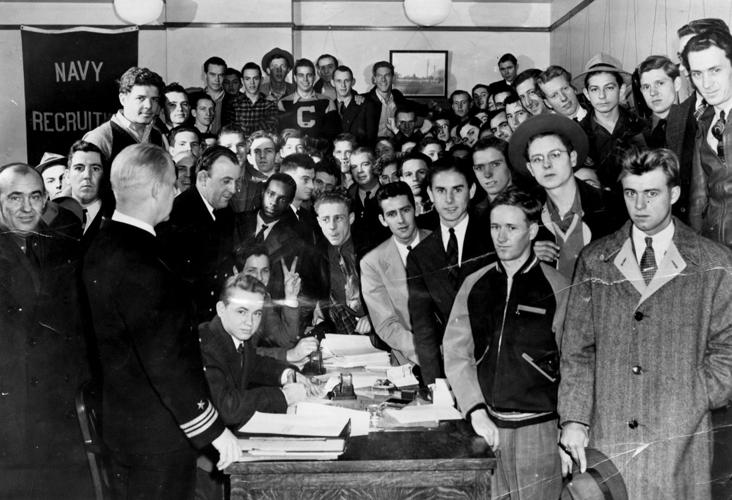
The next day, crowds gathered before loudspeakers at the U.S. Custom House (Old Post Office) downtown to hear President Franklin Roosevelt’s address to Congress. Hundreds of hot-blooded young men mobbed recruiting stations. More than 400 applied for the Navy, 40 times the daily average.
People are also reading…
FBI agents tracked down 50 Japanese nationals living in the St. Louis area and arrested Tetsu Uyeda, manager of the Bridlespur Hunt Club. National Guard soldiers watched bridges and airports. At Jefferson Barracks, a jumpy sentry fired upon a dairy truck. He missed the driver.
TWO FLYBOY HEROES
War news was grim in those early months. Allied navies were shellacked in the Java Sea. American soldiers in the Philippines retreated to Corregidor Island.
The St. Louis Board of Aldermen renamed the Municipal Bridge in honor of Gen. Douglas MacArthur, but Americans needed more to cheer for.

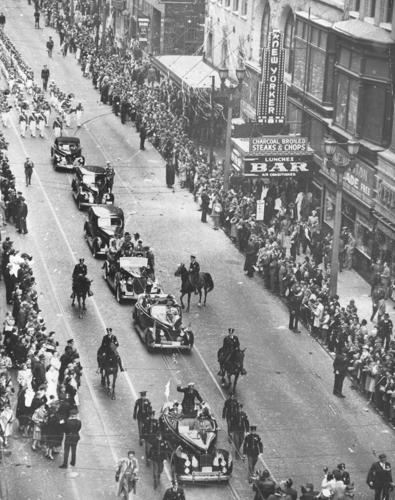
The parade honoring Navy flying ace Edward "Butch" O'Hare moves down Washington Avenue on April 25, 1942. O'Hare is standing in the lead car, waving. Post-Dispatch file photo
On Feb. 20, 1942, Navy pilot Edward “Butch” O’Hare, who grew up in south St. Louis, shot down five Japanese bombers while defending the carrier USS Lexington in his stubby Wildcat fighter. The Navy rushed him home as a tonic to America. He and his wife, Rita, a former nurse at DePaul Hospital on North Kingshighway, met in the White House with Roosevelt, who awarded him the Medal of Honor.
On April 25, the O’Hares rode downtown to a joyful ticker-tape parade. Thousands jammed the sidewalks downtown, shouting “Atta boy, Eddie.” The Post-Dispatch report the next day ran four pages.
A week before the parade, Army Lt. Col. James “Jimmy” Doolittle flew the first of 16 B-25 bombers from the carrier USS Hornet, heading for Tokyo. Their bombs didn’t do much damage, but the attack was electric news in America. The boys had slugged back.
California-born Doolittle and his family lived during the 1930s at 4 Beverly Place, near Delmar and Union boulevards, while he was aviation director for Shell Oil Co. downtown.
O’Hare was killed in action in 1943. In 1949, Chicago named its airport in his honor. Doolittle, also a Medal of Honor recipient, returned to St. Louis for a victory parade after the war.
DOING SOMETHING
Eligible men and women joined the military. Local factories hummed in war production, providing jobs after the long Depression. But civilians still wanted to take part.
Many joined the Office of Civil Defense. They watched the sky for enemy bombers — a silly if therapeutic exercise, given that German and Japanese planes couldn’t reach the American coasts. They practiced extinguishing bomb fires, ran air-raid drills and sponsored a demonstration in Forest Park with an “attack” by old Army biplanes. They also organized a big “blackout” on Dec. 14, 1942, when all city exterior lights were doused.
“A blackout at sea was never like this,” said sailor John Sizemore, enjoying a darkened Washington Avenue tavern with Joy Conley.
MAKING DO FOR THE BOYS

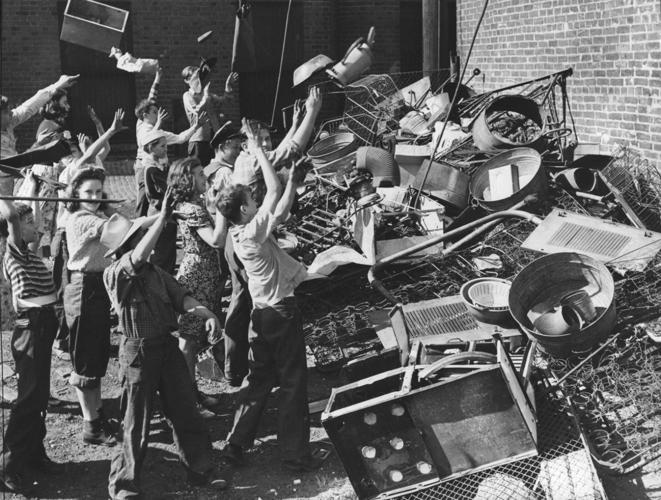
Students at Pestalozzi School, 1428 South Seventh Street, toss the gatherings of their scrap drive onto a pile on Oct. 6, 1942, the second day of the national student drive to collect scrap for war industries during World War II. In two weeks, students in St. Louis city and county collected 7,658 tons. Post-Dispatch file photo
Everything, it seemed, went for the war effort. Rationing began in spring 1942 with strict limits on sugar and tires. It was expanded to gasoline on Dec. 1 and then to most foods. Factories turned out jeeps and rifles, not cars or refrigerators.
In October 1942, an army of 150,000 kids in St. Louis and St. Louis County scoured their neighborhoods for the national scrap-metal drive. Schools competed and brought in 7,658 tons of cans, bed frames, iron sinks and stoves. Joann Weber at Richmond Heights School earned credit for a steel safe from an old family business.
It all went into furnaces, producing metal for some of the 18,000 Liberator bombers and 4 million Garand rifles the nation would produce.
By spring 1943, the federal Office of Price Administration allotted rationing points for a long list of meat, dairy, cooking fats and other foodstuffs, even baby food. Families shopped with ration stamps. If they grumbled, it didn’t make the newspapers.
PRODUCTION INCREASES

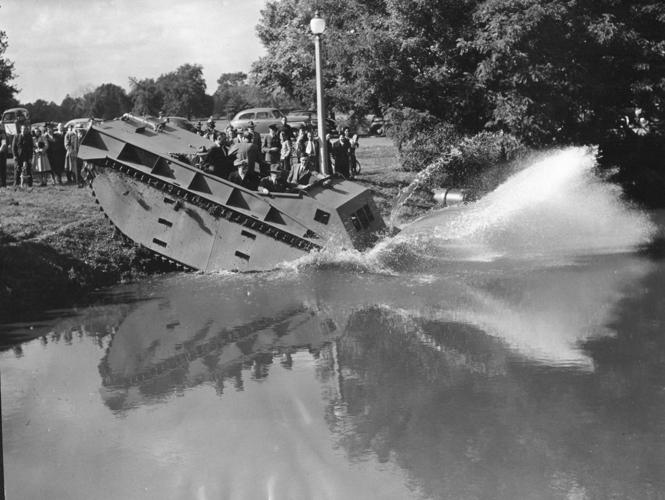
An amphibious attack vehicle built by St. Louis Car Co. of St. Louis is driven into the Grand Basin at Forest Park during a Civil Defense rally and demonstration in the park on Sept. 27, 1942. Post-Dispatch file photo
Local factories already had begun switching to war output before Pearl Harbor. The federal government seized land quickly for a massive small-arms ammunition plant at 4300 Goodfellow Boulevard and a high-explosives works in rural Weldon Spring to make charges for shells and bombs.
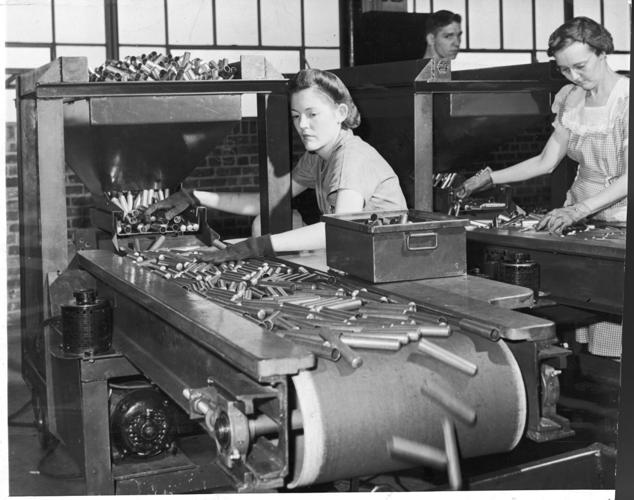
The plant on Goodfellow employed nearly 35,000, many of them women, and produced 6.7 billion rifle and machine-gun rounds by 1945. Bus routes were marked simply “Cartridge Plant.”
Emerson Electric Co. converted its new plant in Ferguson to build bomber turrets. General Motors Corp. on Union Boulevard made 105 mm cannon. St. Louis Car Co. in Baden, maker of subway cars, built amphibious attack vehicles called amtracs. General Steel Co. in Granite City cast tank armor. Magic Chef Co., a stovemaker on Kingshighway, made drop tanks for fighter planes. Jackes-Evans Co., near Penrose Park, stamped millions of metal links for machine-gun belts.
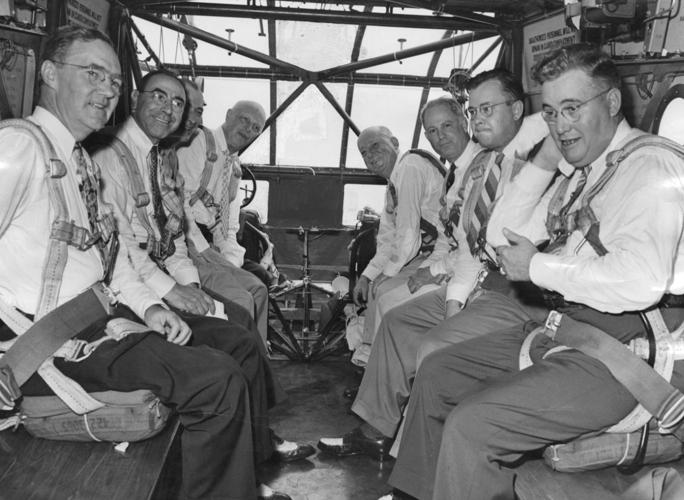
Robertson Aircraft Corp., at Lambert Field, built Army gliders. On Aug. 1, 1943, a demonstration flight of dignitaries crashed at the airport, killing Mayor William Dee Becker and nine others.

Mayor William Dee Becker (on right side, furthest from camera) just before the start of a demonstration flight Aug. 1, 1943, of an Army glider built by Robertson Aircraft Co. at Lambert Field. It crashed when a wing collapsed, killing all 10 aboard. The others are, from left, city officials Charles Cunningham and Max Doyne; Lt. Col. Paul Hazelton; Chamber of Commerce president Thomas Dysart; Maj. William Robertson, glider company president and co-founder of Lambert Field; company chief engineer Harold Krueger and Judge Henry Mueller. Also killed were pilot Capt. Milton Klugh and mechanic Jack Davis. Post-Dispatch file photo
At Mallinckrodt Chemical Co. on the north side, workers processed a mysterious substance known as uranium. Nobody knew why.
WE WANT TO HELP
Throughout the war, the American military was segregated by race, with Black workers generally consigned to support.
Many war plants also practiced segregation, limiting many Black workers to maintenance and porter jobs.
On Aug. 14, 1942, more than 9,000 people gathered at Municipal (later Kiel) Auditorium to demand more participation.
Theodore McNeal, a Sleeping Car Porters official and future state senator, said, “We resent the Jim Crow setup in the armed forces and war industry.”
Black protestors marched at the Cartridge Plant and at Carter Carburetor Co., which made artillery fuses. But factory integration moved slowly.
THE COST
Each day, newspapers ran lists of the killed, missing, wounded and decorated, allotting each person a paragraph. Accompanying round-up stories were mug shots of smiling men in uniform.
A typical day was July 21, 1944, when Post-Dispatch Page 3B carried the headline, “Four from this Area are Killed in Action,” They were Earl Flanery, 22, a bomber gunner missing over Germany, confirmed dead; Edgar Forster, 26, and Marvin White, 23, killed in action in New Guinea; and John Gantner Jr., 21, killed in action in France. The day’s article reported nine others missing in action, most of them aviators; 13 wounded; two dead of previous wounds; and one confirmed prisoner of war.
By war’s end, more than 2,550 St. Louis-area men would die in military service.
https://www.newspapers.com/article/st-louis-post-dispatch/199776471/
Article from Jul 21, 1944 St. Louis Post-Dispatch (St. Louis, Missouri)
VICTORY AT LAST

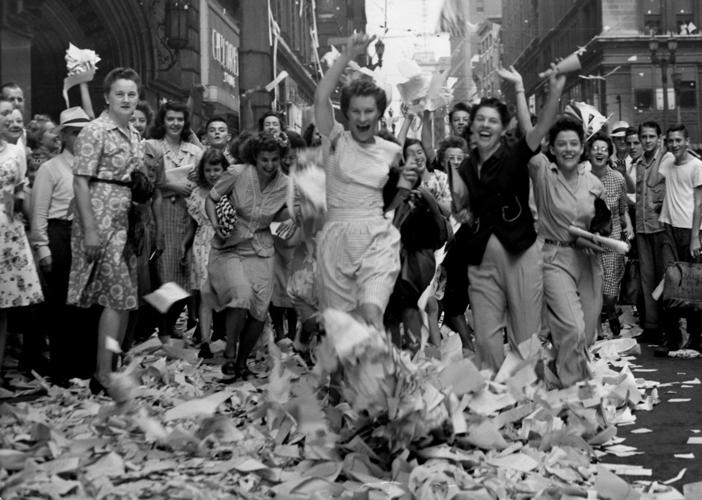
Jubilant St. Louis charge through piles of paper on Olive Street on the morning of Aug. 14, 1945, when President Harry Truman announced that World War II was over. Downtown office workers littered the streets from their windows. The party continued far into the night. Post-Dispatch file photo
Celebration ensued on May 8, 1945, when Germany’s surrender was announced, but war still raged in the Pacific. A weary population braced for a ghastly invasion of Japan. Then came headlines of atomic bombs exploding over Hiroshima and Nagasaki, compliments of the mystery matter from Mallinckrodt. When President Harry Truman confirmed Japan’s surrender on Aug. 14, downtown erupted.
Conga lines shuffled through tossed paper on Olive Street. People banged washboards, cans, anything to make a racket. Soldiers from Jefferson Barracks rushed to the fun. At Soldiers Memorial, an Army band played all night. Young women even kissed Mayor Aloys Kaufmann.
At 5228 Wilson Avenue, the family of Sgt. Ernest Pedroli, who had survived, tapped two kegs on the sidewalk for any stranger wandering by.
Doolittle returned to Lambert Field in a B-25 on Nov. 12 to lead a parade downtown. Behind him marched 10,000 soldiers and veterans and 54 bands. It went on for two joyous hours.
Look Back • St. Louis during WWII
Navy recruiting office

Volunteers crowd the Navy recruiting office downtown on Dec. 8, 1941, the day after the Japanese attack upon Pearl Harbor. More than 400 people went there that day to sign up. Another 350 went to the Army recruiting office. Post-Dispatch file photo
Listening to President Franklin Roosevelt
Downtown workers gather around a loudspeaker on Dec. 8, 1941, to listen to President Franklin Roosevelt's speech to a joint session of Congress one day after the attack upon Pearl Harbor. The scene is at Eighth and Olive Streets, outside the federal Custom House, now the Old Post Office. Post-Dispatch file photo
Guarding bridge after Pearl Harbor, 1941

Soldiers from Jefferson Barracks grab a meal on Dec. 8, 1941, near the St. Louis County approach to the Daniel Boone Bridge carrying U.S. 40 over the Missouri River. Soldiers guarded bridges, power plants, airfields and other key locations after the attack upon Pearl Harbor. Post-Dispatch file photo
Blackout drill, 1942

Sailor John Sizemore and Joy Conley enjoy the dark inside a Washington Avenue tavern during the "blackout" demonstration on Dec. 14, 1942, when almost all of the lights went out in St. Louis. It was a drill in case the region needed to go dark in case of an enemy air raid. The region held several more blackouts, but stopped doing them as war news improved. Post-Dispatch file photo
St. Louis Ordnance Plant

An inspector at the St. Louis Ordnance Plant, 4300 Goodfellow Boulevard, prepares a test firiing of machine-gun rounds. Post-Dispatch file photo
Protest of racially restrictive hiring, 1942

Black workers march along Goodfellow Boulevard on June 20, 1942, to protest racially restrictive hiring at the St. Louis Ordnance Plant. Managers agreed to put blacks on a segregated production unit but didn't order full integration until 1944. Post-Dispatch file photo
Parade honoring Navy flying ace Edward "Butch" O'Hare, 1942
The parade honoring Navy flying ace Edward "Butch" O'Hare moves down Washington Avenue on April 25, 1942. O'Hare is standing in the lead car, waving. Post-Dispatch file photo
Raid preparations, 1942

St. Louis police Lt. Albert Bean demonstrates the proper way to extinguish an incendiary bomb in November 1942. He took part in a session with other public-safety personnel to prepare St. Louis in case of air raids — a remote possibility, given the short range of enemy bombers. Post-Dispatch file photo
Scrap drive, 1942
Students at Pestalozzi School, 1428 South Seventh Street, toss the gatherings of their scrap drive onto a pile on Oct. 6, 1942, the second day of the national student drive to collect scrap for war industries during World War II. In two weeks, students in St. Louis city and county collected 7,658 tons. Post-Dispatch file photo
Civil Defense volunteers march, 1942

Civil Defense volunteers march in Kirkwood during a parade and rally on Oct. 11, 1942. Many civilians wanted to take part in the war effort, even though St. Louis was far from danger. Post-Dispatch file photo
Civil Defense demonstration,1942

A crowd observes the Civil Defense demonstration in Forest Park on Sept. 28, 1942. Events included an "attack" by obsolete Army bi-planes. Post-Dispatch file photo
Weldon Springs Ordnance Plant

Workers at the Weldon Springs Ordnance Plant exhibit some of the TNT they produced and shipped to makers of artillery shells and bombs. The plant, built in a hurry in 1941 across 17,000 acres, was the nation's largest maker of high explosives during the war. Post-Dispatch file photo
Amphibious attack vehicle
An amphibious attack vehicle built by St. Louis Car Co. of St. Louis is driven into the Grand Basin at Forest Park during a Civil Defense rally and demonstration in the park on Sept. 27, 1942. Post-Dispatch file photo
Ration Board, 1942

Motorists line up at the St. Louis County Ration Board, 25 North Brentwood Boulevard in Clayton, to apply for gasoline ration books on Dec. 1, 1942, when rationing began to conserve fuel for the war effort. The government also rationed tires and most foodstuffs during World War II. Post-Dispatch file photo
Navy fighter pilot Edward "Butch" O'Hare, 1942

Navy fighter pilot Edward "Butch" O'Hare, who shot down five Japanese bombers, is honored with a parade in downtown St. Louis on April 25, 1942, during a tour of America to boost civilian morale. O'Hare grew up in St. Louis. With him are (left) his mother, Selma O'Hare of St. Louis; and wife, Rita, a former nurse at DePaul Hospital in St. Louis. Post-Dispatch file photo
St. Louis Ordnance Plant, 1942

Workers at the St. Louis Ordnance Plant, 4300 Goodfellow Boulevard, work the casing line in 1942. The vast works, which employed 35,000 at its busiest, made 6.7 billion .30-caliber and .50-caliber cartridges during World War II. Post-Dispatch file photo
Glider demonstration turns into disaster, 1943
Mayor William Dee Becker (on right side, furthest from camera) just before the start of a demonstration flight Aug. 1, 1943, of an Army glider built by Robertson Aircraft Co. at Lambert Field. It crashed when a wing collapsed, killing all 10 aboard. The others are, from left, city officials Charles Cunningham and Max Doyne; Lt. Col. Paul Hazelton; Chamber of Commerce president Thomas Dysart; Maj. William Robertson, glider company president and co-founder of Lambert Field; company chief engineer Harold Krueger and Judge Henry Mueller. Also killed were pilot Capt. Milton Klugh and mechanic Jack Davis. Post-Dispatch file photo
Workers at Emerson Electric Co. plant, 1943

Workers at the Emerson Electric Co. plant, 8101 West Florissant Avenue in Ferguson, assemble gun turrets for B-24 Liberator bombers in 1943. The plant became the nation's largest producer of revolving aircraft turrets, making as many as 70 each day. Post-Dispatch file photo
V-J Day celebration, 1945

On the night of V-J Day (Victory over Japan) on Aug. 14, 1945, happy crowds jammed the streets around Soldiers Memorial downtown for a dance. An Army band played each of the armed forces anthems to the wild cheers of members of the service branches. Post-Dispatch file photo
V-J Day celebrations
Jubilant St. Louis charge through piles of paper on Olive Street on the morning of Aug. 14, 1945, when President Harry Truman announced that World War II was over. Downtown office workers littered the streets from their windows. The party continued far into the night. Post-Dispatch file photo